

Think of your heart as a flexible squeeze bulb that is filled with water. Every time you squeeze that bulb, it pushes out a specific amount of fluid. However, it never empties out completely. Some water always stays behind inside the bulb.
In medical terms, your heart works exactly the same way. The ejection fraction is simply the measurement of how much blood your heart pumps out with each individual beat.
Moreover, it looks at the percentage of blood leaving the main pumping chamber instead of the total volume.
This percentage is a direct window into your cardiovascular health. A high percentage means your heart muscle is strong as well as efficient.
Conversely, a low percentage indicates that the muscle is weakened and is struggling or failing.
Understanding your ejection fraction helps you track how well your circulatory system is working. If you are managing a heart condition, tracking this number is completely essential.
Let us break down how doctors calculate this metric, what your specific score means, and how you can naturally protect your heart’s pumping power.
Explaining Systolic And Diastolic Functions
Your cardiac cycle relies on two distinct alternating phases, which are called systolic and diastolic. Furthermore, they work in tandem to keep blood moving through your body.
Comparison Matrix: Systole Vs. Diastole
| Feature | Systolic Phase (Systole) | Diastolic Phase (Diastole) |
| Main Action | The lower heart chambers contract with force. | The lower heart chambers relax completely. |
| Blood Movement | Expels blood out into your major arteries. | Fills back up with fresh blood from upper chambers. |
| Role in Metric | Critical phase for measuring ejection fraction. | Ensures adequate volume holds for the next squeeze. |
| State of Muscle | Highly active and tense pumping stage. | Resting and filling stage right after contraction. |
The Contraction Phase: Systole
During systole, your lower heart chambers contract with force. This action expels blood into your major arteries. Specifically during this active phase, your ejection fraction becomes a critical metric.
Also, it measures the exact proportion of blood pushed out of the left ventricle during that single contraction.
The Filling Phase: Diastole
On the other hand, diastole follows immediately after the contraction ends.
During this phase, the ventricles relax fully. They fill back up with fresh blood arriving from the upper chambers.
This resting phase ensures your heart holds enough volume for the next squeeze.
What Is A Normal Ejection Fraction By Age Chart
Your score is always expressed as a clean percentage. While a perfect score does not mean 100%, healthy ranges stay remarkably consistent across most adult age groups.
| Age Group | Normal Ejection Fraction Range | Functional Classification |
| Young Adults (18 to 39) | 50% to 70% | Optimal pumping efficiency |
| Middle-Aged Adults (40 to 59) | 50% to 70% | Standard healthy baseline |
| Older Adults (60+) | 50% to 65% | Slight natural decline allowed |
| Any Age (Heart Failure Risk) | Under 40% | Clinically reduced performance |
The Mathematical Formula: Calculation Of Ejection Fraction
Cardiologists use a specific mathematical formula in order to determine your percentage. Additionally, the equation relies on measuring two distinct fluid volumes inside your left ventricle.
- End-Diastolic Volume (EDV): The total amount of blood inside the ventricle when it is completely full.
- End-Systolic Volume (ESV): The small amount of blood left behind right after the heart contracts.
The equation is as follows:
EJECTION FRACTION (EF) = [ (EDV -ESV) / EDV] * 100
For example, let us say your filled ventricle holds 100 millilitres of blood. After a contraction, 40 millilitres remain behind. The heart successfully pumped out 60 millilitres. Your final ejection fraction score would be exactly 60%.
How Do Doctors Measure Your Pumping Efficiency
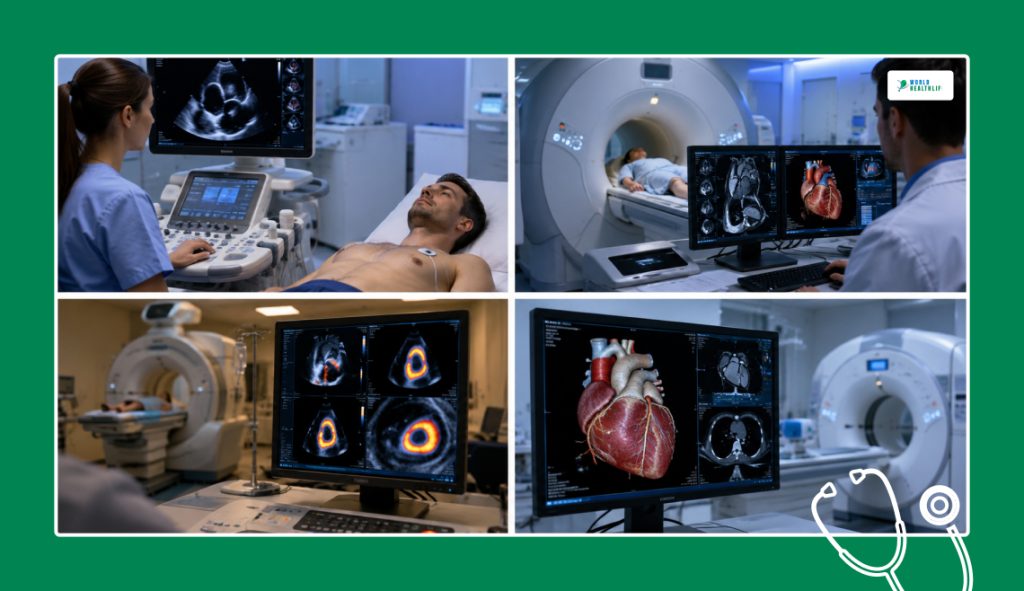
When it comes to tracking your score, medical professionals rely on non-invasive imaging technologies. Moreover, these tools provide highly accurate data without requiring surgery.
Echocardiography
Echocardiography is known to be the most common diagnostic method when it comes to understanding your pumping efficiency.
The method uses safe sound waves to map out your heart chambers in real-time.
Cardiac MRI:
The test offers incredibly high-resolution images, where doctors make use of these when they are in need of a highly precise structural evaluation.
Nuclear Medicine Scans
These are used by technicians, who inject a tiny amount of radioactive tracer. This material outlines blood flow to track muscle movement in a perfect manner.
Computed Tomography (CT)
A specialized cardiac CT scan builds a 3D model of your heart. In addition, it tracks volume changes during each beat.
Decoding Your Score: The Significance Of Ejection Fraction
Your medical team uses your score to place you into a specific health category. These categories guide your overall treatment plan.
Ejection Fraction Ranges And Clinical Meaning
| Percentage Range | Health Category | What It Means for Your Body |
| 50% to 70% | Normal Range | Your heart pumps effectively. Vital organs get plenty of oxygen. No medical treatment is needed. |
| 41% to 49% | Borderline Range | Pumping power drops slightly. This is an early warning sign. Your heart works under hidden stress. |
| 40% and Below | Reduced Range | Your heart muscle is weak. It cannot meet your body’s demands. This is a classic sign of heart failure. |
Normal Range: 50% To 70%
A normal ejection fraction means your heart is pumping effectively. Besides, your vital organs are receiving a steady supply of oxygen-rich blood.
Consequently, you do not require medical intervention if you fall in this range.’
Borderline Range: 41% To 49%
Having a borderline range is an indication of a slight drop in pumping power. It serves as an early warning sign for potential cardiovascular issues.
Although you might not feel any symptoms yet, your heart is working under stress.
Reduced Ejection Fraction: 41% And Below
When you have a low score, say 41% or below, it means your heart muscle is weakened. Additionally, this state is a hallmark sign of heart failure.
Why A Low Score Matters: Long-Term Impacts
When it comes to having a low ejection fraction, it can be directly interpreted that your heart pump is struggling. Usually, it points to real structural damage inside the muscle.
Several everyday heart conditions can cause your numbers to tank.
Chronic Heart Failure
This condition makes it tough for your heart to move blood around. You will likely deal with fluid backup. Patients often feel winded, constantly tired, or notice swollen ankles.
Cardiomyopathy
This is a direct disease of the physical muscle tissue. The walls of your heart can stretch out or get way too thick. Both of these changes stop the muscle from squeezing properly.
Coronary Artery Disease
Clogged arteries block off the blood supply to your heart tissue. Over time, sections of the muscle starve from a lack of oxygen. This weakness instantly drops your overall percentage.
Heart Attacks
A heart attack leaves permanent scars on your heart. Scar tissue is stiff and cannot move or squeeze. This permanent dead zone immediately kills your pumping efficiency.
How To Fix It: Proven Treatments And Tactics
You can actually pull a low ejection fraction score back up. Moreover, modern medical care puts a prime focus on taking the physical pressure off your heart muscle.
Prescription Medications
Doctors use pills to change how hard your heart has to work. ACE inhibitors open up your blood vessels. Beta-blockers guard the muscle against stress hormones. Diuretics flush out excess water to stop painful swelling.
Heart Device Therapies
Advanced cases usually require a tiny implant to handle the work. An ICD monitors your heart rhythm every second to prevent sudden stops. A CRT device sends tiny shocks to make your lower chambers squeeze in perfect sync.
Daily Lifestyle Changes
Your everyday choices make a massive difference in your recovery. Cutting out salty foods stops fluid from building up in your chest.
Easy, doctor-approved walks will rebuild muscle strength over time. You also need to quit smoking immediately to save your blood vessels.
Keeping Tabs: Why Regular Checks Matter
Your number is never fixed in stone. Instead, it shifts up and down constantly depending on your health. Regular echocardiograms show your doctor if your pills are actually doing their job.
Catching a dropping number early lets your team fix your doses before a major crisis hits.
Taking Charge of Your Health
Tracking your heart numbers is a vital part of staying alive. Moreover, your ejection fraction is the ultimate tool for reading your exact cardiac output.
Knowing your baseline lets you make smart choices whether your number is good or bad.
Do not wait until you are gasping for air or your legs swell up to take action. Work closely with a cardiologist and monitor your chest health.
Ultimately, taking early steps is the best way to secure a normal, active life for decades.
Read Also:


