
You just had a tooth pulled. Maybe it was a wisdom tooth. Maybe it was a badly infected molar that had been giving you grief for months.
Either way, you have to stay back at home after an extraction. Plus, always have a gauze in your mouth. Better if you put an ice pack on your cheek. But is this normal? Are there any ways to get rid of it?
A lot of us in the US ask the same question after a tooth extraction. Again, that’s what brings millions of Americans to Google every year after a tooth extraction.
And it’s a fair question. The difference between normal healing and dry socket can be genuinely hard to tell, especially if you’ve never experienced either.
Again, pictures of dry socket vs normal healing on Google can also clear a lot of doubts. But before you search for pictures, you need to know exactly what to search for!
What Happens Inside Your Mouth After A Tooth Extraction?
Let’s understand what happens in your mouth after the extraction. Does your body accept one missing tooth or launch an emergency response?
At first, blood fills the empty socket region. Very soon, you will find a blood clot there. Meanwhile, you should know that the blood clot is very useful. It is saving you from getting infections.
To clarify, there are sensitive nerves in the socket. During extraction, you tear the tooth from the nerves. As a result, the nerves are now open. Well, they can be easily damaged. That’s why the blood comes up to protect them.
A few days later, you will find the clot becoming hard. That means the granulation process is ongoing.
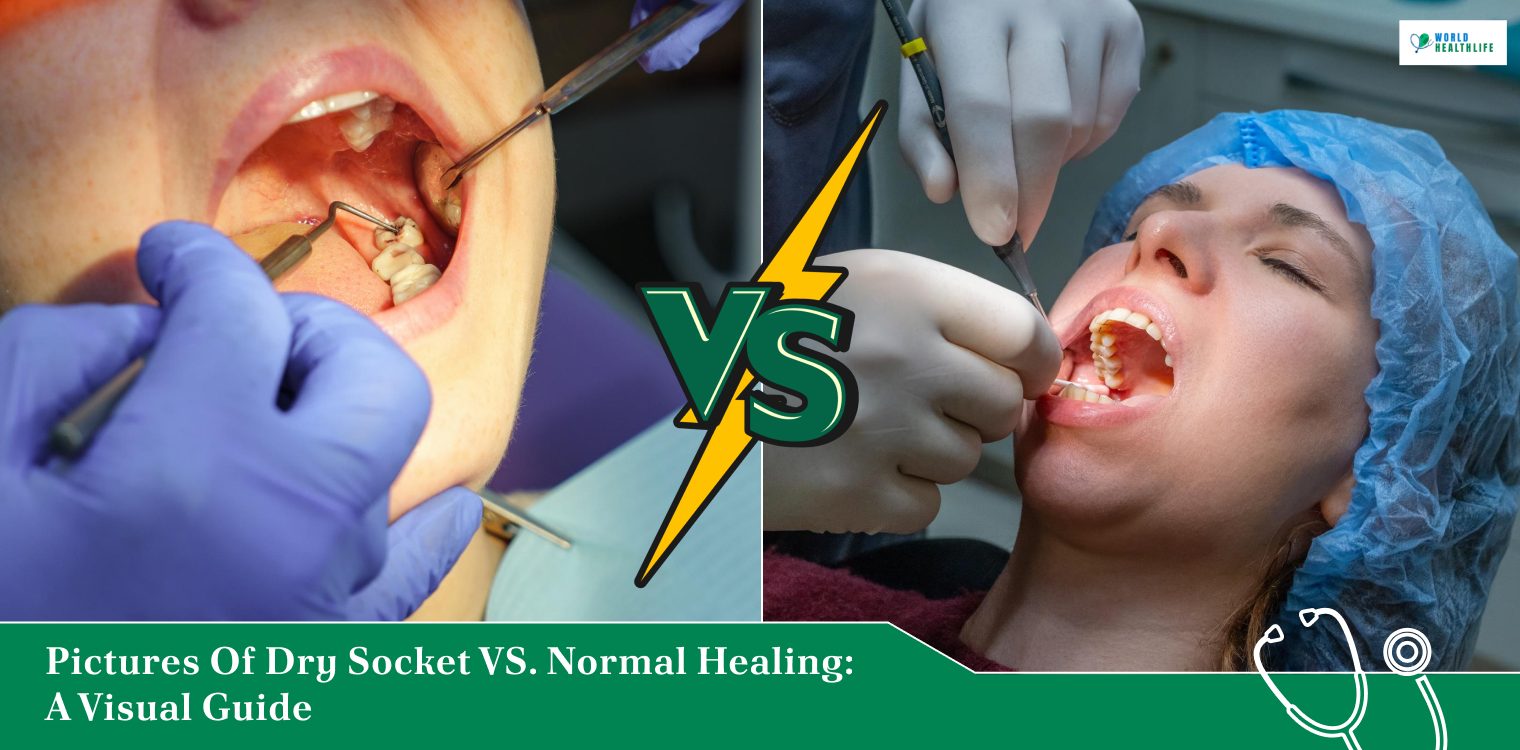
In simpler terms, beneath the clot, your gum is developing new tissue. Search for pictures of dry socket vs normal healing to see how it actually appears.
As a result, the clot looks whitish. Again, that is nothing but a cluster of tissues only. But I know a lot of people who panicked at the sight of that.
Honestly, you don’t need to worry. In fact, that’s a normal scenario. You actually need to worry if something else happens.
What Is Dry Socket? The Simple Version
Dry socket is a condition in which the blood clot protecting the tooth extraction site is removed. Dentists also call it alveolar osteitis. It might happen that the clot did not form properly. Or, it dissolved as the clot was weak.
But what happens when the clot is not there? In simpler words, there is no covering for the bones and nerve ends in the socket. A perfect recipe for infection.
Is Dry Socket Really Very Painful?
This is a very common Google search. Once the doctor tells you that it’s a dry socket, you start googling. I know the pain is the main concern here.
Honestly, it’s not a mild and damp pain. This pain will hit you hard. In fact, you will feel a numbing effect around the whole jaw and upto the ear. Most importantly, the pain will hit you sharply at intervals.
Remember, you have often asked yourself: why does one side of my throat hurt when I swallow? When the pain in the teeth is dull, it can still spread to the glands.
That’s when you feel in the throat or ear. It’s hard to distinguish that the pain is specifically spreading from the socket.
While I had a dry socket, I would stay awake during the night. I searched whether dry socket is a common problem in the US. Or my case is actually rare.
Cleveland Clinic confirms that it is actually rare. Around 2 to 5% people in the US suffer from it. But that’s not the threatening part. The number of cases is rising. Already, there are 30% more cases, standing today in 2026.
How Can You Predict Having A Dry Socket?
That actually depends on the extraction. My dentist told me the anchor was harder, and its shape was irregular. In my case, the clot did not form because of that. At the same time, the clot there eroded because it could not hold on to the uneven surface.
However, the dentist also told me other reasons. Are you a smoker? Did you have oral contraceptives recently?
Any of these can increase the chance of having a dry socket. Meanwhile, if you are using contraceptives frequently, you can also encounter frequent sharp or dull right upper quadrant pain.
If you know the root cause, you can avoid it. At least none of you has to go through the pain as I did!
Dry Socket VS. Normal Healing: How Can You Differentiate?
I want you to clearly understand this difference. Try to form an image in your mind based on my analysis below. I’ll describe exactly what each condition looks like in plain terms.
Normal Healing: Day By Day
Here is a day-by-day breakdown:
Day 1 – 2
Right after extraction, the socket looks raw and red. There’s a blood clot sitting in the hole. TO clarify, it looks dark, almost maroon or burgundy.
The surrounding gum tissue is swollen and may look bruised. Some bleeding is normal for the first few hours. Above all, pain is present but manageable with the medication your dentist prescribed.
Day 3 – 4
The clot is still there, but changing. Simply put, it’s transitioning from that dark red to a duller, more muted color. In addition, the edges of the socket may start looking slightly whitish again.
But don’t worry. As I mentioned, that’s normal granulation tissue forming. Swelling may peak around day two or three, then start to ease. In my case, it was the same. To clarify, from day 2, the pain should be on a downward trend.
Day 5 – 7
The socket is visibly filling in. That white or yellowish tissue is actually a good sign. To sum up, it means new gum tissue is actively forming. Pain should be noticeably less than in the first few days.
If you’re still taking prescription pain meds at this point without much relief, it’s a concern. Visit your dentist today. Thankfully, nothing of the sort happened in my case.
Week 2 And Beyond
Once they see improvement, people become casual. Yes, you got it right. I am one of them. But I’,m grateful that I faced nothing bad. Since week 2, you will notice the opening gets smaller. In addition, tissue continues filling in.
Most people feel close to normal by the end of two weeks. However, wisdom tooth sockets can take longer. On my dentist visit one day, I came across such a patient. He was in the 6th week, but the bone did not heal properly. You can search for “pictures of dry socket vs normal healing stage by stage”.
Side-By-Side Comparison: Dry Socket VS. Normal Socket
| Feature | Normal Healing Socket | Dry Socket |
|---|---|---|
| Pain pattern | Steadily improving each day | Improves briefly, then gets significantly worse |
| Visible clot | Dark red/maroon clot present; transitions to pale tissue | No visible clot, or clot has largely dissolved |
| Socket appearance | Filling in with tissue; may look white/yellowish (normal) | Hollow, empty; may see bone at the bottom |
| Smell/taste | No significant change | Foul odor, bad taste that doesn’t go away |
| Pain timing | Peaks around day 2–3, then declines | Intensifies or returns around day 3–5 |
| Pain location | Localized to the extraction site | Can radiate to the ear, jaw, or temple |
| Swelling | Peaks around day 2–3, then subsides | May worsen rather than improve |
| Fever | Not typically present | Possible if secondary infection develops |
Who Gets Dry Socket? The Real Risk Factors
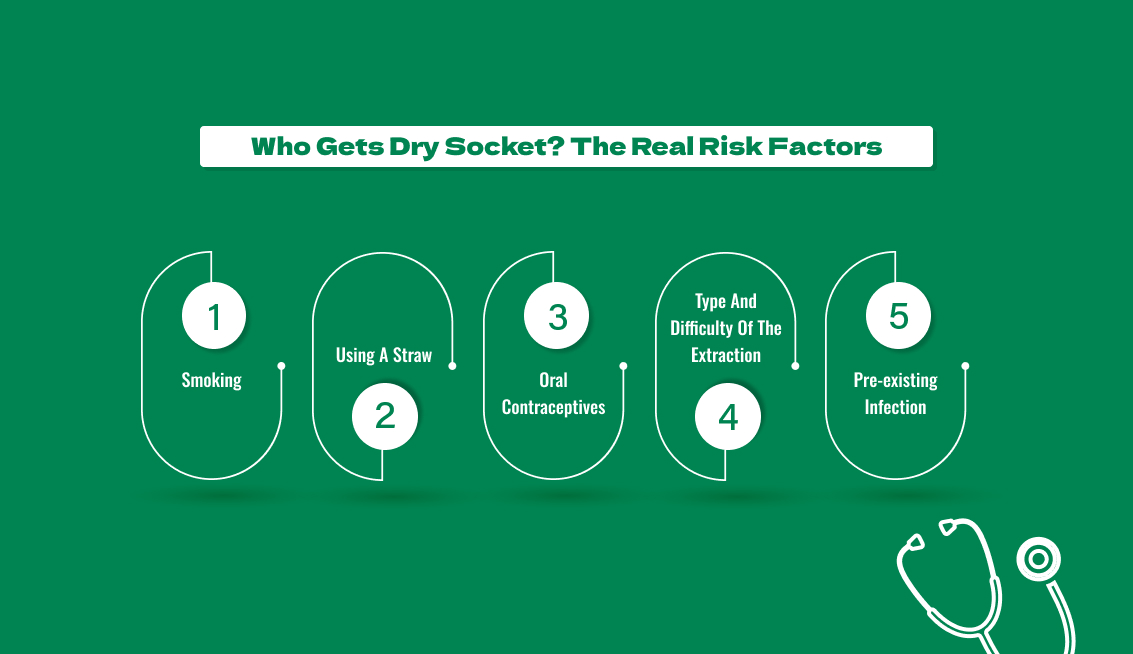
Dry socket doesn’t happen randomly. Certain factors make it considerably more likely. In the same vein, some of them are things you can control before and after your procedure.
Smoking
This is the big one. A study by Maverick Medical Clinic found that smokers are 3x more likely to develop dry socket.
The mechanism is twofold. First, nicotine constricts blood vessels, reducing blood flow to the healing socket. Second, the sucking motion of inhaling on a cigarette creates negative pressure in the mouth.
Again, it is the same force that can physically pull a clot loose. Dentists typically advise no smoking for at least 48–72 hours after extraction, and longer is better.
Using A Straw
Same principle as smoking. Simply put, the suction is harmful to you in this stage. It seems harmless. But that negative pressure can dislodge a clot that’s only a day or two old.
This is why my dentist mentioned “no straws” consistently in post-extraction instructions. It’s not just a precaution. It’s based on solid reasoning.
Oral Contraceptives
This one surprises people. People using oral birth control have a significantly higher risk of dry socket following wisdom tooth extraction.
The likely reason relates to how estrogen affects clotting factors and fibrinolysis. In other words, the process by which clots break down.
If you’re on the pill and need an extraction, it’s worth mentioning to your dentist or oral surgeon beforehand. Some practitioners prefer to schedule elective extractions during the lowest estrogen days of the cycle when possible.
Type And Difficulty Of The Extraction
Not all tooth removals are equal. A simple extraction of a fully erupted tooth is very different from surgically cutting out an impacted lower wisdom tooth that’s partially buried in bone.
To sum up, the more traumatic and complex the procedure, the higher the risk of dry socket.
Pre-existing Infection
Having active bacteria in the mouth before extraction can interfere with clot formation.
If your dentist prescribed antibiotics before or after your procedure, that’s likely why. Research has shown that antibiotic use reduces the risk of dry socket by around 36%.
The Pain Question: How Much Pain Is Too Bad?
I find people asking this question a lot. How much pain is “normal” pain, and when does it become a warning sign?
Here’s the honest answer from my personal experience. A minimum pain is expected. But you will not have sharp or long-lasting pain. Especially a pain that lasts long. If the pain exists, go see your dentist.
Normal post-extraction pain typically peaks around day two or three and then gradually decreases. You should be reaching for pain medication less often as the days pass, not more. If you find yourself in more pain on day four than you were on day two, it’s not a good sign.
What To Do If You Think You Have Dry Socket?
First: don’t panic. Dry socket is unpleasant, but it’s treatable and not dangerous in most cases. It won’t spread. Well, that’s what most journals say. In fact, my doctor also agreed with the same.
Call your dentist. The American Dental Association recommends returning to your provider to manage dry socket symptoms rather than trying to manage it entirely at home. Here is what my dentist asked me to do:
- Gently flush the socket with a medicated mouthwash or saline solution to clear out any debris
- Pack the socket with a medicated dressing, usually containing eugenol (clove oil), which has natural analgesic properties
- Prescribe or recommend NSAIDs like ibuprofen for pain management between dressing changes
- Ask you to return every day or two to change the dressing until the pain resolves
Most people feel significantly better within 24 to 48 hours of the first treatment. Full resolution typically takes a few additional days to a week once treatment begins.
What you should not do is ignore it, hoping it resolves on its own. It might, eventually. But without treatment, you’re looking at several more days of significant pain and a higher chance of secondary infection. Not worth it.
Signs You Need to Consult Your Doctor Immediately
If you have any one of these symptoms besides pain, contact your dentist the same day. Or go to an urgent dental clinic:
- Fever above 101°F
- Pus or discharge coming from the socket
- Severe swelling that is worsening after day three
- Pain that is not responding to over-the-counter pain medication at all
- Numbness or a pins-and-needles sensation in the lip or chin (this can indicate nerve involvement)
How To Prevent Dry Socket: My Dentist’s Advice
Prevention is easier than treatment. Most of it comes down to following post-op instructions carefully:
- No smoking or tobacco products for at least 48–72 hours after extraction (longer is better)
- No straws for the first week
- Avoid vigorous rinsing on the day of the extraction — it can wash the clot away
- Avoid hard, crunchy, or chewy foods on the extraction side for several days
- Keep the area clean. And gently rinse with warm salt water starting the day after surgery
- Follow any antibiotic prescription exactly as directed if one was prescribed
- Sleep with your head slightly elevated for the first couple of nights
One thing is worth noting here. You can do everything right and still suffer from a dry socket. But why?
Sometimes, clots are just mechanically fragile, especially after difficult extractions. If it happens, get treatment. Don’t beat yourself up about it.
Luckily, in my case, it did not happen, even after a difficult extraction. To see what a naturally fragile tooth looks like, search for pictures of dry socket vs normal healing.
Frequently Asked Questions (FAQs)
Almost certainly not. White or pale yellowish tissue inside the socket after a few days is normal granulation tissue. In other words, your body is actively rebuilding. To clarify, check out pictures of dry socket vs normal healing on Google.
You can look but be careful about how you interpret what you see. Using a flashlight and a mirror, you should be able to see if there’s tissue filling the socket. But the pain pattern and smell need a dentist’s attention.
For dry socket specifically, urgent dental care clinics exist across the US. However, the best part is that most can see you the same day or the next day. Search “emergency dentist near me” or “urgent dental care” in your area.
The treatment itself includes rinsing and packing the socket. Simply put, it is straightforward, and any general dentist can do it. In the meantime, ibuprofen (if you can take it) and clove oil on a cotton ball can provide some temporary relief. Particularly, clove oil helped me a great deal.
No. Dry socket is a healing complication. Certainly not a sign that the extraction was performed incorrectly. Even perfectly executed extractions can develop dry socket due to patient-specific factors.


