
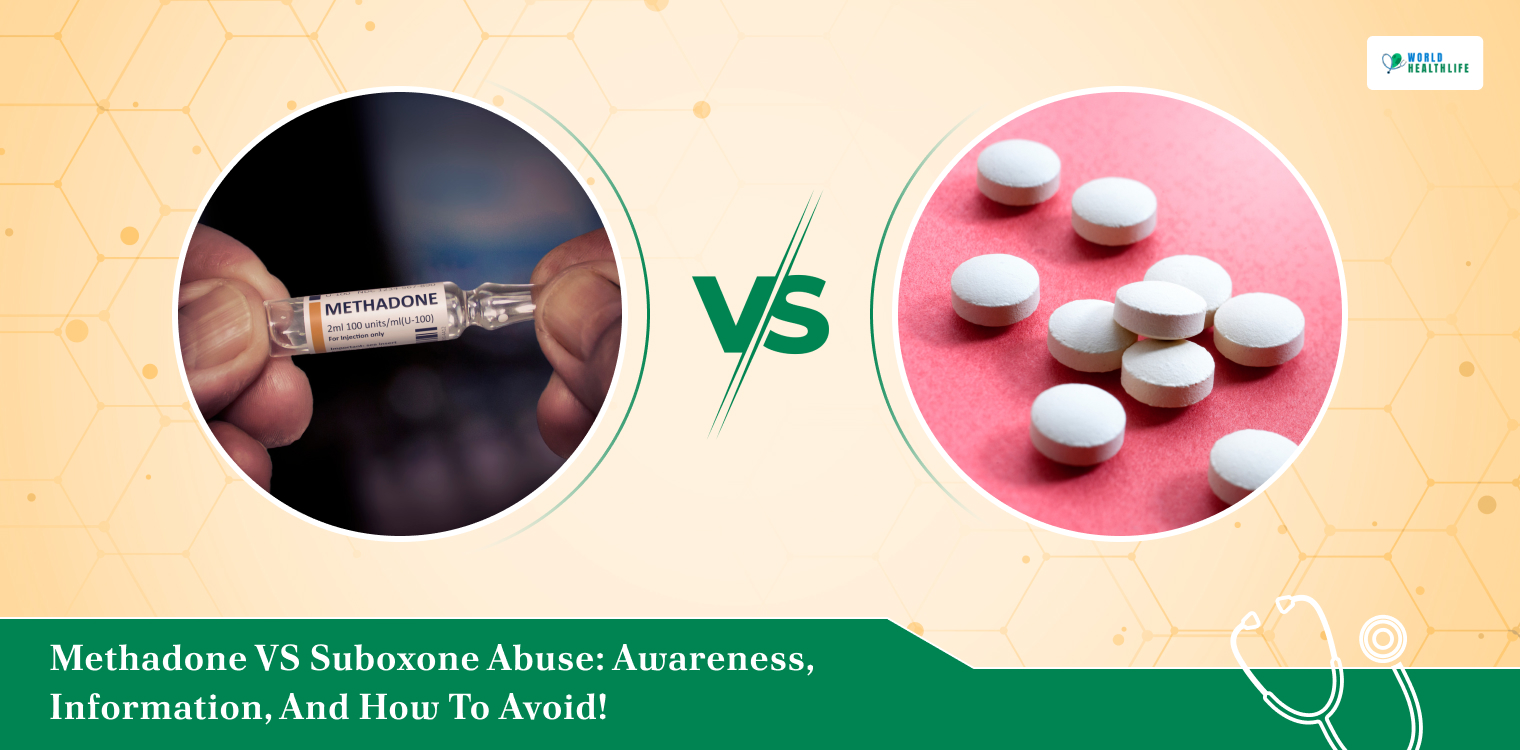
Long time, no see? We were knee-deep in research, looking for ways to inform our readers best. So, here we are with a comparison between Methadone vs suboxone – one of the commonly confused groups.
Moreover, with the rise in their abuse, it is even more important to differentiate between the two. As a treatment option for opioid addiction, these drugs come into play when the player experiences opioid withdrawal.
The following article will help you know if you can develop a dependency on either of the two drugs and bust any myths surrounding their consumption!
Quick Answer: Methadone vs Suboxone
If you’re trying to understand the difference between methadone and suboxone, here’s the simplest way to look at it:
Methadone is a stronger, long-acting opioid used for more severe cases of opioid dependence.
Suboxone is a milder option that combines buprenorphine and naloxone, making it safer and harder to misuse.
Both medications are used to reduce withdrawal symptoms and cravings, but they must always be taken under medical supervision. There is no safe way to use them without a prescription.
Questions Answered in this Article
1. Methadone vs Suboxone: How Does It Reach the Abuse State?
2. Why Suboxone Vs Methadone Is Up For Discussion?
3. Side Effects of Methadone vs Suboxone
4. Suboxone Vs Methadone Treatment: What You Need to Know
Methadone vs Suboxone: How Does It Reach the Abuse State?

Methadone vs suboxone are both effective medications that come in handy when an individual experiences symptoms of opioid withdrawal. For those unaware, this is a challenging period for the individual as they go through different symptoms that are pretty extreme.
Methadone vs suboxone abuse is well-known, but it is mostly in extreme cases where the dosage and treatment plan have not been followed closely. Let’s look at their respective compositions and how you can safely use them without worrying about addiction.
Why Suboxone Vs Methadone Is Up For Discussion?
Well, we had to dive into the comparison between Methadone vs suboxone for the sake of our reader’s welfare! There is a lot of chatter online, which naturally leads to the spread of misinformation and rumor-mongering.
Both are harmful to the medical sector as they can take individuals who need the drugs away from helpful treatment. This is why it is relevant now more than ever for us to address the rumors around Methadone vs suboxone abuse.

Did you know, out of the two, suboxone is a less addictive substance, and that’s clear from the classification? Drug classification helps medical professionals see how the drug should be used and prescribed for an individual.
So, it’s less likely for an individual to misuse a drug and abuse unless they get it from unofficial sources. Both the drugs, particularly methadone is available only with a prescription. So, the chances of self-medicating are slim.
Self-medicating and self-diagnosing are two of the most prominent issues glaring at healthcare professionals. Millions of blogs and posts without credibility across different platforms are at fault!
Of course, you have all the right to explore the issue and find a home remedy or a shortcut to the treatment. However, it is hardly seen that credible posts – especially those coming from official authorities go viral.
How Misuse Actually Happens?
Both methadone and suboxone are designed to help people recover from opioid addiction, not create it.
However, problems can happen when the medications are used incorrectly.
This usually happens when people:
- Take more than the prescribed dose
- Use the medication without a doctor’s supervision
- Mix it with alcohol or sedatives
- Get it from unregulated or illegal sources
When used properly and monitored by a doctor, the risk of misuse drops significantly.
What is Methadone?
A long-acting full opioid agonist, this is a schedule II-controlled medication that requires a medical prescription. Schedule II controlled medications also have a high potential for abuse.
So, it’s best to rely on your doctor’s judgment – they can evaluate your symptoms and prescribe what’s correct for you. Self-medicating, especially with such drugs, can be harmful at many levels – one of which is putting your body systems at risk.
The reason this drug is under the limelight is the misconception that it works precisely like opioids – effects included. That’s far from the truth, as the action area may be the same, but it does not cause the same hallucinogenic effect as other opioids.
| Did you know – Methadone was initially in use as a painkiller in 1947? |
What is Suboxone?
Similar to Methadone, suboxone is an opioid agonist that acts somewhat like Methadone. One characteristic difference between Methadone vs suboxone is the composition – suboxone has naloxone and buprenorphine.
Suboxone acts less powerfully in the brain areas where Methadone does, so it is less likely it will have a strong chance of abuse. In addition, the drug belongs to the Schedule III classification, which is proof of its lower potential for abuse.
Methadone VS Suboxone: Key Differences
| Methadone | Suboxone |
| Full opioid agonist (acts strongly on opioid receptors) | Partial agonist with naloxone (limits misuse) |
| Higher risk of overdose | Lower overdose risk (ceiling effect) |
| Effects increase with higher doses | Effects level off at higher doses |
| Usually given through specialized clinics | Can be prescribed more flexibly by trained doctors |
In simple terms, Methadone focuses on stronger control, while suboxone offers a safer balance.
Side Effects of Methadone vs Suboxone

One of the other essential things to know about such drugs is the side effects that can change the way people consume such drugs. Here are a few of the common side effects of Methadone vs suboxone:
- Overdose
Overdose with Methadone and suboxone is a risk due to Methadone’s high dosage, and both these medications are prone to misuse. In comparison to other opioids, Methadone vs suboxone has a high chance of being abused for therapeutic purposes.
The risk of an overdose is lower in suboxone than in Methadone due to the composition, which has a characteristic ceiling effect. This means the drug’s effectiveness does not increase when increasing the dosage.
Implying that even after increasing the dose, one cannot get the same “high” effect as with other opioids. However, one should not try to grow and consume the dose as it can heighten the side effects.
- Physical dependence
Both medications are opioids best for treating opioid withdrawal symptoms – however, it can lead to significant dependence. This is mainly due to their intended long-term use, which can slowly lead to their need for proper bodily functions.
- Heart rhythm changes
These drugs can cause QT prolongation when the heart takes longer to contract and relax than usual. This is significant due to its impact on the heart rhythms, which can lead to sudden cardiac arrest.
- Negative side effects
One of the crucial points to understand with the fear of developing an addiction to these two drugs or Methadone vs suboxone abuse is individual effects. A branch of drug science, pharmacodynamics, explains how medications can impact two individuals differently – even with the same dose.
Various factors affect the impact of a drug within the physiological system; this also determines the intensity of the adverse effects.
Suboxone Vs Methadone Treatment: What You Need to Know

Both Methadone and suboxone are great for addiction treatment – we’ve become familiar with this fact. However, it is also important to note that the drugs cannot work well without an adequate dose – which a doctor can recommend.
The treatment plan with suboxone looks like this:
- Independently outside a dedicated drug addiction program
- As part of the drug addiction program with other drugs
- Methadone is easier to use in flexible dosing and helps its effectiveness.
- Neither should be present in the same prescription, as it can worsen the withdrawal symptoms.
- Switching from one to the other requires medical supervision, which can cause severe side effects.
- You mustn’t make the switch on your own!
Dosage
The physician sets the dosage after considering your symptoms, test results, and past medical history. Even your current health conditions, apart from the withdrawal symptoms, are essential in determining the correct dosage. Especially one that will be effective with minimal damage.
Methadone is administered either through intravenous (IV), intramuscular (IM), or subcutaneous routes. The most effective is the IV route of administration – when the doctor or nurse administers the drug through a transparent pipe/tube, delivering it into a vein.
The initial dose can be between 2.5 mg to 10 mg IV every 8-12 hours. These conditions must be maintained for the best results. This must be done under supervision.
Suboxone is administered either through a sublingual route (under the tongue). This includes using a film and is prescribed only per the follow-up visits. The dosage can range anywhere between 8 mg/2 mg – 24 mg/6 mg buprenorphine/naloxone per day.
When To Use Methadone Vs. Suboxone
Using Methadone vs suboxone is solely dependent on patient factors such as their degree of opiate dependence. As evident from the above sections, suboxone is best for mild-moderate cases, whereas Methadone is suitable for all levels of dependence.
A physician decides when the use of Methadone is best by assessing the patient’s needs and health status. So, deciding which one should be appropriate for use at a time requires the consideration of the patient factors mentioned above.
One other factor includes the dependency level – for mild-moderate cases; suboxone is usually prescribed. On the other hand, Methadone works best for almost all dependency levels – and is safe to use within the prescribed dosage.
Can You Become Dependent On These Drugs?
Yes, but it’s important to understand what that means.
Dependence is when your body adapts to a medication. Addiction happens when a person keeps using something even though it is causing harm.
In medical treatment, doctors use controlled doses to stabilize the body and gradually reduce dependence. Higher doses don’t increase Suboxone’s effects significantly, which is why doctors generally consider it safer.
These medications are meant to support recovery, not replace addiction.
Real-Life Use: When Each Is Prescribed
The choice between methadone and suboxone depends on the situation.
Methadone treats severe or long-term opioid dependence. Doctors usually prescribe suboxone for mild to moderate dependence or when they need more flexibility in treatment.
Structured clinic programs typically use methadone, while doctors often prescribe suboxone for outpatient care.
There is no one “better” option. In real life, it depends on the patient and their condition.
Common Myths About Methadone VS Suboxone
Many people get the wrong idea about these medications.
Some believe they simply replace one addiction with another. In reality, they help control withdrawal and support recovery when used properly.
Others think suboxone is completely safe. While it is safer, it still requires medical supervision.
There is also a belief that methadone always leads to abuse. This is not accurate when it is used under proper medical care. Misinformation is one of the biggest barriers to effective treatment.
Frequently Asked Questions
Is methadone or suboxone safer?
Suboxone is generally considered safer due to a lower risk of overdose.
Can I switch between them myself?
No, switching requires medical supervision.
Do these drugs make you feel “high”?
Not when taken as prescribed.
Are they long-term treatments?
They can be used long-term depending on recovery plans.
Can I take them without a prescription?
No, both are controlled medications and require a doctor’s approval.
Which One Is Better?
So, now that we have weighed the facts, it is fair to share our opinion on drug use. Before we conclude, we’d like to reinstate the importance of professional checkups and how consuming these drugs only after consultation is safe.
Considering the impact of each drug and their composition and mechanism of action – suboxone is safer and less addictive due to its characteristics. Methadone, on the other hand, is an excellent option if the physician sees a greater dependency on another opioid.
Care must be taken to consume only the recommended dose and follow every instruction.
YOU MAY ALSO LIKE:


