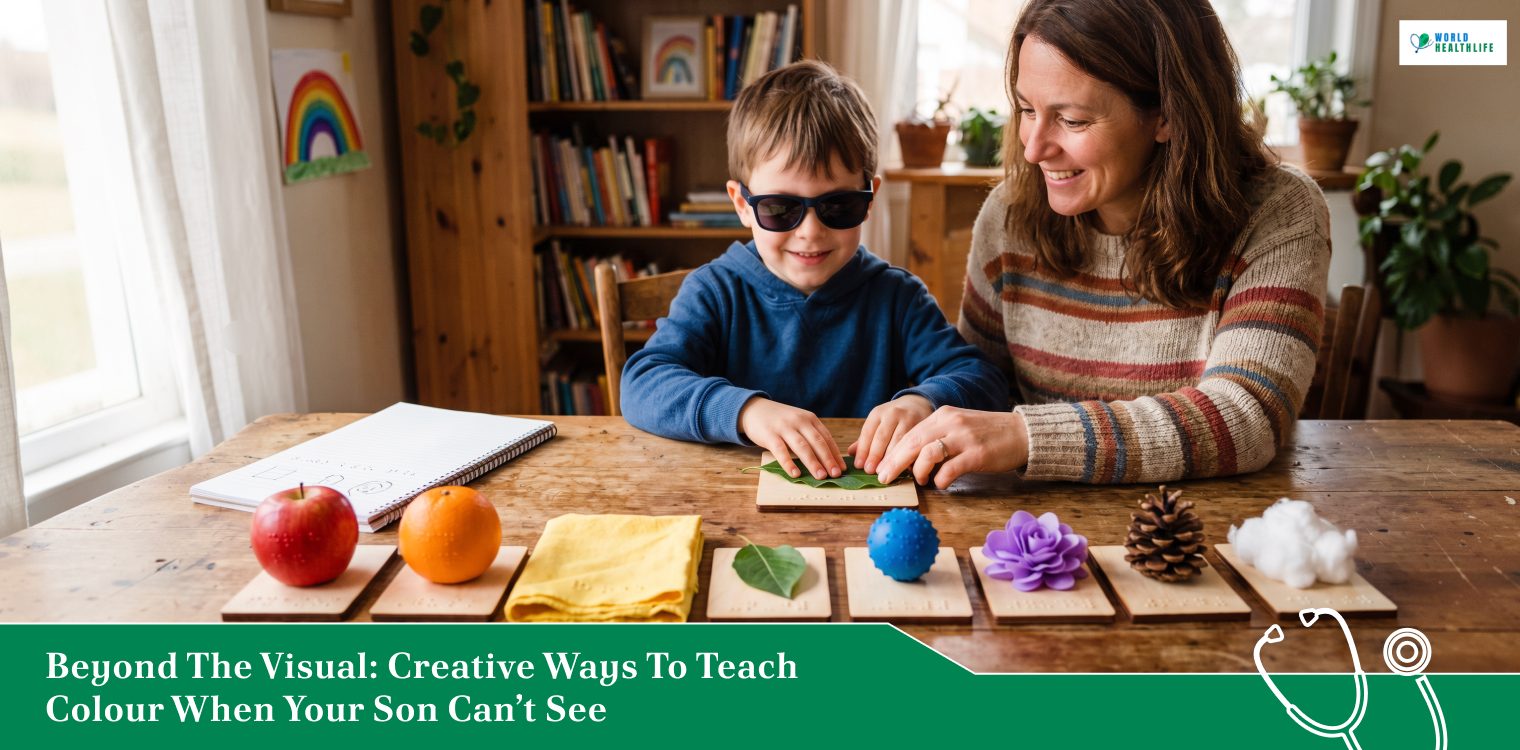
Discovering that your child has profound visual impairment or complete blindness brings an overwhelming wave of emotions. As a parent, you would naturally want to share every beautiful aspect of life with your little one.
Soon, everyday conversations spark a complex hurdle: my son can’t see. How do I explain colours to him?
While colour is a fundamental visual property for sighted people, it is ultimately a type of sensory data. For a child who is born blind, colour is usually an abstract label given to physical objects and environments.
Thankfully, our brains are highly adaptable.
By learning about crossmodal correspondences, you will be able to teach your child what colours mean.
Don’t be scared of the name. It is a scientific concept of linking one sensory pathway to another. This means using sound, touch, taste, temperature and emotion.
Thus, this comprehensive guide will offer actionable and health-focused parenting strategies so that the gap is filled.
Why Teaching Colour Language Matters For Blind Children
Before we can begin, you may be wondering a few things. Is discussing colour actually necessary? Or will it cause your son emotional distress?
Pediatric development specialists strongly advocate for the integration of colour language into your child’s daily routine.
- Social Inclusivity: Sighted children naturally use colour words in conversations, stories, and play. Teaching your son these associations helps him participate confidently in social settings.
- Safety and Information: Colour is often used as a critical marker for safety and ident
- Cognitive Matching: Understanding that specific items consistently possess certain colours builds a richer, logical mental map of the world.
5 Practical Ways To Explain Colour Without Sight
When navigating the thought, “my son can’t see. How do I explain colours to him?” remember that you are translating a visual wavelength into a non-visual language.
You can use the following multi-sensory techniques to bring the colour spectrum to life.
The Temperature Spectrum
The human body naturally maps scientific temperatures to internal feelings of colour. Visually impaired individuals frequently utilize a mental “heat scale” to categorize hues.
| Hues | Colours That Can Be Described | Description |
| Warm Hues | Yellow, Red, Orange | Have your child stand under the direct warmth of the sun or near a safe radiant fireplace to feel yellow or orange |
| Cool Hues | Blue | Place an ice cube or a cool splash of water on his hand to represent blue |
Textures And Weight
Tactile learning is the cornerstone of early development for blind children. Moreover, you can construct texture colour cards at home to give abstract concepts a physical form.
Say, for green, you can give your son a handful of fresh, crisp grass. You can also give him some soft, moist leaves to touch. Explain that green is a representation of life, freshness and growth
Now, for brown, you can let him run his hands through rich and heavy garden dirt or a rough tree bark.
Tastes And Aromas
Our olfactory and gustatory systems are incredibly powerful toolsets for memory anchoring. In addition, kitchen exploration can turn into an immersive colour classroom.
For example, you can serve a warm bowl of spicy soup or a ripe strawberry for the colour red. Explain that red is bold, vibrant and bursting with intense energy.
For yellow, you can offer a slice of tart lemon or a sweet and smooth banana.
Auditory Mapping: Pitch And Volume
According to clinical research, it has been indicated that blind individuals naturally match distinct audio tones to specific colours.
- High-pitched, loud, or fast-paced sounds, such as an emergency siren or upbeat trumpet, correlate with intense colours such as red or bright neon shades.
- Low-pitched, steady, and gentle sounds, such as rolling ocean waves or soft rain, organically mirror calming colors such as blue or deep purple.
Emotional Connections
Human beings naturally tie colours to moods. Connecting feelings to hues helps your child interpret descriptions in creative storytelling and literature.
| Colour | Primary Sensory Association | Emotional Metaphor | Practical Example |
| Red | Radiating heat, spice, quick heartbeat | Excitement, anger, intense love | Ripe strawberries, warm fire |
| Blue | Cool water, refreshing breeze | Calmness, tranquility, sadness | Pool water, crisp winter air |
| Yellow | Gentle sunshine, citrus scent | Joy, high energy, cheerfulness | Fresh bananas, warm sunlight |
| Green | Crisp leaves, fresh cut grass | Peace, health, new beginnings | Lawn grass, indoor houseplants |
| White | Smooth, soft, uniform cleanliness | Purity, silence, absolute emptiness | Fluffy cotton balls, cold snowflakes |
| Black | Heavy, dense, cozy or mysterious | Quietness, rest, deep sleep | Nighttime, heavy wool blankets |
Dealing With Overlap And Confusion

As you try to work through the question, “My son can’t see. How do I explain colours to him?”, you will inevitably run into descriptive overlaps that will confuse a young child.
For instance, your son may ask “If ice is blue because it is cold, why is the boiling ocean water also blue?”
He may also ask, “If fire is red because it is hot, why are hot chilli peppers also red?”
Navigating Colour Nuances
Parents often feel stuck when children notice these language overlaps. In order to make these concepts digestible, you can break your explanations down into foundational rules.
Use these core strategies to guide your conversations.
Explain Colour As A Label
Teach him that colour is an external label assigned by sighted people and not an intrinsic physical trait such as shape or texture.
Prioritize The Basics First
Put a prime focus on primary and secondary colours. Save complex shape gradients such as “turquoise” and “magenta” for when he is older,
Frame Colour As Information
Give him frequent reminders that colour tells a story about the current state of an object. For instance, green indicates a banana whereas yellow denotes that it is now sweet and ready to eat.
Medical And Developmental Guidance For Sighted Parents
A vital aspect of adjusting to your son’s visual loss is surrounding yourself with professional and medical resources.
When a parent expresses, “My son can’t see, how do I explain colours to him?”, clinical teams can provide specialized tools to ease the home learning transition.
Certified Orientation And Mobility Specialists (COMS)
Professionals with COMS have proper training to teach visually impaired children how to travel safely and understand their physical space.
Early Intervention Services
If your son is under three years old, state-funded early intervention programs offer physical, occupational and sensory therapies right in your home.
National Organisations
Foundations such as the National Braille Press (NBP) and Perkins School for the Blind provide highly specialised tactile colour books, sensory toys, and guides. Additionally, these are specifically designed to assist parents of blind children.
Speak Of The World Naturally
The most vital parenting advice is to never omit colour from your vocabulary out of fear or sadness.
Remember to speak about the world around you naturally. Say things like, “Let’s put on your warm green coat today,” or “This red apple is deliciously sweet.”
Your son does not need a working visual cortex to appreciate the beautiful, rich tapestry of life.
Ultimately, by linking your words to his active senses, you give him the tools to comprehend, share, and confidently navigate a vibrantly coloured world.