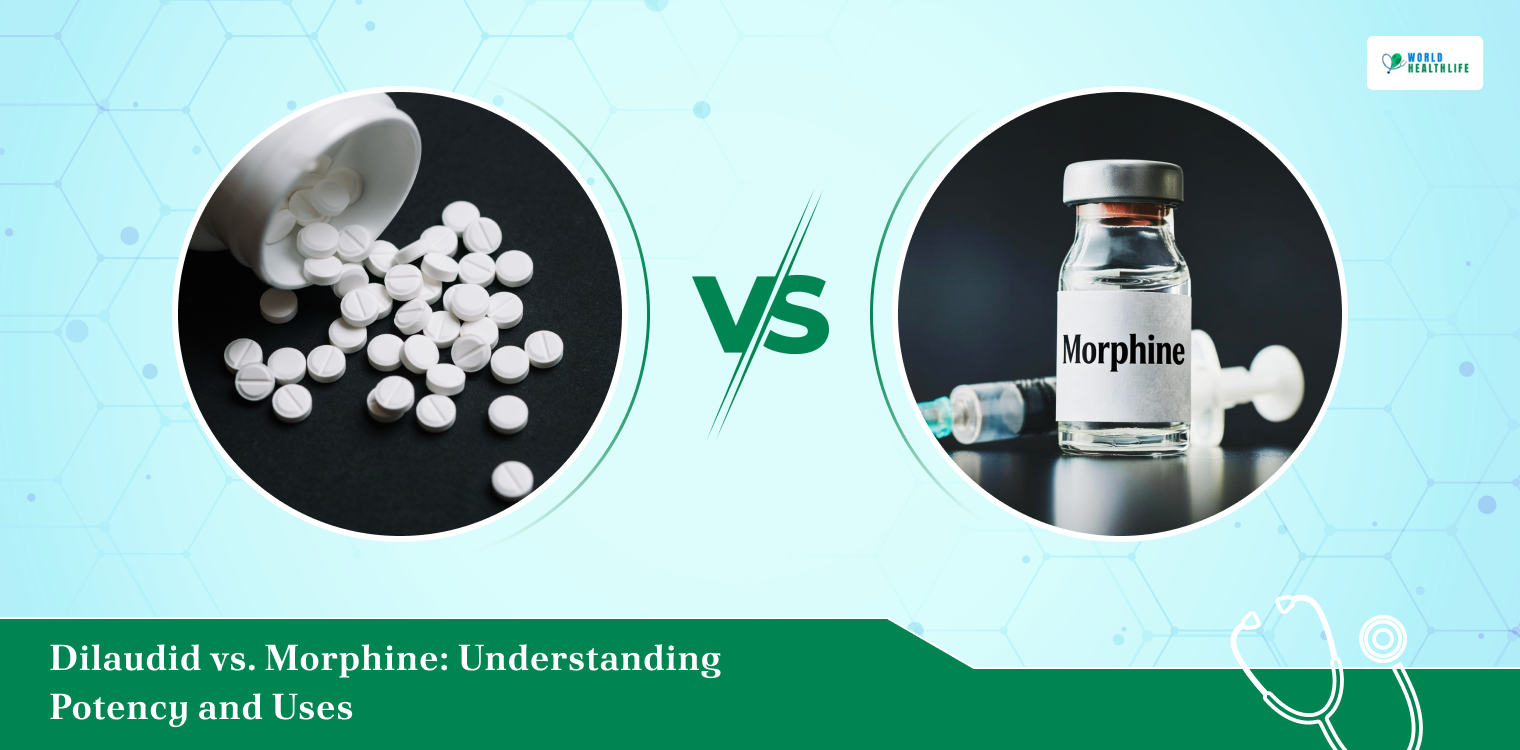
Managing pain has become one of the most crucial things in the modern healthcare sector. It often includes opioid medications, fighting between Dilaudid vs Morphine. Both are potent drugs that differ in strength and other factors.
The following article will explore these differences and explain why one’s better. We’ll also examine the dosage and safe consumption to avoid side effects.
Let’s dive into the medications, their differences, and how they compare to other opioids such as Tramadol and Percocet.
Why I Took Time To Break This Down?

I wasn’t planning to go this deep into pain meds.
It actually started with a small moment. Someone close to me had surgery. At that moment, I experienced nothing unusual. But later, they mentioned something that I still remember. The doctor switched them from morphine to Dilaudid halfway through recovery.
And that raised a very basic question: if both are for pain, why move from one to the other?
I didn’t have a clear answer then. So I did what I usually do. I started reading. To clarify, I was researching from medical sites, doctor comments, and even patient stories buried in forums.
Here’s what bothered me.
I’m not writing this as a clinician. I’m writing as someone who tried to make sense of a confusing switch and realized a lot of people are probably wondering the same thing.
Remember that on paper, these drugs look similar. In real life, they are wide apart.
Is Dilaudid Stronger Than Morphine?

There is much speculation about whether one is stronger than the other and which is true. Well, hydromorphone or dihydromorphinone takes the place in this race. Dilaudid is nearly 7-10 times more potent than Morphine. This effect is seen when the drug is administered intravenously.
The high potency of Dilaudid is what makes it the doctor’s choice for acute and severe pain. The following sections will now look at the different characteristics of Dilaudid that make it different from Morphine and whether it is a better choice overall.
Why is Dilaudid Preferred Over Morphine?
Does being more potent suffice for being the choice over Morphine? Well, it depends on the factors for choosing an opioid. There is more than one reason for Dilaudid to be the preferred choice over Morphine. Let’s have a look:
Better Tolerance
Apart from the better potency of Dilaudid vs Morphine, the enhanced tolerance for patients is another reason why doctors prefer this over the latter. Patients who usually experience severe side effects from opioids such as Morphine can easily rely on Dilaudid for better results.
Faster Onset
The onset time for Dilaudid is faster in comparison to Morphine. Dilaudid shows analgesic effects within 5 minutes of IV administration. At the same time, Morphine takes 5-10 minutes for peak activity.
Shorter Duration
This drug’s shorter half-life makes it great for faster pain relief. The hydrophilic nature of the molecules possesses μ-opioid receptor agonist activity. However, the analgesic effect stays for nearly 3-4 hours.
Lower Volume Required
The high potency allows the drug to be effective even at lower volumes. Thus, even at lower doses, it will effectively reduce the pain. Moreover, the same effectiveness will be possible for Morphine at higher volumes.
How Long Does Morphine Last?
Now that we know more about Dilaudid let’s know more about Morphine. Morphine is available in different forms, such as:
- Immediate-release morphine that lasts for 4-6 hours
- Extended-release morphine that lasts up to 12 hours and longer
Morphine also provides steady pain relief. However, it must be administered frequently in chronic or severe pain.
How Long Does Dilaudid Stay in Your System?
Different studies follow different conditions to test the duration of this drug’s presence in the system. Following are the different detection windows for the drug in our system as per various tests:
- Blood: Up to 24 hours
- Urine: Nearly 2-4 days
- Saliva: 1-2 days
- Hair: Nearly 90 days
The pain-relieving effects of Dilaudid last for nearly 4-6 hours, whereas traces of the drug can be found for longer in the body.
Common Uses For Dilaudid And Morphine
Now that we know how Dilaudid vs Morphine, Tramadol, and Percocet play, here are a few use cases of Dilaudid and Morphine. Let’s have a look:
- Post-surgical pain
- Cancer-related pain
- Severe injuries or trauma
- End-of-life palliative care
Additionally, as said earlier, Dilaudid has a higher potency, which makes it more suitable for cases that require rapid relief. It can also work in cases when Morphine is ineffective.
Dilaudid vs. Tramadol: Which is Better?

Now that we know the basic yet significant differences between Dilaudid vs Morphine, let’s see how it compares with other drugs.
Here are the different comparative factors for Dilaudid vs Tramadol. Let’s have a look:
| Factor | Dilaudid | Tramadol |
| Potency | Much stronger, suitable for severe pain in cases of cancer or post-surgical recovery | Milder potency, best for moderate pain poses a lower risk of respiratory depression |
| Use Cases | Suitable for acute to severe pain | Best suited for chronic conditions such as arthritis |
| Side Effects | Higher risk of addiction due to the high potency even at low volumes. Causes respiratory depression. | Lower risk of addiction and severe side effects |
Thus, it’s safe to say that Tramadol is much safer than Dilaudid. However, it may not be effective for severe pain.
Why Doctors Actually Switch Between Them?
Most people don’t tell you this. However, you must know what triggers the change.
There’s usually a trigger for switching. From what I’ve seen, morphine is often where things begin. It’s familiar. It’s been used for decades. Doctors know how people tend to respond to it.
But then something happens. Maybe the patient says the pain is still cutting through. Some patients say they still feel dull pain. That’s one situation.
Or the opposite. To clarify, the pain is controlled, but the person feels nauseated. That happens more than people expect.]
That’s when Dilaudid enters the picture. It’s not just that it is a stronger drug.” It behaves differently in the body. Faster, in many cases. Sometimes cleaner, depending on the person.
I remember reading a case where someone described morphine as “blurry relief.” When they switched, they said the pain dropped more sharply, without that same fog.]
Now, does that happen for everyone? No.
But it happens enough that doctors keep both options ready. So the switch is rarely random. It’s usually a response.
Risks That No One Else Discusses
Most articles stop at listing side effects. For example:
- Drowsiness
- Nausea
- Constipation.
But in real situations, a few other risks become vital in the background. One of them is dosing confusion. And this is a big one with Dilaudid.
It’s much stronger than morphine. That means even a small mistake, a misunderstanding, or a mix-up in communication can have a bigger impact than expected.
Hospitals know this, which is why they double-check everything. Outside that setting, it becomes more important for patients to stay alert and ask questions.
Then there’s something less obvious, like adjustment over time.
The body gets used to opioids slowly. You don’t notice it day by day. But after a while, the same dose may not feel the same. That’s where things can become complicated.
And finally, there’s the emotional layer.
Relief isn’t just physical. For some people, it also brings a sense of calm, even quiet. That can feel like a break from stress or discomfort. It’s subtle, but it matters. To sum up, over time, that feeling can become something people don’t want to lose.
Ask Questions Before You Take Either
If I were in that situation, these are the questions I’d ask. First, ask why this one? Is it about strength, speed, or how I reacted to something earlier?
Secondly, ask what it will feel like at the start? That’s something people often don’t ask. But it helps. Even a rough idea makes it easier to handle the first dose.
Thirdly, don’t forget to ask what’s “normal” and what’s not? Because when you’re already in pain, it’s hard to tell if something feels off or expected.
And lastly, how long is this meant to last? Short-term use feels very different from something that stretches out over time. Knowing that upfront changes how you think about it.
None of these questions is technical. But they give you control over how the body reacts to them. And in situations like this, even a little control matters.
Make Informed Choices
What makes you decide which one to choose? At first, look at how much pain you are in. At the same time, consider whether you can tolerate this drug. So, evaluate Dilaudid vs Morphine and see which one suits you more.
Both these meds have specific roles. Dilaudid acts faster and is better for acute pain management. Morphine helps settle tremendous pain.
When you understand both drugs, you can also administer the intake at home.