
| Learning disabilities affect individuals all over the world. Dedicated nurses act as primary caregivers who assist these individuals, protect their legal rights, and directly bridge gaps in healthcare accessibility. This expert guide simplifies the current UCAS questions for your disability nursing application so you can present a highly authentic and polished statement. |
A learning disability is a permanent neurodevelopmental condition that alters how an individual processes information, picks up new skills and manages independent living.
It is not a mental illness. Instead, it originates during childhood and does not develop later in adult life. If you are currently applying for a nursing course in the UK and figuring out how to answer the new UCAS prompts, this guide is built for you.
In addition to this, it will explain exactly what admission teams look for in every prompt. You will also be briefed about how to structure your responses.
Nursing practice throughout this sector is strictly regulated by the Nursing and Midwifery Council (NMC). Moreover, their official code establishes the professional benchmarks you will be trained to maintain.
Data analysis from Mencap indicates that close to 1.5 million people in the UK live with a learning disability. This includes an approximate number of 349,000 children.
In addition, you must understand that UCAS has replaced the old personal statements with three structured questions for 2026 entry, answered within 4,000 characters in total and a minimum of 350 characters per answer.
Therefore, this learning disability nursing personal statement guide from The Academic Papers UK sheds light on the opportunities to stand out, the common mistakes that students usually make, and how they can avail of nursing assignment help for guaranteed success.
Core Idea At A Glance
- This guide provides you with techniques to write effective answers to UCAS questions.
- All UK universities, including Imperial College London and the University of Warwick, access applicants through the UCAS application framework, so each answer must show your knowledge and awareness of the field.
Embracing Disability Nursing Personal Treatment As A Career Path
Choosing this career path requires a deep understanding of the way specialized clinical care intersects with everyday support. In addition, admission tutors want to see why you feel drawn to this specific branch of healthcare instead of adult or mental health nursing.
A successful application needs to show that you have an understanding of how a tailored disability nursing personal treatment plan improves long-term patient outcomes.
Understand why Learning Disability Nursing? Understanding the Question
In this UCAS question, universities basically focus on the motivation, desire, and passion to provide care to the patients and eliminate underlying health complications such as learning disability. A good learning disability nursing personal statement needs to show an understanding of the special role that learning disability nurses play in supporting people to obtain the optimum level of health, independence, and quality of life.
Important Note: Sympathy should be avoided; applicants should highlight the concept of respect, inclusion, dignity and empowerment.
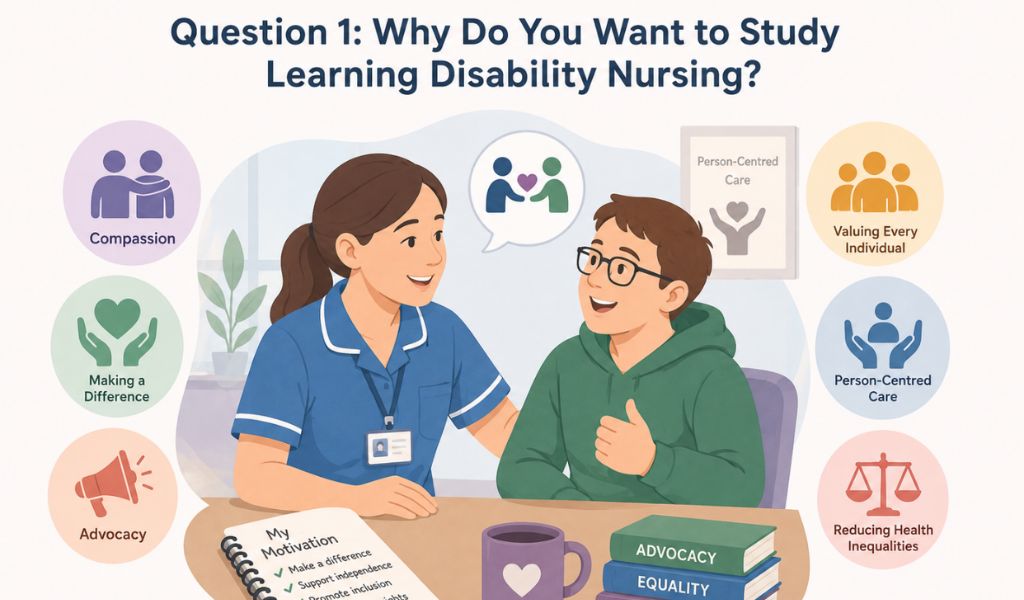
To efficiently attempt and answer this question, you need to incorporate the following points:
- Your enthusiasm for supporting people with learning disabilities.
- The need for advocacy and addressing health inequities.
- Your dedication to person-centered care.
- Experiences that led you to choose your profession.
- Values of compassion, respect, empathy and dignity.
How Have Your Qualifications And Studies Prepared You?
Once you have answered the first question, you must address this significant one. Always remember that this UCAS question evaluates your academic preparation.
University admissions teams require proof that you have sufficient and necessary knowledge, academic skills, and professional attitude needed to study at the degree level.
If you have previously completed assignments, research projects or independent reading regarding healthcare or disability equality, you can use those details to build a highly convincing response.
Studying biology develops your knowledge of the nervous system’s anatomy and physiology, which is crucial for modern disability nursing personal treatment methods. Meanwhile, psychology coursework clarifies how human beings learn, behave and retain information.

What Else Have You Done To Prepare Outside Formal Education?
This question carries the most weight for nursing applicants, because hands-on care experience sits at the heart of the profession. Assessors focus on the practical experiences that motivated you to provide care and improve the well-being and independence of people with a learning disability.
Here are some examples of relevant learning disability work experience:
- Support worker roles
- Care assistant positions
- Volunteering within the community
- SEN (Special Educational Needs) Schools
- Residential care settings
- Youth support programs
- Charity volunteering such as Mencap
It is important to understand that you are not just describing your experience; you must explain how each experience fostered your interest in learning disability nursing.
For instance, you might have noticed the need to tailor communication to the needs of individuals. Some people might need support and information through pictures, Easy Read books, or Makaton sign language.
Reflecting on these experiences shows awareness of accessibility and inclusion.
For each experience, work through the following reflection questions that you may be asked:
- What happened?
- What was your take-away message?
- How did it impact your learning disability nursing knowledge?
- How do you think it will help you to become a better nurse?
Values, Advocacy And Professional Awareness
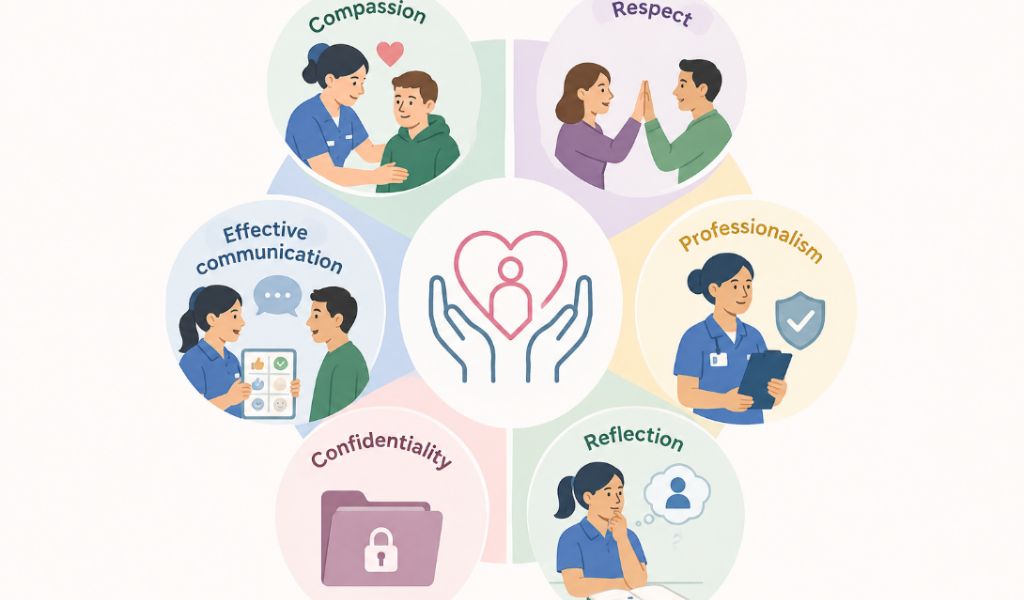
Within the nursing sector, particularly when assisting individuals with learning disabilities, healthcare workers must display robust personal values, clear advocacy skills, and strong professional awareness.
Moreover, these are the three elements that need to shine through your UCAS responses. This is because they are the exact traits admissions tutors seek out when shortlisting candidates.
Modern nursing revolves fully around person-centered care. This means recognizing that each individual possesses unique strengths, distinct preferences, personal goals, and specific support requirements.
Professionals work in close partnership with patients. This helps to build an effective disability nursing personal treatment strategy instead of simply making assumptions that they know what is best for them.
The Mental Capacity Act 2005 is the legislation that protects an individual’s right to make their own choices whenever possible. Briefly discussing this act highlights an advanced level of professional understanding that very few applicants showcase.
Pair this point with absolute confidentiality. Also, never share details that could identify an actual person you have cared for. This is because both UCAS guidelines and the NMC Code demand completely anonymized examples.
UCAS Rules And Common Mistakes
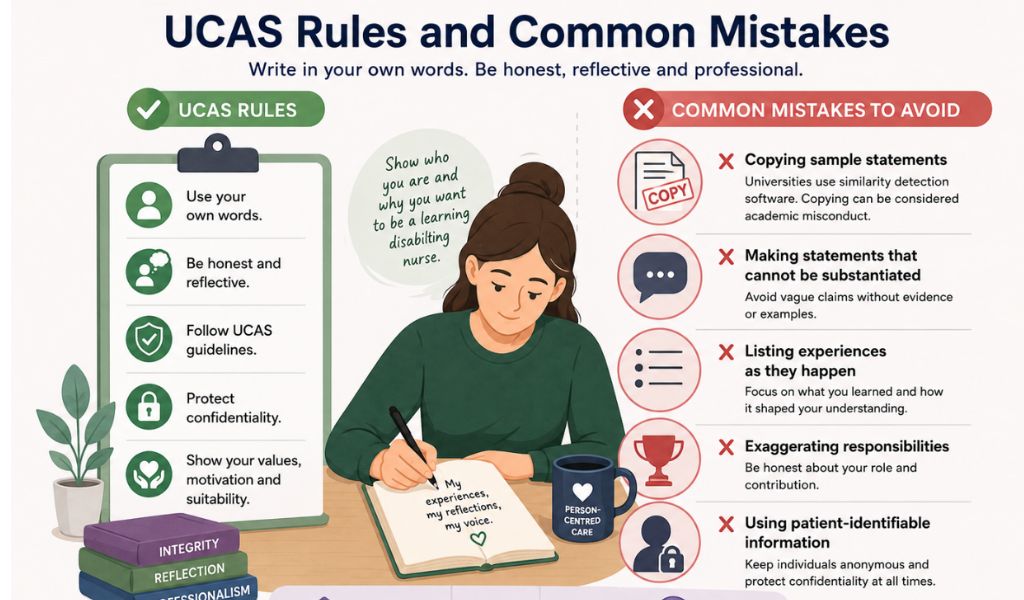
The following are the common mistakes that you must avoid while attempting UCAS questions.
Do’s
- Copying LD nursing personal statement examples word for word; treat examples as learning resources, not templates.
- Making statements that cannot be substantiated
- Listing experiences without reflecting on what each one taught you.Exaggerating responsibilities
- Using patient-identifiable information
Don’ts
- Make sure you provide real-life examples that show that you are suitable for learning disability nursing and address each UCAS question directly in your own words.
Get Expert Feedback On Your Disability Nursing Personal Statement
If you need professional support with your application, our admission essay help team at Cheap Essay Writing UK is ready to review your current draft.
Moreover, we will fill in any missing details while ensuring that each UCAS requirement is met perfectly. Your unique voice will be kept completely intact. The most successful applications are highly personal and are filled with clear examples, which are deeply reflective and genuinely anchored in a true understanding of the field.
Utilizing professional proofreading and editing services helps polish a variety of things. These include your structure, grammar, clarity, and the overall impact. In this way, your application remains undeniably yours.
Next Steps For Your Application
Writing a disability nursing personal statement becomes far more manageable once you understand what each UCAS question is really asking.
This guide has covered how to approach the three questions, the advocacy and person-centered values admissions tutors expect, and the common mistakes to avoid.
Root every answer in genuine experience, keep your own voice, and your application will reflect the professional you intend to become.
Frequently Asked Questions
Here are some of the questions that people often want to know
Is ‘“Disability Nursing”’ The Same As Learning Disability Nursing?
Learning disability nursing is the officially recognized field within the UK healthcare system. People often use the term “disability nursing” informally when talking about this profession. Therefore, a statement focused on either term describes the identical academic application.
How Do I Write A Learning Disability Nursing Personal Statement For 2026?
Draft reflective, personal responses that directly tie your core values to the three updated UCAS questions. Make sure to explain how your clinical mindset shapes your approach to individual disability nursing personal treatment plans within each answer.
What Experience Is Relevant (Support Work, SEN, Charities Like Mencap)?
Practical understanding is shown through support work, SEN placements, care roles, volunteering, community projects, and charity experience with organizations such as Mencap.
How Do I Show Advocacy And Person-Centered Values?
Explain how to facilitate individual decisions, foster inclusion, honor dignity, adjust communication and ensure access to suitable services.
How Do I Approach The Three UCAS Questions For This Field?
Discuss your motivation first, then your academic preparation, and finish with practical experience, demonstrating advocacy, ting in practice, communication, reflection, person-centered care and professionalism throughout.