
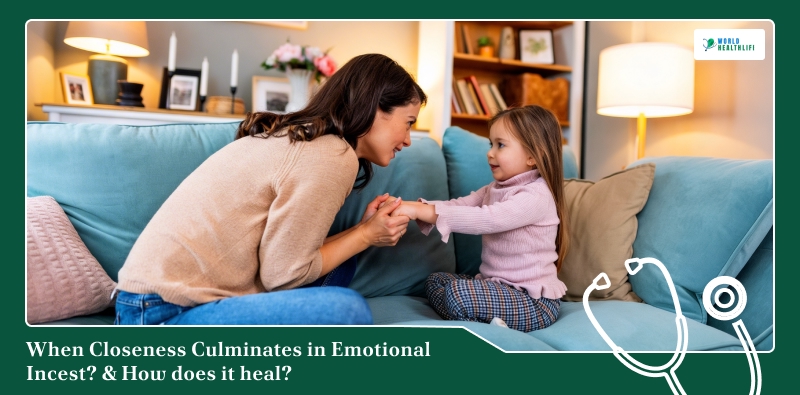
Some family dynamics look loving from the outside. Still, they leave a person feeling strangely drained, confused, or guilty years later. That’s part of what makes emotional incest so hard to name.
Primarily, it does not always look dramatic. Rather, it looks like loyalty. Even then, it looks like being the favorite child, which can feel flattering at first. Then later, ang bigat pala. In fact, you grow up and realize that what felt like closeness was also pressure.
This topic makes people uncomfortable, and the word itself is intense. However, the core idea is simpler than it sounds. In general, emotional incest happens when a parent or caregiver leans on a child for emotional support. They do so in a way that crosses the normal line between parent and child.
This way, the child becomes a stand-in for an adult partner, a best friend, or an emotional anchor. This happens not physically, but emotionally. That changes a person quietly, slowly, and in ways they may not understand until adulthood.
What Is Emotional Incest?

At its heart, emotional incest is role confusion. Primarily, the child is asked, directly or indirectly, to carry feelings that were never theirs to carry. Basically, a parent vents to them as a peer would.
Depends on them for comfort, they also act jealously when the child wants space, friends, or a life of their own. Sometimes the child is praised for being mature. In some cases, they are guilted into staying emotionally available. Either way, the message lands hard: “Your job is to take care of me.”
What makes this different from healthy closeness is the burden it places on others. Actually, healthy closeness lets a child feel safe, guided, and free to grow. Meanwhile, emotional incest makes the child feel responsible.
In healthy families, support moves downward. That is, from parent to child. In emotional incest, it gets flipped, that is. child to parent. Parang, the kid becomes the emotional shock absorber of the home, and everybody acts like that’s normal.
How Emotional Incest Differs from Healthy Closeness
A lot of people need this distinction, so here it is in plain English. Not every close family is unhealthy. Some families are warm and connected without being intrusive.
The problem starts when closeness comes with obligation, guilt, blurred privacy, and the feeling that separation is betrayal. That is not intimacy. Rather, it is enmeshment wearing a softer face.
| Healthy Closeness | Emotional Incest |
|---|---|
| The child can have privacy and independence | The child feels watched, needed, or emotionally on-call |
| The parent shares appropriately | The parent overshares adult pain and expects comfort |
| Love feels safe and steady | Love feels tied to loyalty and emotional availability |
| The child can grow apart naturally | The child feels guilty for pulling away |
The difference is not always obvious in childhood. For instance, kids adapt. They do what keeps the household calmer. They do what earns approval. Also, they stay nearby, listen longer, and say less. Then years later, they wonder why every relationship feels like work.
How Emotional Incest Develops in Families
Usually, emotional incest does not appear out of nowhere. Rather, it grows in families where boundaries are already weak, and adults are emotionally unsupported.
For instance, a lonely parent may lean on a child because they don’t trust other adults. Meanwhile, a parent in a cold marriage may turn to a child for comfort. Moreover, a single parent under intense stress may start treating a child like a companion instead of a child.
Hindi naman laging evil. But even when it is unintentional, the effect can still cut deep.
There’s also the family culture piece. In some homes, loyalty gets overvalued, and boundaries get treated like rejection. In this case, privacy is called selfishness. Moreover, disagreement is seen as disrespect.
The child learns to shrink their own needs because keeping the parent emotionally stable feels more urgent. This way, it becomes a pattern of survival. In general, these are hard to put down once they’ve kept you safe.
Parentification and Role Reversal
A common thread here is parentification. Basically, it is a clinical term for something many adults describe more simply. “I felt like the parent.” They were the listener after fights. They are the ones who had to stay calm. Or, they are the ones who absorbed the parent’s loneliness, anger, insecurity, or heartbreak.
Maybe they heard way too much about marriage problems. Or, maybe they were told, “You’re the only one who understands me.” On paper, that sounds touching. In a child’s nervous system, it often manifests as a feeling of pressure.
This is one of the saddest parts of emotional incest. Also, the child may feel special and trapped at the same time. That combination is really confusing, and it can shape how they understand love itself.
Signs of Emotional Incest in Childhood and Adulthood

The signs are mostly subtle because many survivors were praised for them. They are praised for being “mature, “selfless,” or “the rock.” But if we slow it down, the pattern starts to show.
In childhood, emotional incest looks like adult-level conversations and guilt for wanting independence. Also, there is a lack of privacy, pressure to prioritize a parent’s feelings, and a constant sense that the child must not upset the parent.
Meanwhile, in adulthood, the signs get more complicated. For instance, people may struggle to name what they want. Also, they may feel guilty resting, saying no, or making choices that disappoint others.
Moreover, they may attract relationships in which they overgive and underreceive. Or they may panic when somebody needs too much from them because their system remembers the old weight.
Minsan ganito siya. You either become everybody’s caretaker, or you run the second someone gets emotionally complex. Sometimes both, depending on the day.
Common Signs That Often Linger
The following are some of the major signs of emotional incest:
- Difficulty setting boundaries without feeling cruel.
- Confusion about personal identity, values, or desires.
- Chronic guilt, shame, or fear of abandonment.
- People-pleasing and conflict avoidance.
- Over-responsibility in romantic and family relationships.
These signs are not random personality flaws. Rather, they usually make sense in context. If your childhood taught you that love meant emotional service. Then, adulthood may feel like one long audition for approval.
The Lasting Impact of Emotional Incest
The biggest wound is not just anxiety or boundary problems. It is the damage to a person’s sense of self. Emotional incest can make someone hyper-aware of other people and weirdly out of touch with themselves.
They can read a room in three seconds and still not know what they feel. Rather, they provide deep care to everyone else and freeze when asked a simple question like, “What do you need?”
Ayun na, silence, blankness, or guilt.
There are mental health effects, too, of course. Anxiety, low self-worth, shame, emotional confusion, depression, and trauma responses all show up around this pattern.
Some people also live in a body that never fully relaxes. The childhood role may be over, but the nervous system still acts like it has a shift to cover. That constant readiness, scanning, and inability to soften follow a person for years.
| Area of Life | How Emotional Incest Can Show Up |
|---|---|
| Identity | “I know how others feel, but I don’t know who I am.” |
| Relationships | Overgiving, rescuing, unstable closeness, fear of separation |
| Emotions | Guilt, shame, anxiety, and emotional numbness |
| Boundaries | Saying yes automatically, then feeling resentful later |
| Self-Worth | Feeling valuable only when needed |
Moreover, real life is even more complex. It is about missing someone and feeling suffocated by them at the same time. Or being called selfish for doing something normal. It’s being good at care, but exhausted by intimacy.
How to Heal from Emotional Incest

Healing usually starts with one awkward, powerful realization. “This was not my role.” That thought cracks something open. It happens not all at once, but usually in pieces. You begin to see that the guilt you carry is old. Also, the reflex to overfunction is old.
Moreover, the belief that love must be earned through emotional labor is also old. Grabe, that kind of realization feels both relieving and a little scary. This is because old roles feel familiar even when they hurt.
1. Set Healthy Boundaries without Turning Yourself into the Villain
In general, boundaries are a huge part of recovery, but they often feel wrong at first. Also, survivors of emotional incest are used to equating boundaries with abandonment. So when they say no, take space, or stop overexplaining, their body may react as if danger is coming.
However, it does not mean the boundary is bad. Rather, it means your system is learning a new language. Dahan-dahan lang.
2. Reconnect with Your Own Needs and Identity
You ask yourself small questions:
- What do I like?
- Things that drain me
- What kind of relationship actually feels safe?
- What do I believe when nobody is leaning on me?
These are simple questions. However, for someone shaped by emotional incest, they feel surprisingly hard. The point is not to answer perfectly. Rather, the point is to begin.
3. Therapy Helps Untangle What Feels Normal But Isn’t
Therapy can be deeply useful here because it gives language to experiences that were normalized for years. Approaches like CBT may help with guilt and self-worth. Parts work can help people understand the younger protective selves still running the show. EMDR may help when the memories and body responses feel stuck. Walang magic fix, obviously. But the right support can help a person stop confusing obligation with love.
Frequently Asked Questions
No. However, it does not involve sexual contact. Still, it is a serious emotional boundary violation.
Yes, it can be. For instance, a parent may not mean harm. However, the impact on the child might still be lasting.
Not necessarily. It might happen in any family structure where boundaries become blurred.
Yes, they do. Moreover, therapy, boundaries, and self-awareness help rebuild identity and healthier relationships.
A major sign of emotional incest in adulthood is feeling responsible for other people’s emotions. This happens even when it drains you.
Reclaiming Boundaries, Identity, and Healthier Relationships
The hardest thing about emotional incest is that it mostly gets mistaken for devotion. The child looked close to the parent, helpful, loyal, and mature. Although people praised it, no one saw the cost. In fact, it can be enormous.
It leads to a shaky identity and exhausting relationships. Also, it leads to a life built around emotional availability instead of real choice. Once you see that pattern, though, something shifts. Hindi na puro fog.
That is the real hope in this conversation. It is not perfection or instant healing. Rather, it is just the possibility of a different life. It is one where love does not require self-erasure, and closeness might exist with boundaries. It is the place where being needed is no longer the same thing as being worthy.
If this topic hit something tender, that matters. Make sure to listen to that. In fact, sometimes naming the wound is the first honest form of relief.


