Acid-reducing meds are one of those quiet crutches of modern life. You do not notice them until you really need them. It might be after a heavy dinner or a late coffee. Also, you might need them for stress that sits in your chest like a brick.
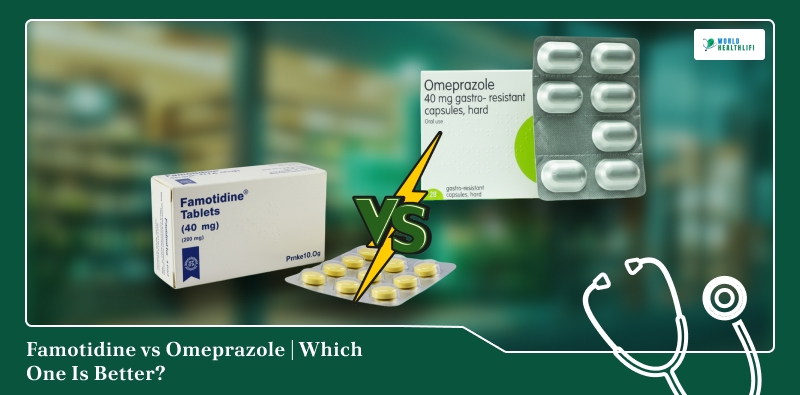
Then suddenly you are staring at the pharmacy shelf, trying to decode what’s actually worth taking. This Famotidine vs Omeprazole guide helps you buy without a prescription.
Quick Answer
Although both famotidine and omeprazole reduce stomach acid, they work differently and are recommended for different situations.
- Famotidine is for instant relief from occasional heartburns
- Omeprazole is designed for longer relief for people going through acid reflux frequently.
This comparison explains the key differences, benefits, risks, and when Famotidine Vs Omeprazole may be the better choice.
The better choice depends on how often your symptoms occur, not on which one is “stronger”.
Famotidine Vs Omeprazole: At a Glance
This table will help you to grasp the solution to your instant problem:
| Feature | Famotidine | Omeprazole |
| Drug Class | H2 blocker | Protein Pump Inhibitor (PPI) |
| Best for | Occasional heartburn | Frequent heartburn and GERD |
| Starts working | About 30-60 mins | 1-4 days |
| Lasts for | About 10-12 hrs | Upto 24 hrs |
| Daily consumable? | Usually no | Yes (14 days course) |
| Before Meals | Yes, if preventive of heartburn | In the morning, before breakfast |
| Immediate relief | Yes | No |
| OTC availability | Yes | Yes |
If your heartburn appears only after certain meals, famotidine is usually a better choice. If acid reflux bothers you multiple times a week, go for omeprazole; it does provide long-lasting control, but it requires patience, as it doesn’t work instantly.
What Are Famotidine and Omeprazole?
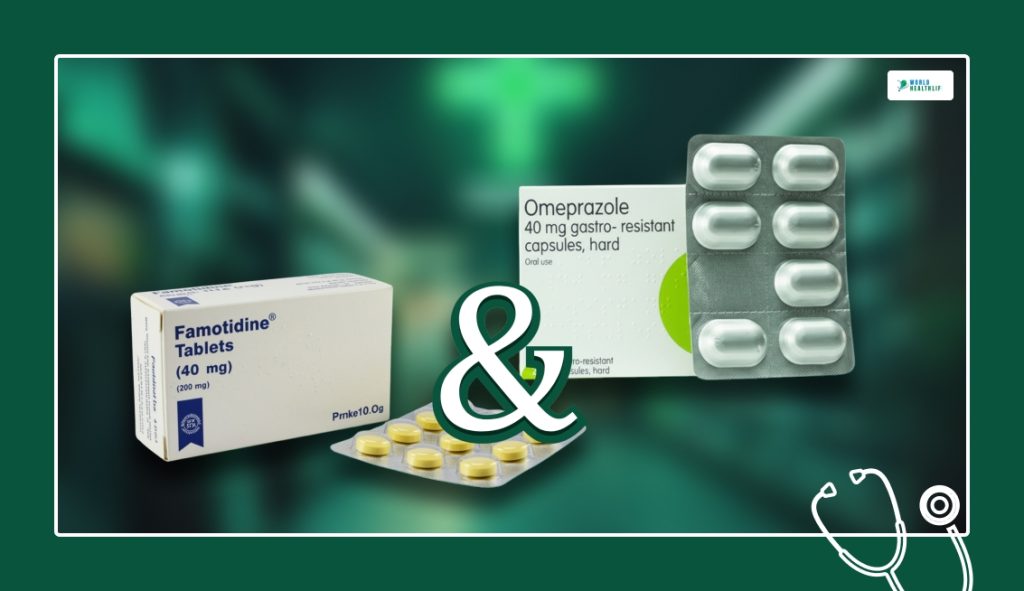
Both famotidine and omeprazole help in reducing or stopping acid production. However, there are subtle differences. Let’s understand them with the help of definitions.
Famotidine
Famotidine is an H2 blocker (histamine H2-receptor antagonist). OTC (Over-the-counter) versions are commonly sold as Pepcid AC and generics. They are usually intended to relieve heartburn linked to acid indigestion and sour stomach. Also, they prevent heartburn when taken before trigger meals.
This is how you can use it:
- Swallow a tablet with water
- Do not chew
- Use it as needed within the stated daily maximum.
You must also know when to stop self-treating and when to talk to a clinician. This matters a lot because persistent heartburn can be a sign of something else entirely.
Omeprazole
Omeprazole is a proton pump inhibitor (PPI). OTC versions include Prilosec OTC and generics. However, their mission differs from famotidine’s.
In general, OTC omeprazole is marketed and labeled for frequent heartburn. It is for symptoms that show up two or more days a week. Also, it is not intended for immediate relief.
Meanwhile, the standard OTC format is a 20 mg delayed-release tablet taken once daily for a 14-day course. In fact, the label is strict about taking no more than 1 tablet a day.
Pros and Cons of Famotidine vs Omeprazole
Short on time? Here’s a comparison table highlighting the key pros and cons of using famotidine or omeprazole.
Famotidine
| Pros | Cons |
| Fast relief | Doesn’t suppress acid as strongly |
| Works before trigger meals | Relief may not last all day |
| Fewer medication interactions | Not ideal for chronic GERD |
| Easy to use occasionally |
Omeprazole
| Pros | Cons |
| Strong acid suspension | Doesn’t work immediately |
| Excellent for frequent use | More drug interactions |
| Long-lasting effect | Monitored usage |
| Helps heal acid damage |
Famotidine vs Omeprazole: When to Use Each?
Now, before we jump into the details, take a quick look:
Choose famotidine if:
- Heartburn happens occasionally.
- Spicy food, coffee or alcohol usually triggers it
- You want instant relief
- Dont take acid medicine every day unless prescribed
- You need something before having something rich in taste.
Choose Omeprazol if:
- You experience heartburn every other week
- Symptoms keep returning
- Your doctor suspects gastroesophageal reflux disease (GERD)
- Acid reflux affects your sleep
- You need a long term control under medical supervision.
Famotidine
Adults and children 12 and over can typically use OTC famotidine. Basically, it is meant to relieve symptoms or prevent them if you take it shortly before a trigger meal. Typical labels cap use at 2 tablets in 24 hours. Also, they advise a medical evaluation if you need to use it for more than 14 days.
Moreover, it includes red-flag symptom warnings:
- Trouble swallowing
- Vomiting blood
- Black stools
- Chest pain that is not routine heartburn.
Omeprazole
For OTC omeprazole, answering the “how” is half the therapy. In fact, adults 18 and over use one delayed-release 20 mg tablet once daily every 24 hours for 14 days. However, take it before you eat in the morning. Make sure to swallow the whole.
The label repeats the idea that it may take 1 to 4 days for the full effect to take place. Also, it states that Omeprazole is not exactly for immediate relief. Moreover, you must not take it for more than 14 days. Furthermore, do not repeat the 14-day course more often than every four months unless a doctor tells you to.
However, if symptoms persist, worsen, or come with red flags (like bloody stools or swallowing pain), the label points you away from self-treatment.
Science Simplified:-
Think of your stomach as a kitchen:
- Famotidine turns down the signal telling your stomach to produce acid. Since it blocks the message, relief comes quickly.
- Omeprazole goes a step further by temporarily switching off many of the acid pumps themselves. It takes longer to build up, but the acid suppression lasts longer.
Medications Work With Better Lifestyle Changes
Even the best acid-reducing medicine cannot completely compensate for habits that repeatedly trigger reflux.
You may notice better symptom control if you:
- Avoid lying down right after heavy meals
- Eat smaller portions
- Reduce late-night eating
- Maintain a healthy weigh
- Identify and avoid trigger foods like spicy meals, caffeine, alcohol
These adjustments often reduce how frequently you need medications.
How They Work: Mechanism of Action
Famotidine blocks histamine-2 receptors in the stomach lining, which reduces acid secretion. Primarily, omeprazole irreversibly blocks proton pumps, the final step in acid production. This helps suppress acid more deeply once enough doses stack up.
Essentially, it shapes what you feel and when you feel it. With famotidine, the relief pattern is mostly more immediate and tied to a specific dose. However, with omeprazole, the relief pattern is steadier over days. Make sure you actually take it as the OTC label suggests.
Speed of Relief and Duration of Effect
Famotidine is usually the better “I need relief tonight!” type option (at least in the way people experience it in real life). In fact, the OTC label also supports that flexible use, since it includes directions for relieving symptoms and for preventing symptoms before meals.
Omeprazole is explicitly labeled as not intended for immediate relief. In fact, it may take 1 to 4 days for the full effect to be felt.
To be honest, many people indulge in complex self-dosing behaviors, such as doubling up or switching products too quickly. In the US, the label expectations are part of the drug’s identity.
| Feature | Famotidine OTC (Pepcid AC style) | Omeprazole OTC (Prilosec OTC style) |
| What it’s positioned for | Relief and prevention of heartburn from triggers | Frequent heartburn, not immediate relief |
| How do you usually take it? | As needed, including before trigger meals | Daily, once every 24 hours for 14 days |
| Day one experience | Often noticeable when symptoms are active | Can start working day one, but may need days for full effect |
| Label guardrails | Max 2 tablets in 24 hours (typical Pepcid AC label) | 1 tablet daily, do not use more than 14 days. Also, repeat no more often than every 4 months unless directed |
Famotidine vs Omeprazole: Conditions Treated
In general, prescription versions of these drugs cover a broader range of disease states. However, OTC labeling is narrower and more symptom-focused.
OTC famotidine is formulated for heartburn linked to acid indigestion and sour stomach. This includes prevention before trigger foods.
OTC omeprazole is formulated for frequent heartburn. It is specifically for heartburn that occurs two or more days a week. However, it is not meant for the person who only gets heartburn once in a while and wants instant relief.
Comparative Efficacy
When people say “better,” they usually mean either faster comfort or fewer flare-ups over time. So, when you are choosing OTC for Famotidine vs Omeprazole, focus on the following:
- If you want fast comfort, famotidine tends to win in lived experience. This is because it is positioned as a symptom reliever. Also, you can use it before a meal to prevent heartburn.
- If you want fewer flare-ups and more stable control in frequent heartburn, OTC omeprazole is the better option. In fact, it is designed to be taken daily for a full 14 days. Also, the label essentially tells you that it is for sustained suppression, not a quick patch.
Side Effects and Safety Profiles

On the surface, both famotidine and omeprazole are usually tolerated well. Also, the side effects can be annoyingly non-specific. In general, these include:
Those can belong to the medication or to the condition you are treating. Hence, the timeline matters a lot. If symptoms shift right after you start a product, it is worth noticing rather than brute-forcing through it.
Moreover, both product labels include warning language to prevent self-treatment of a more serious condition.
Long-Term Safety Considerations
US OTC labeling itself already implies limits. For instance, Pepcid AC style labels emphasize short-term self-treatment. Also, they advise seeing a doctor if you need it for more than 14 days.
Prilosec OTC is even more structured. Basically, it is a 14-day course. You should not repeat that course more often than every four months unless a doctor tells you to.
That matters because long-term continuous PPI use is a different clinical conversation than an occasional OTC course. If you are living on PPIs month after month, the label is basically nudging you to stop self-managing and get evaluated.
Drug Interactions and Precautions
At the outset, OTC omeprazole’s Drug Facts include a list of “ask a doctor or pharmacist before use” warnings. It consists of several prescription drugs, including warfarin and clopidogrel.
In fact, clopidogrel labeling explicitly says to avoid concomitant use with omeprazole or esomeprazole. It is due to CYP2C19-related concerns. This is important for anyone on antiplatelet therapy after cardiac events or stents.
Meanwhile, famotidine’s OTC labeling is usually simpler. However, it still flags kidney disease as a reason to ask a doctor before use. This matters because dosing and side effects might shift in renal impairment.
Famotidine vs Omeprazole: Which One Is Better?
It is not about “Which drug is stronger?” Rather, it is more about pattern recognition.
If you have occasional heartburn, especially tied to meals, alcohol, late eating, or stress spikes, famotidine fits the label intent better.
However, if you have frequent heartburn (2 or more days a week) and keep circling back to symptoms, OTC omeprazole is literally designed for that use case. It works only if you commit to the 14-day course and follow the daily dosing rule.
Moreover, your medication list matters too, especially blood thinners and antiplatelets. Also, your risk tolerance matters because deeper suppression is not always the right default.
Quick Decision Map
| Your pattern | What often makes sense OTC | Why does it tend to fit |
| Heartburn once in a while, tied to triggers | Famotidine | Can relieve and also prevent when timed before trigger meals |
| Heartburn most weeks, shows up 2+ days weekly | Omeprazole 14-day course | Labeled for frequent heartburn, designed for steady control |
| Need immediate relief right now | Famotidine or an antacid | OTC omeprazole is not intended for immediate relief |
| On clopidogrel or similar therapy | Caution with omeprazole | Labeling and prescribing info caution against the combination |
| Kidney disease history | Caution with famotidine | OTC labels often advise asking a doctor before use |
Famotidine vs Omeprazole: When to Use Each?
The best time to consume famotidine is before a meal that you know might cause acidity. Meanwhile, the best time to consume omeprazole is in the morning, that is, before you eat anything.
Famotidine
Adults and children 12 and over can typically use OTC famotidine. Basically, it is meant to relieve symptoms or prevent them if you take it shortly before a trigger meal. Typical labels cap use at 2 tablets in 24 hours. Also, they advise a medical evaluation if you need to use it for more than 14 days.
Moreover, it includes red-flag symptom warnings:
- Trouble swallowing
- Vomiting blood
- Black stools
- Chest pain that is not routine heartburn.
Omeprazole
For OTC omeprazole, answering the “how” is half the therapy. In fact, adults 18 and over use one delayed-release 20 mg tablet once daily every 24 hours for 14 days. However, take it before you eat in the morning. Make sure to swallow the whole.
The label repeats the idea that it may take 1 to 4 days for the full effect to take place. Also, it states that Omeprazole is not exactly for immediate relief. Moreover, you must not take it for more than 14 days. Furthermore, do not repeat the 14-day course more often than every four months unless a doctor tells you to.
However, if symptoms persist, worsen, or come with red flags (like bloody stools or swallowing pain), the label points you away from self-treatment.
Frequently Asked Questions (FAQs)
Sometimes it is okay. However, you require a clinician’s guidance for specific patterns, such as nighttime breakthroughs. Make sure not to self-stack without pharmacy input or a clear plan.
Omeprazole may take 1 to 4 days for the full effect. So, take it daily as directed and don’t double-dose.
You must stop OTC treatment if you experience red flags such as trouble swallowing, bloody or black stools, and chest pain. Other symptoms include persisting beyond label timeframes.
Choose Wisely!
Famotidine vs Omeprazole – Which one is better? Essentially, famotidine is the more flexible option for occasional, trigger-based heartburn. It is for people who want something that can relieve or prevent without committing to a daily course.
Meanwhile, omeprazole is more structured, aimed at frequent heartburn. It works best when used exactly as labeled, once daily for 14 days, not as a quick rescue. However, interactions and red flags matter, especially with meds like clopidogrel.
In fact, the “better” choice is the one that matches your symptom pattern, fits your medication list, and stays within OTC label guardrails rather than pushing past them.