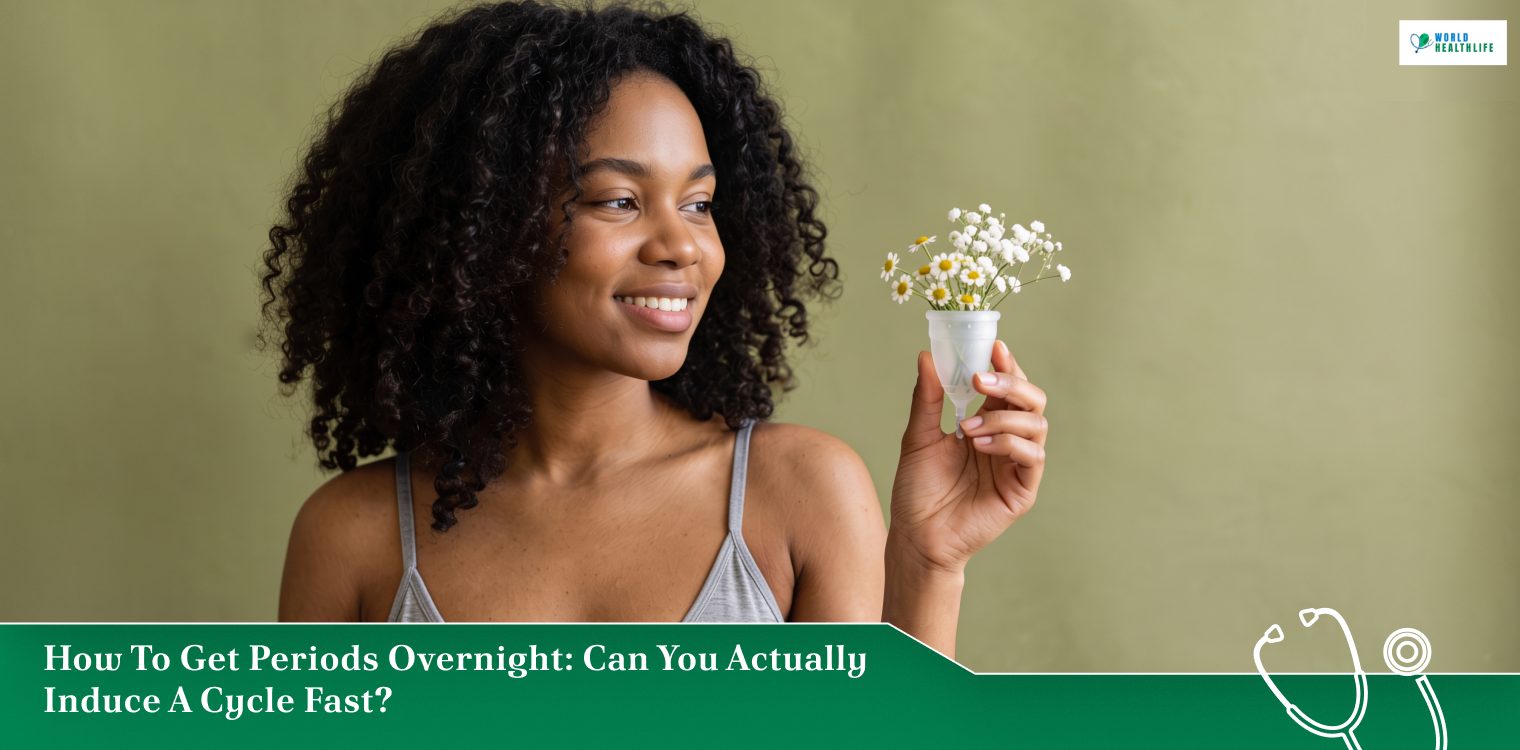
If you are frantically typing “how to get periods overnight” into your search bar, you are definitely not alone.
You may be dealing with the anxiety of an unexpected delay or trying to clear your schedule before a major vacation. In this case, a late cycle can be incredibly stressful.
Menstrual irregularities affect millions of women worldwide. However, the internet is flooded with overnight fixes that simply do not work.
The human endocrine system runs on its own precise biological clock, meaning you cannot force endometrial shedding to happen in a matter of hours.
If your cycle is running late, there are proven, safe, and medically sound ways to get your menstrual health back on track.
So, this guide cuts through the online myths to explore what actually works.
It will further delve into why your period might be delayed, and when it is time to skip the home remedies and consult a healthcare provider.
Can You Actually Get Your Period Overnight?

Before exploring how to safely nudge a delayed cycle, we need to answer a critical baseline question: Can you actually get your period overnight?
The short, medically accurate answer is no.
There is no home remedy, lifestyle hack, or clinical treatment that can safely trigger endometrial shedding in an hour or a single night.
Your body operates on a strict, hormonal biological clock governed by complex feedback loops between your brain and ovaries.
No matter how pressing your upcoming schedule is, you cannot instantly override this system.
Most people searching for an immediate fix are trying to plan around a major event.
Whether you are packing for a beach vacation, preparing for a wedding, or managing the anxiety of a late cycle, a poorly timed period can disrupt your plans.
An overnight miracle is biologically impossible.
However, you can safely speed up the arrival of a delayed period or regulate an unpredictable cycle.
Understanding how your hormones control this timeline is the key to identifying what actually works.
The Non-Negotiable First Step: Ruling Out Pregnancy
Before exploring any lifestyle changes, herbal supplements, or home remedies to induce a delayed cycle, there is an absolute medical rule you must follow.
That is, take a home urine pregnancy test.
If an underlying pregnancy is the reason your cycle has stalled, attempting to force bleeding can be dangerous.
For instance, high-dose botanical emmenagogues, intense exercise, or supplements can be highly dangerous to both your body and the developing embryo.
Rule out pregnancy first to ensure whatever steps you take next are clinically safe.
Answering The Popular Question, “How To Get Periods Overnight?”

As I have already mentioned, it is not possible to get your periods overnight naturally no matter how much you truly do. So, if you are searching for the answers to “how to get periods immediately in one hour” or “how to get periods in a day,” you will be getting answers that are related to getting your periods fast.
While most women have no problems related to their natural bleeding cycles, a lot of women, especially the ones who are anemic or who have Polycystic Ovarian Disorder will find it extremely difficult to have a natural cycle.
Women with PCOS not only have trouble maintaining their dates, but they also find it difficult to plan any event as they are never quite sure when their D-Day will begin!
But hey, that is why I am here to help!
Keep scrolling down to know how to get your periods fast…
How Can You Induce Periods?
If you have been searching for the best and safest ways of inducing periods, you have reached the right place.
There are a number of ways in which you can get your periods faster. You can do that by changing your lifestyle, eating healthy, and adding supplements to your diet.
Here are the best ways in which you can get your periods faster by inducing them.
Direct Scannable Period-Induction Matrix
To understand how different methods evaluate against each other, review this structured comparison table:
| Induction Method | Mechanism of Action | Realistic Clinical Timeline | Primary Medical Risk |
| Heat Therapy(Warm Baths/Pads) | Dilates pelvic blood vessels; physically relaxes uterine wall muscles. | May offer support within a few days if a period is already imminent. | None (Harmless physical comfort). |
| Dietary Emmenagogues(Papaya/Ginger) | Traditional herbs used to support pelvic circulation and nudge estrogen. | Variable; can take a week or longer to notice subtle biological adjustments. | Gastric irritation if consumed in extreme, concentrated amounts. |
| Clinical Progesterone Pills | Artificially elevates progestin levels, then triggers bleeding via drug cessation. | Typically causes a withdrawal bleed within 2 to 14 days after finishing the course. | Requires a direct prescription; can cause headaches or mood fluctuations. |
1. Lifestyle Changes

There are several exercises and lifestyle changes that you can incorporate in your day-to-day life in order to ensure that you are able to get your periods faster. The idea is simple— what you need to do is take care of your mental health. Making sure that you are not feeling stressed is one of the best ways to get your periods early.
You can take a warm or hot water bath or even try a warm compress, for example, to relax the cervical muscles. This will, in turn, help to stimulate the flow of blood in your uterus and thereby make it possible to get your flow before time. Having regular sex can also help you to regulate blood flow.
2. Food

Eating certain foods is one of the best ways to get your period faster.
If you are looking to speed up your cycle using nutrition, many online articles suggest specific dietary changes. These sources often claim that eating foods like papaya, parsley, and ginger can help prepone your period dates.
There are several other items that you can incorporate into your diet in order to prepone or induce your period. These include fennel seeds, pineapple, and cumin. These ingredients contain some enzymes that help to regulate your blood flow and manage the hormones, making your uterine walls contract.
The Truth About Vitamin C And Uterine Contractions
High-dose Vitamin C (ascorbic acid) is a popular internet recommendation for preponing a cycle.
Anecdotal theories suggest it safely increases estrogen while dropping progesterone to encourage bleeding.
However, there is no scientific evidence proving Vitamin C triggers uterine contractions or forces a period to arrive early.
Eating Vitamin C-rich foods like citrus fruits or bell peppers is excellent for overall immune health.
Conversely, consuming massive supplemental doses can cause the following without altering your period timeline:
- acute digestive distress
- severe stomach cramping
- diarrhea
But Why Is There A Delay?

Now that you know the answer to “how to get periods overnight,” it is time for you to know why there might be a delay in your natural cycle.
There are a number of reasons why periods are irregular. Some of the most common reasons for delays in periods are as follows:
- Health Issues
- Stress
- PCOD/PCOS
- Lifestyle
- Weight fluctuations and changes
- Birth Control Pills
- Menopause
- Pregnancy.
Before trying to induce periods, it is best to consult your gynecologist to know why there is a delay if you are facing one.
Respecting Your Body’s Biological Clock
Searching for how to get periods overnight is a common response to an unexpected delay or an upcoming vacation.
However, the human endocrine system simply cannot be forced to bleed instantly.
Natural strategies like lowering your cortisol levels through stress relief, utilizing soothing heat compresses, and eating nutrient-dense foods can gently encourage an on-the-way cycle to drop slightly sooner.
If your period is missing for more than three consecutive cycles, or are dealing with chronic conditions like PCOS, home remedies are a temporary band-aid.
Skip the unverified internet hacks. Moreover, schedule a comprehensive evaluation with your gynecologist.
Finally, work together to identify and treat the underlying hormonal root cause safely.
Disclaimer: The information provided in this article is for general informational purposes only. It does not, and is not intended to, constitute medical or health advice. Please consult a qualified healthcare professional for medical guidance or expert health assistance.
Read Also: