A lot of people use values vs morals as if they mean the same thing. Although they might feel close enough, actually, they are not.
For instance, someone might say, “I value honesty!” Meanwhile, someone else might say, “I think honesty is morally right.” In both cases, most people would nod and move on. That is fair, of course! However, the more the idea sits in the mind, the wider the gap gets.
The gap widens when someone chooses a partner or reacts when a friend lies. It also comes up as the weird guilt that follows doing something that seemed practical at the time. However, it might not be right later. That’s where this topic starts getting real.
That is why the terms “values” and “morals” are worth learning about. This is because relationships and the sense of self shape choices. Minsan, they even shape the kind of stress a person carries without realizing it.
Values vs Morals: What They Really Are?
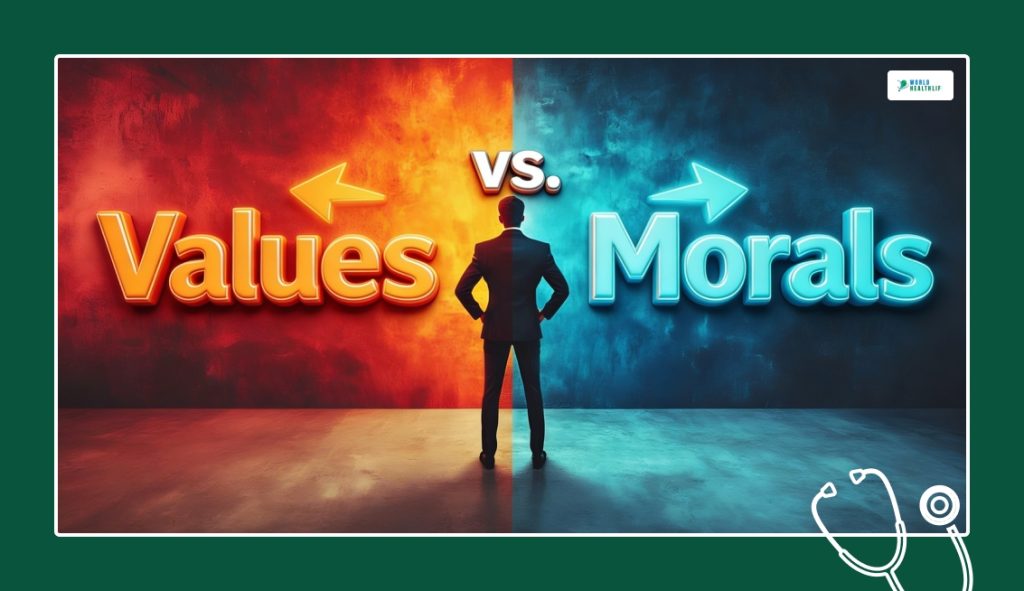
Primarily, values are the things a person sees as important. They are priorities. In fact, these are qualities or ideas that matter and pull life in a certain direction.
For instance, someone might value freedom, stability, kindness, ambition, family, privacy, or creativity. It is like saying, “This matters to me.”
Meanwhile, morals are more about right and wrong. Essentially, they are the standards people use, or inherit. This way, they judge behavior. In fact, morals say out, “This is acceptable,” or, “No, this crosses a line.”
In general, morals tend to feel heavier and loaded. They are more tied to conscience, culture, religion, or upbringing.
However, in everyday life, these things overlap a lot. In fact, if a person values honesty, they may also believe that lying is morally wrong. Basically, if someone values loyalty, there may be a moral duty to stand by people.
So yes, they connect. Parang magkadikit sila, but they’re not identical.
What Values Usually Sound Like
Values mostly show up in the language of preference, purpose, and personal direction. In fact, a person might say they value peace, independence, discipline, or compassion. Essentially, these are the things that shape:
- How they want to live
- What they chase
- What they protect when life gets noisy.
Interestingly, values are not always “good” in a moral sense. For instance, someone might value status more than honesty. Also, someone might value winning more than fairness.
That doesn’t mean they are evil. Rather, it merely means values tell you what matters to a person. It does not tell automatically whether that thing is ethically sound.
What Morals Usually Sound Like
Morals sound firmer and a little less negotiable. They often come with inner approval or inner resistance. It is like:
- Don’t steal
- Don’t betray
- Help people when you can
- Don’t exploit someone weaker than you.
These ideas feel less like preference and more like judgment. That’s why moral conflict tends to sting more.
If a person goes against a value, there may be disappointment. However, if a person goes against a moral belief, there may be shame, defensiveness, or deep unease. Medyo mabigat siya in a way, values alone sometimes aren’t.
Values vs Morals: Major Differences
| Aspect | Values | Morals |
|---|---|---|
| Core Meaning | What matters to you | What you believe is right or wrong |
| Main Focus | Priorities and direction | Conduct and judgment |
| Source | Personal experience, goals, identity | Family, culture, religion, society, conscience |
| Flexibility | Can shift with age and experience | Can shift too, but often more slowly |
| Common Example | “I value independence.” | “It’s wrong to manipulate people.” |
| Emotional Effect | Fulfillment or frustration | Peace, guilt, pride, shame |
That table helps, but real life is more complex than tables. Also, people don’t walk around saying, “Excuse me, that was my value speaking, not my moral code.” They just react and try to explain themselves afterward.
How Beliefs Sit Underneath Both
Of course, before values and morals, there are beliefs. In fact, beliefs are the ideas people hold to be true about themselves and the world.
For instance, if someone believes people are mostly selfish, values and morals may become more guarded. However, if someone believes people can grow, there may be more forgiveness. Meanwhile, if someone believes success is everything, that belief quietly rearranges the rest of the inner world.
That is why two people might both say they value honesty and still behave completely differently. In this case, one might believe truth builds trust. Meanwhile, another might believe truth is useful only when it protects them.
Therefore, the same word has a different foundation. Ganun talaga minsan. Here, language sounds shared, but the inner wiring isn’t.
Apart from that, some beliefs are chosen, while some are inherited. These include:
- Family habits
- Religious messaging
- Social pressure
- School culture
- Heartbreak
- Praise
- Humiliation.
All of it leaves fingerprints. Then one day, a person thinks, “This is just who I am,” when really it may be partly, “This is what I absorbed.”
When Values and Morals Work Together
When values and morals line up, life feels cleaner. For instance, someone who values kindness and also believes it’s wrong to humiliate people. That alignment makes behavior more natural.
Also, there is no need to force decency in public and cruelty in private. There’s no splitting into versions of the self depending on who’s watching.
That kind of alignment often creates steadiness. In this case, a person trusts themselves more. Meanwhile, other people usually trust that person more, too. The choices may still be hard, but they make sense internally. There’s less static in the head.
When Values and Morals Clash
In many cases, a clash between values and morals can leave a person feeling torn. For instance, they might value honesty. However, telling the truth might wreck a relationship.
Also, they might value ambition. However, the only way to get ahead in a certain system seems morally questionable. They value peace, but staying silent lets something unfair continue.
There isn’t always a clean answer. In fact, that is what makes this topic so human. It is not confusing because people are careless.
Rather, it gets confusing because life is rarely tidy. Moreover, decisions get made in context, while people improvise. They justify, regret, and learn a little late.
| Situation | Value Involved | Moral Tension |
|---|---|---|
| Keeping a friend’s secret | Loyalty | The secret may harm someone else |
| Taking a better-paying job | Security and ambition | The company’s practices may feel wrong |
| Avoiding a difficult truth | Peace and harmony | Dishonesty may damage trust |
| Cutting off a relative | Self-respect and safety | Guilt over family duty may linger |
If someone has ever done something practical that still felt wrong afterward, this experience is already familiar. Gets mo? The brain says one thing made sense. Meanwhile, the conscience keeps muttering in the background.
What Matters for Mental and Emotional Well-Being
In general, people talk about stress as if it only comes from workload, money, or relationships. However, inner conflict is a stress as well. But it is quieter, more private, and still draining.
When values and morals keep colliding, a person can end up feeling guilty without clarity, resentful without language, or stuck without knowing why. That’s not a weakness. Rather, it is usually a signal. It is something in the inner framework that needs attention.
Sometimes the answer is not to become more rigid. Rather, it is to become more honest. It is about asking, “What do I actually believe?” “What did I inherit?” or even “What am I pretending to care about because it makes me look good?”
Although those are uncomfortable questions, they are quite useful at the outset.
How to Figure Out Your Own Values and Morals
A dramatic identity crisis isn’t required for this. A quiet check-in is enough. Though, to be fair, life tends to force the conversation eventually.
Hence, a good place to start is noticing where the strongest emotional reactions show up. Essentially, anger points to a violated value. Meanwhile, guilt might point to a moral conflict.
Also, envy can reveal a value that hasn’t yet been admitted. Moreover, repeated frustration usually means a person is out of sync with something important.
In this case, find answers to the following:
- Traits that you respect most in other people
- Behavior that you judge most strongly
- Things that you keep sacrificing for (Even when no one asks you to)
- Choices that keep bothering you days later
Those answers won’t give a perfect map. However, they will give clues. These are enough to begin with.
It Helps to Separate Inherited Rules from Chosen Principles
This one matters a lot. Some morals come from home, school, religion, or the social environment in which a person grew up. However, the real question is whether those beliefs still feel true now or are being followed on autopilot.
That doesn’t mean rejecting everything inherited from the past. In fact, some inherited wisdom is solid. Meanwhile, some of it protects people. At the same time, some of it gives life structure and meaning. Some of it may just be fear dressed as virtue.
That’s worth noticing, kahit medyo uncomfortable.
Finding a More Honest Way to Live
So, values vs morals is not really a battle. Rather, it is more like an internal conversation. Values tell a person what matters. Actually, morals tell them what feels right or wrong. Meanwhile, beliefs sit underneath both, quietly shaping the whole thing.
Hence, the goal isn’t to become morally superior or perfectly consistent. Rather, the goal is to understand the inner logic well enough that choices no longer feel random. What helps is less self-betrayal. Less borrowed language. Less confusion that keeps repeating under different names.
When values are clear, life has more direction. Also, when morals are examined, life has more integrity. Moreover, when the two finally start speaking to each other clearly, life gets a little less noisy.
Frequently Asked Questions (FAQs)
While values are personal priorities, morals are standards of right and wrong. Moreover, values guide what matters to you, while morals guide what feels acceptable.
Of course. The following aspects lead to the change of values and morals in people:
• Life experience
• Maturity
• Loss
• Faith
• Culture
• Reflection.
Not necessarily. Both morals and values serve different purposes. Primarily, morals guide ethical judgment, while values shape priorities, goals, and the life you want to build.
Yes. A person might value success or loyalty. Still, they might make choices that ignore fairness, honesty, or responsibility.
Since values and morals overlap in daily life, both of them shape behavior. Also, they influence choices and are often learned through the same experiences.