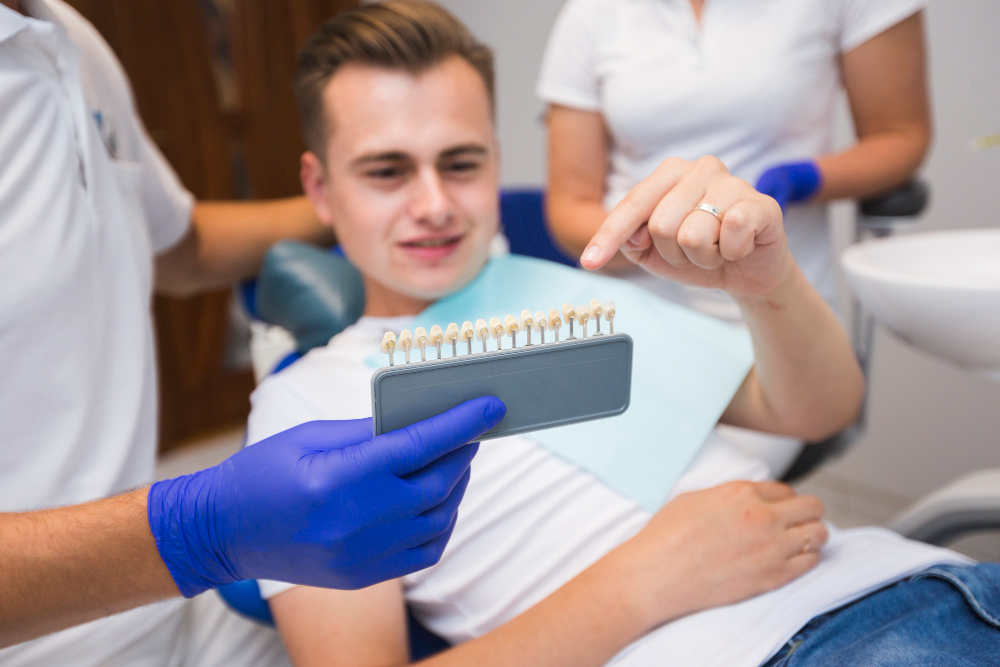
If you’re researching cosmetic dental work abroad, you’ve probably noticed that clinics often mention “veneers” and “crowns” as if they are exactly the same thing.
But in reality, they are not. They differ in final output, longevity, and prices.
That said, choosing the wrong treatment will not just affect the final result you want, but also pay for something your smile doesn’t need.
This matters even more when you’re planning treatment in Turkey.
Package pricing and “Hollywood Smile” deals often bundle both terms together, making it harder to know what the clinic is actually quoting you for.
So, before you compare Veneers vs Crowns in Turkey: the price or book a flight, you must understand what genuinely separates veneers from crowns, and how that difference plays out specifically for international patients traveling to Turkey for dental work.
Let’s Find Out Veneers Vs Crowns In Turkey
Let’s keep a slow pace before we rush to decide which option is best for your oral health.
What Are Veneers?
A veneer is an ultra-thin shell, custom-made to cover the front surface of a tooth. It is made of porcelain or composite resin.
We typically use veneers as a cosmetic solution to correct:
- Discoloration that doesn’t respond to whitening
- Minor chips or cracks
- Gaps between teeth
- Slightly uneven or misshapen teeth
Because veneers only cover the front surface, your underlying tooth needs to be reasonably healthy. They are not designed to fix structural or functional problems.
What Are Dental Crowns?
A crown is a full cap that covers the entire tooth, from the gumline up. Unlike a veneer, it wraps around every surface, not just the front.
We recommend a crown when the tooth itself is compromises your oral health, for example:
- After a root canal
- To protect a tooth that’s cracked or severely worn down
- To restore a tooth with a large filling fails
- As the visible part of a dental implant or bridge
That said, veneers primarily improve the appearance of healthy teeth, whereas crowns restore strength and function to a damaged tooth.
5 Key Differences Between Veneers Vs Crowns In Turkey
So now, before you decide between the two options to improve your smile, let us go through the 5 biggest differences that matter most for your treatment journey.
1. How Much of the Tooth Is Removed
Before you jump in, see how many of your teeth need fixing.
- Veneers require minimal enamel removal, sometimes less than a millimeter, just enough for the shell to bond properly.
- Crowns require shaping the entire tooth down to a smaller core, since the crown needs to fit over it like a cap.
This difference matters for long-term tooth health. Veneer preparation is far less invasive, which is one reason dentists try to use veneers when your dental health allows.
2. The Real Cost Difference
In Turkey, prices vary depending on the material and the clinic, but the general breakdown internationally tends to hold:
| Treatment | Typical Price Range (per tooth) |
| Composite veneers | Lower cost, shorter lifespan |
| Porcelain/zirconium veneers | Mid-to-higher cost, longer lifespan |
| Porcelain crowns | General price similarly to or above premium veneers |
| Zirconium crowns | Higher cost, very durable |
While the price gap between veneers and crowns isn’t huge on a per-tooth basis, it adds up fast in a full-mouth case.
A “Hollywood Smile” package built on 16-20 veneers will cost differently than the same package built on crowns, even if the visual result looks similar in before-and-after photos.
This is exactly why we always recommend comparing treatment plans instead of prices alone.
Two clinics can show very different prices for a similar-looking smile, simply because one is proposing veneers and the other crowns for your specific case.
3. Recovery Time And Sensitivity
You are now probably wondering how long it takes to recover and how fast you can fly back to your home with this new smile.
- Veneers generally involve a shorter, more comfortable recovery. Because dentist alters the tooth, sensitivity tends to be mild and short-lived.
- Crowns involve more tooth reduction, so it’s common to experience temporary sensitivity to hot, cold, or pressure for one to two weeks after the procedure.
If you need a root canal beforehand, recovery time will be longer.
If you are traveling to Turkey, this also affects how long you might have to stay there before flying back home with a beautiful smile.
You must give yourself enough time for a follow-up appointment for the extra peace of mind, especially after crown procedures.
4. Longevity And Maintenance
If you’re investing in your smile, it is completely natural for you to be curious about how long the results will last.
Fortunately, veneers vs crowns are designed to last for years if you promise to take good dental care.
- In most cases, porcelain veneers last from 10 to 15 years. But only with proper care. On the other hand, composite veneers have a shorter lifespan, often 5 – 7 years. After that, they need replacement or touch-ups.
- Crowns, especially zirconium, tend to last longer, sometimes 15 – 20 years, because they protect the entire tooth rather than just the front surface.
One thing for you to keep in mind, neither option is permanent.
Both will eventually need replacement, and that’s worth asking about before treatment, especially if you’re planning to return to your home country afterward.
5. Reversibility
Surprisingly, this is one of the least discussed differences, yet it is probably the most important.
- Veneer preparation, when minimal, can sometimes be considered semi-reversible in certain cases.
- Crown preparation is not. Once a tooth is shaped down for a crown, it will always need a crown or equivalent restoration going forward.
This is a key reason why we recommend that a proper diagnosis matters more than what is advertised in their similar result looking package.
If your tooth doesn’t structurally require a crown, getting one anyway is an irreversible decision made purely for cosmetic reasons.
Why This Distinction Matters More When You’re Treating Abroad
When you are planning dental treatment from another country, the before-and-after photos can easily get you carried away.
But photos alone don’t tell a story.
Photos that you see: those two different photos might be treated very differently based on their tooth structure, decay, or other dental work.
That is exactly why we recommend getting you a proper diagnosis as your priority before you show your teeth to the dentist without his study.
According to Turquie Santé, an international patient support platform, a proper treatment plan in Turkey should always start with photos, dental X-rays, and, ideally, a video consultation with a dentist before they confirm a final price or technique, not after you arrive in the country.
Additionally, this step protects you from unexpected financial stress.
A quote based on a real diagnosis is far less likely to change once you’re already sitting in the clinic chair, which is one of the more common complaints among patients who book treatment abroad without an initial assessment.
Which One Do You Actually Need?
We hope that we covered almost everything you needed to know about Veneers vs Crowns in Turkey.
| Here is the final takeaway. In most cosmetic-only cases (whitening that didn’t work, minor chips, slight gaps), veneers are usually the more conservative and appropriate choice. For a damaged, weakened, or previously treated tooth, a crown is often medically necessary, regardless of how the final result looks. |
You must pay extra attention to the clinic that offers you the same solution for every case, regardless of your actual dental condition.