
Today’s topic: Why does a dilemma make your decision-making more complex?
We have all been in situations like this. Standing at a crossroads. Not literally, but in our minds. At that moment, we are completely stuck. Not able to make a decision.
You keep evaluating which option is better. You may lose sleep over it, but you still can’t reach a conclusion.
If you also face situations like this in your daily life, you must read this article till the end. The most triggering question for me while writing was why does a dilemma make your decision-making more complex?
I realized that the dilemma forces your brain to overwork. As a result, your emotions and values work together simultaneously. But they can’t come to a consensus.
This is an important condition that we all need to know about. Most importantly, any of us may face a dilemma at any time. While we can’t avoid it, we can certainly break free from it.
In the same vein, we need to know whether there are available treatment plans or therapeutic procedures for managing frequent dilemmas.
What Is A Dilemma?
A dilemma is when you are not able to make a decision. It can be a simple or a tough one. Irrespective of that, there are multiple options in your head.
But none of them makes complete sense to you. What’s worse, you cannot discard any of the options, either.
The Classic Medical Example
Imagine a patient, Priya. For her, the dilemma is a chronic condition. Now, medication is really important for her.
Meanwhile, the doctor gave her two treatment plans. The first one controls all symptoms. However, it also comes with chronic side effects.
Secondly, the doctor suggests an overhaul of the patient’s lifestyle. It is a more difficult and gradual process.
However, it is also sustainable and has no side effects. Now she can’t decide which one to follow. What’s going on in her head:
- Abandoning one means missing out on its benefits
- Can I try both simultaneously?
- What if the one I choose does not yield results?
These are not all. But most of the people with chronic dilemmas face such simple dead ends. However, it is their chronic condition that prevents them from making a simple choice.
Wait. Did what Priya faced make more sense to you? Were you also mentally stuck imagining her scenario?
There is a high chance that you have a dilemma to some extent! Don’t need to be scared. But it is always better to consult a medical expert!
What Are The Real Troubles That You Face While In A Dilemma?
- You are stuck between values that collide (comfort vs. long-term health)
- You need to evaluate uncertain outcomes. Above all, you cannot know the future.
- For you, every option has a real downside
- You feel a sense of personal responsibility that makes every step feel heavy
Why Does A Dilemma Make Your Decision-Making More Complex?
This is where it gets genuinely fascinating. Again, this is where health comes directly into the picture.
When you face a routine decision, your brain uses shortcuts called heuristics.
To clarify, heuristics are mental patterns built from experience. They let you decide quickly and move on. But when you face a dilemma, those shortcuts stop working.
The brain has no reliable template for the situation. As a result, it shifts into a much more effortful mode of processing.
Practical vs Moral Dilemmas In Health: Why Does A Dilemma Make Your Decision-Making More Complex?
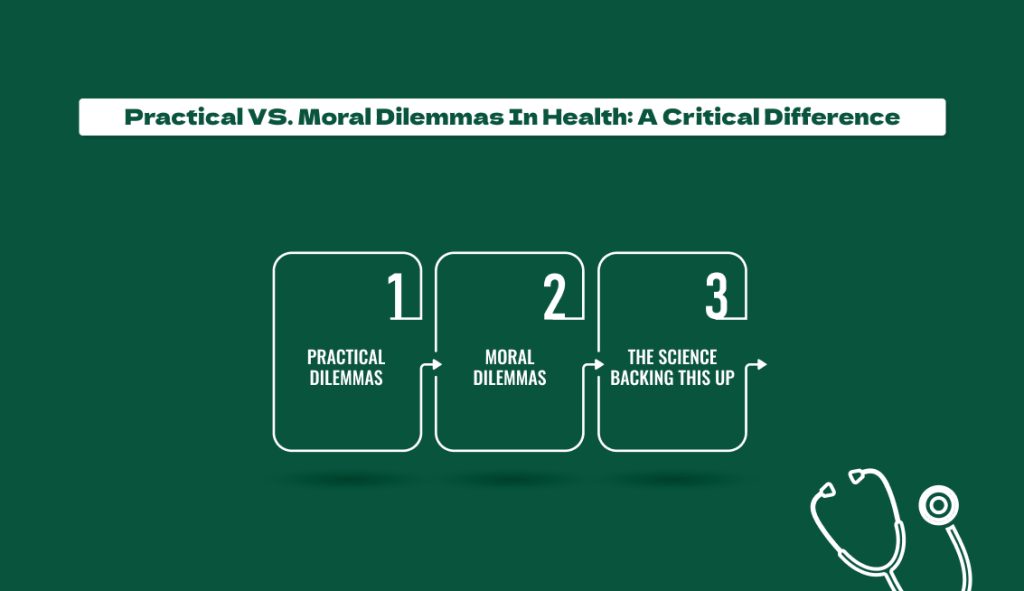
Not all health-related dilemmas are the same kind. It helps enormously to know which type you are facing.
Practical Dilemmas
These involve logistics, resources, and time. They feel difficult but are ultimately solvable with the right information.
Example: Imagine choosing between two hospitals for a procedure. One closer to home but with a slightly lower rating. Again, another farther, but highly specialized.
This is a practical dilemma. Research, consultations, and logistics can help you arrive at a clearer answer.
Moral Dilemmas
These go deeper. They involve ethics, values, the well-being of others, and sometimes irreversible outcomes.
Example: A caregiver deciding whether to push for aggressive treatment for an elderly parent, knowing the parent had once expressed they would not want that, but fearing losing them. There is no clean answer here. Both choices involve sacrifice.
Moral Dilemmas Feel Harder Because:
- Outcomes may be permanent and cannot be undone
- The harm of a wrong choice is not just personal. It touches others also.
- Responsibility cannot be handed off or shared
What Loss Aversion Looks Like In Health Decisions:
- Delaying a difficult conversation with a specialist
- Staying on a treatment plan out of familiarity, not effectiveness
- Avoiding lifestyle changes because they represent giving up something you enjoy
- Handing the decision to someone else to relieve the pressure
Avoidance feels safer in the moment. But avoidance is never neutral. Every day of delay is itself a decision with consequences.
The Science Backing This Up
The research in this space is both robust and deeply relevant to everyday health decisions.
Studies in behavioral science consistently find that people delay decisions significantly longer when outcomes affect others, not just themselves. When a choice touches your family, your care team, or your community, the brain puts up additional hurdles.
The fear of being responsible for harm to another person is one of the most potent brakes on decision-making we know of.
Neuroscience studies using brain imaging have confirmed that emotional processing spikes sharply during uncertainty.
Brain regions associated with stress and threat detection become highly active not just in emergencies, but in any situation where the future is unclear. Including medical and personal health decisions.
Research in cognitive psychology also shows that decision fatigue is dramatically worse when choices carry moral weight. Once you add values, responsibility, and others’ well-being to an equation, the brain drains much faster than it does for simple choices.
This is why you may feel exhausted after a difficult medical consultation. But not because it was physically tiring. However, it demanded everything of your mind at once.
How To Think Clearly When You Are Caught In A Dilemma
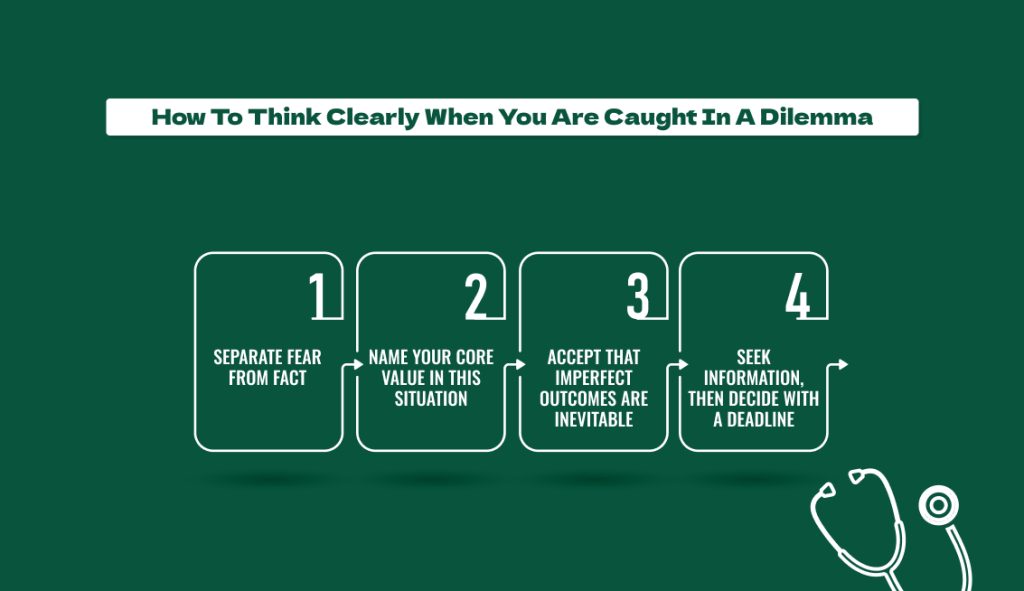
Now you can answer the question: why does a dilemma make your decision-making more complex? Knowing this is really important.
Above all, it will help you to gain more clarity on your situation. Here we will share some strategies that really work for most people in this kind of situation.
Step 1: Separate Fear From Fact
Do not let fear take control of the situation. I know it is common for people facing a dilemma to feel paralyzed by fear. But here is something easy that you can still do in such a situation.
Either think it through or write down what you fear will happen. After that, analyze whether that is a logical thing to happen, given the current circumstances. If you practice this, you will definitely feel much clearer in your head.
Step 2: Name Your Core Value In This Situation
You cannot achieve everything in one go. Makes sense? Now you have to make yourself understand that, when you are making a decision.
In Priya’s case, she has to think about what she needs the most. If she values long-term health, then therapy is her best option. But if she is up for quick relief, she can stick to medicine.
Step 3: Accept That Imperfect Outcomes Are Inevitable
Try to accept the outcome of your actions naturally. In simple words, just accept your fate and move on. If needed, work better and gradually change your fate.
Once you do that, you will find yourself less confused about which decision is right now! Otherwise, you will be making a single decision for the rest of your life.
Step 4: Seek Information, Then Decide With A Deadline
A lot of us don’t do fact-checking. If you can’t make a decision, talk to people who know better.
If not, read from journals, white papers, and more. Most importantly, set a timeline for making the decision.
| Aspect of Dilemma | What It Means for You | What Helps |
|---|---|---|
| Cognitive overload | The brain works harder under uncertainty | Break the decision into smaller parts |
| Emotional heaviness | Caring deeply makes choices feel weightier | Name the emotion; don’t let it drive alone |
| Loss aversion | Fear of losing what you have delays action | Focus on what you gain, not just what you risk |
| Moral complexity | Values conflict with each other | Identify which value takes priority right now |
| Decision fatigue | Mental energy depletes faster with weight | Decide in the morning; limit the decision window |
| Responsibility pressure | Stakes affect others, not just you | Consult trusted people; don’t carry it alone |
Frequently Asked Questions (FAQs)
Certainly not. In other words, you feel paralyzed when the brain is thinking too much. But it can be a serious issue if the situation persists. Again, if it is impacting your daily work, you need to seek medical attention.
Even with all the information, I still experience value-based conflicts. Simply put, a doctor also faces a dilemma while suggesting a treatment plan.
Yes, in the long run. When you face a dilemma, and your brain makes a calculation, you build up strong resilience. In other words, you have the capacity to deal with any kind of uncertainty.
Do you feel serious anxiety when a dilemma hits you? Is it impacting your personal life, daily life outcomes, and quality of life? That’s enough of a hint to go see a medical practitioner.
| Disclaimer: This article is for informational and educational purposes only and does not substitute for professional medical advice. Reading this content does not create a doctor-patient relationship. Always consult a qualified healthcare provider for medical concerns and never delay seeking professional advice based on what you read here. |