

When it comes to having gallbladder surgery, the procedure itself is actually shorter than most people’s commute to the hospital.
Yet, of course, there is always a question. How long does gallbladder surgery take? This is a question that actually has more than one honest answer.
The thing is that due to there being an operation, there is the day you spend at the hospital.
Following that is the recovery that follows.
For a routine laparoscopic procedure, the surgeon is usually working for about 45 minutes to an hour and a half. The rest of the day is spent on preparation, anesthesia, and waking up.
Thus, this guide will break down each stage and explain what can make the operation run longer.
Finally, it will set out what the weeks afterward look like.
How Long Does Gallbladder Surgery Take? The Short Answer
Medically, gallbladder removals are termed cholecystectomies, where most of them are done laparoscopically. That is, through a few small cuts in the abdomen.
This is the faster and gentler route. Also, it is what surgeons choose whenever it is safe.
Moreover, open surgery, with one large incision, takes longer and is used less often.
The table below compares the main approaches.
| Type of Surgery | Typical Operating Time | Typical Hospital Stay |
| Laparoscopic (standard) | 45 to 90 minutes | Same day or one night |
| Robotic-assisted laparoscopic | 60 to 120 minutes | Same day or one night |
| Single-incision laparoscopic | 60 to 100 minutes | Same day or one night |
| Open cholecystectomy | 1 to 2 hours | 2 to 4 days |
| Laparoscopic converted to open | 1.5 to 3 hours | 2 to 4 days |
Why The Range Is So Wide
Always understand one thing. No two gallbladders are identical, so it is inevitable that you and another person will obviously have different anatomies.
A healthy gallbladder is something where the surgery is smoother. Generally, it lifts away cleanly and can come out in under 45 minutes in experienced hands.
A swollen, scarred, or fat-buried gallbladder takes far more care.
The reason behind this that the surgeon must identify the bile duct and blood supply before cutting anything.
Therefore, if time is taken, it is sort of a safety feature instead of a delay.
What “Operating Time” Does And Does Not Include
Quoted times usually cover the period from the first incision to the last stitch. They leave out the anesthesia, which takes about 15 to 30 minutes at the start.
Moreover, the waking-up period afterward. So a one-hour operation often means two hours or more in the operating suite from start to finish.
Your Day At The Hospital, Hour By Hour
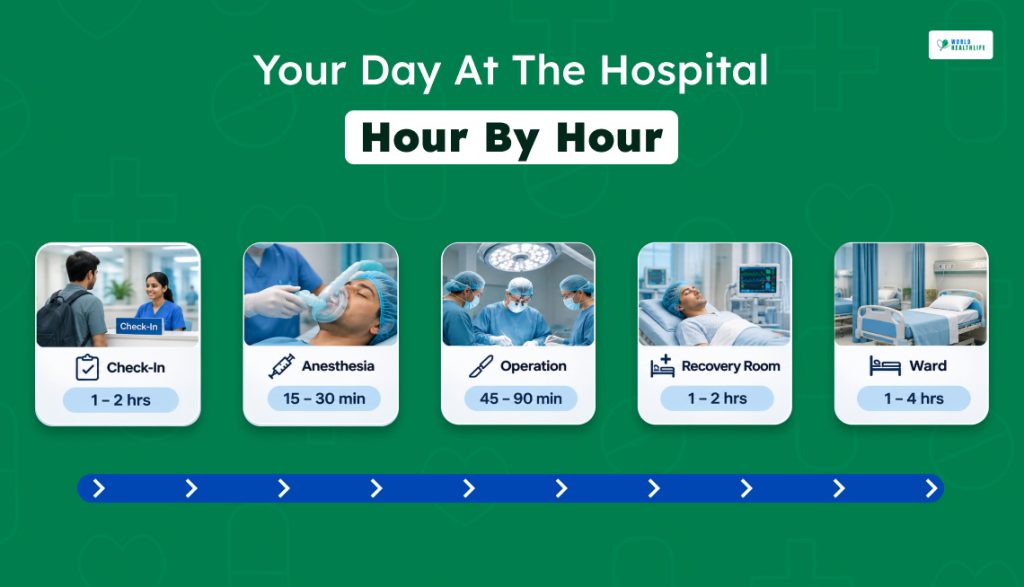
Since the surgery is only one part of the day, it helps to see the whole timeline. For a planned laparoscopic operation, most people are in the hospital for four to eight hours in total.
In fact, most people go home that evening.
The sequence below shows where the time goes.
| Stage | What happens | Approximate time |
| Check-in and preparation | Paperwork, vitals, IV line, questions from the surgeon and anesthesiologist | 1 to 2 hours |
| Anesthesia | General anesthesia is given; you are asleep before surgery begins | 15 to 30 minutes |
| The operation | The gallbladder is removed through small incisions | 45 to 90 minutes |
| Recovery room | Waking up, monitoring, pain and nausea control | 1 to 2 hours |
| Short stay on the ward | Drinking, eating, walking, and passing urine before discharge | 1 to 4 hours |
Before The Operation
Expect to stop eating several hours beforehand. That is usually after midnight.
Also, try to avoid certain medicines such as blood thinners if your surgeon says so.
The team will confirm your identity, the procedure, and your allergies, and mark the plan on your chart.
This stretch is where most waiting happens, so arriving on time matters more than arriving early.
How Long Does Gallbladder Surgery Take From Start To Finish In The Operating Room?
Once you are wheeled in, the anesthesiologist puts you to sleep, and the team positions you and cleans the abdomen.
Here is how it goes:
- The surgeon inflates the abdomen with carbon dioxide gas
- A working space is created
- A camera and instruments are inserted
- The gallbladder is freed
- The surgeon seals the duct and artery with clips.
The organ is then lifted out through the navel incision.
Altogether, the stay in the operating room is usually between 1 and 2 hours.
What Happens During The Operation
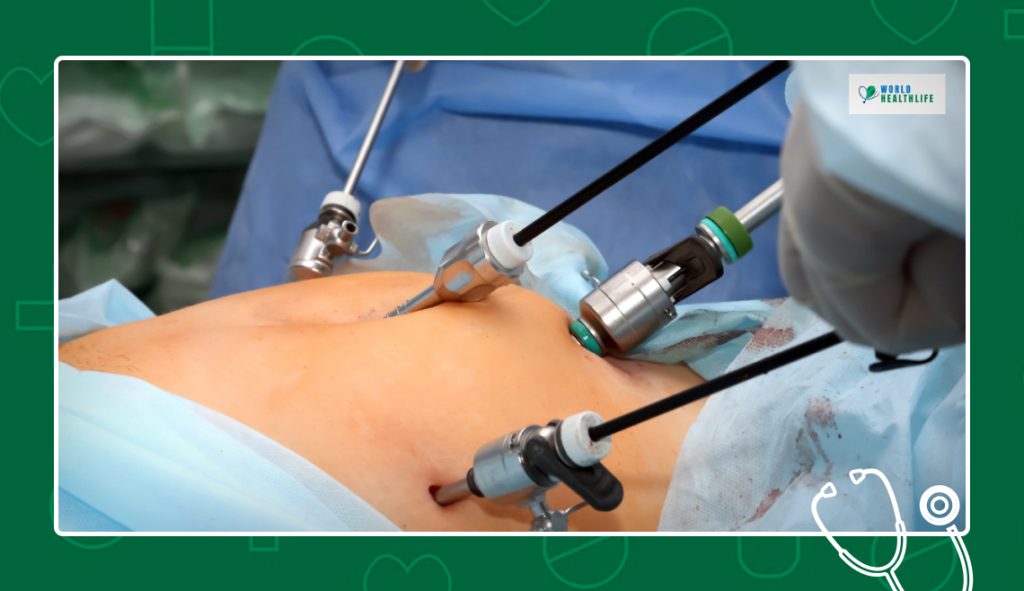
Understanding the steps explains why the surgeon cannot rush them. The goal is not speed but a clear view of the anatomy.
The bile duct is thin and sits very close to the gallbladder. Surgeons follow a standard safety routine before any cutting begins.
The Key Steps
The surgeon makes three or four small incisions, each about a half to one inch long. A camera shows the inside of the abdomen on a screen, and instruments are passed through the other openings.
The surgeon identifies the cystic duct and artery, confirms they are the correct structures, clips them, and separates the gallbladder from the liver bed.
The gallbladder is removed in a small bag, and the incisions are closed with stitches or glue.
Optional Extras That Add Time
Sometimes the surgeon wants a closer look at the bile ducts.
An imaging test during the operation, called an intraoperative cholangiogram, uses dye and X-ray to check for stones and map the ducts.
Typically, it adds 15 to 30 minutes. A drain may also be placed if there is a lot of inflammation, which adds only a few minutes.
Factors That Make Gallbladder Surgery Take Longer
A standard operation can stretch past two hours when the situation is more complicated.
None of these factors means something has gone wrong. Moreover, surgeons plan for them. The table here shows the most common ones.
| Factor | Why It Adds Time |
| Acute inflammation or infection | Swollen, fragile tissue bleeds easily and hides landmarks |
| Previous abdominal surgery | Scar tissue (adhesions) must be carefully separated |
| Higher body weight | More fat makes the view and instrument reach harder |
| Stones in the bile duct | May need extra imaging or a separate procedure |
| Unusual anatomy | Ducts or vessels may sit in unexpected places |
| Emergency surgery | Gallbladder is often more inflamed than in planned cases |
| Surgeon training setting | Teaching cases may take somewhat longer |
When A Laparoscopic Operation Becomes Open
In roughly 2 to 5 percent of cases, the surgeon switches from keyhole to open surgery partway through.
Reasons include severe inflammation, heavy scarring, bleeding, or an unclear view of the ducts.
This is a sign of careful judgment, not failure, and it prioritizes safety over the smaller scar.
Conversion lengthens the operation and the hospital stay and makes recovery slower.
Gallbladder Surgery With Bile Duct Stones
If a stone has traveled into the common bile duct, it may need to be removed separately.
The usual method is ERCP, a procedure done with an endoscope passed through the mouth. This typically takes 30 to 90 minutes.
Moreover, it may be done before, during, or after the gallbladder is removed. This is dependent on the hospital’s approach. Try to plan on a longer day if this applies to you.
Emergency Vs. Planned Surgery
Timing makes a real difference to how smooth the operation is. A planned procedure takes place when the gallbladder is calm, and you are well prepared.
An emergency operation, done during an acute attack with infection or inflammation, is harder.
Surgeons may also wait a few days or weeks for inflammation to settle before operating, when that is safe.
Here is the actual reason why a planned surgery is usually faster.
With a calm gallbladder, tissues are less swollen and easier to separate.
In addition to that, you have also had time for tests, medication review, and fasting instructions.
As a result, there are fewer surprises. Not just that, but also the operation tends to be near the low end of the time range.
However, in case the surgery is urgent, there is no need to worry.
In acute cholecystitis, which is a severely inflamed gallbladder, the condition is often treated with antibiotics first.
Following this, doctors perform surgery within a day or two.
Some patients are too unwell for early surgery, and a drainage tube is placed in the gallbladder instead until they are stronger.
Emergency operations more often involve a longer stay, sometimes two to four days.
How Long Does Recovery Take?

Surgery time is short, but healing takes longer, and the pace varies. Most people feel surprisingly well within a few days after a laparoscopic operation.
Even so, the tissue inside is still healing, so activity needs to return in stages rather than all at once.
| Time after surgery | What is typical |
| Day 0 to 1 | Drowsiness, incision soreness, shoulder pain from gas, light meals, short walks |
| Days 2 to 7 | Pain easing, gradual return to normal eating; many people stop prescription painkillers |
| 1 to 2 weeks | Return to desk work and most daily activities |
| 2 to 4 weeks | Lifting limits usually lifted; exercise resumed gradually |
| 4 to 6 weeks | Full recovery for most; open surgery patients may need this long or more |
When To Talk To Your Surgeon
So as we can see, in case you are weighing surgery, ask how your own situation changes the expected timeline.
The thing is, when you have a history of abdominal operations, higher body weight, stones in the bile duct, or a recent bout of severe inflammation, all of these can lengthen the procedure.
Thus, do one thing: Plan for the time away from work too.
The reason behind this is that the answer to how long gallbladder surgery takes depends on how long you need to recover.
Also, it is not only dependent on how long you are in the operating room.
Most people find the process easier than they feared.
Do not be afraid. The operation is brief, and you will find out that the hospital stay is manageable, and by the end of the first week, many are back to ordinary routines.
However, remember to ask your surgeon the specific questions, prepare the practical details, and give the healing the time it needs.
Disclaimer: The information provided in this article is for general informational purposes only. It does not, and is not intended to, constitute medical or health advice. Please consult a qualified healthcare professional for medical guidance or expert health assistance.
References
- Zackria, R., & Lopez, R. A. (2023, August 28). Postcholecystectomy syndrome. StatPearls – NCBI Bookshelf.
- Asad, U., Wang, C. F., & Jones, M. W. (2025). Laparoscopic cholecystectomy. PubMed.
- Jones, M. W., Guay, E., & Deppen, J. G. (2023). Open cholecystectomy. StatPearls – NCBI Bookshelf.
- Dewana, A. M., Namq, A. J., Ahmed, B. S., & Baban, A. A. (2025). Optimal timing for cholecystectomy: unveiling insights from a decade-long study on acute cholecystitis and symptomatic cholecystolithiasis. BMC Surgery, 25(1), 199. PubMed Central.


