
During a sudden cardiac arrest emergency, the difference between survival and clinical mortality relies entirely on the immediate delivery of high-quality cardiopulmonary resuscitation (CPR).
Human instincts and manual training provide the baseline foundation for emergency care. However, executing consistent chest compressions under extreme psychological stress is remarkably difficult.
Human fatigue, panic, and a lack of real-time visibility frequently cause rescuer techniques to degrade within the first two minutes of an active rescue attempt.
To eliminate this critical margin of human error, modern emergency medicine utilizes automated, sensor-driven monitoring systems.
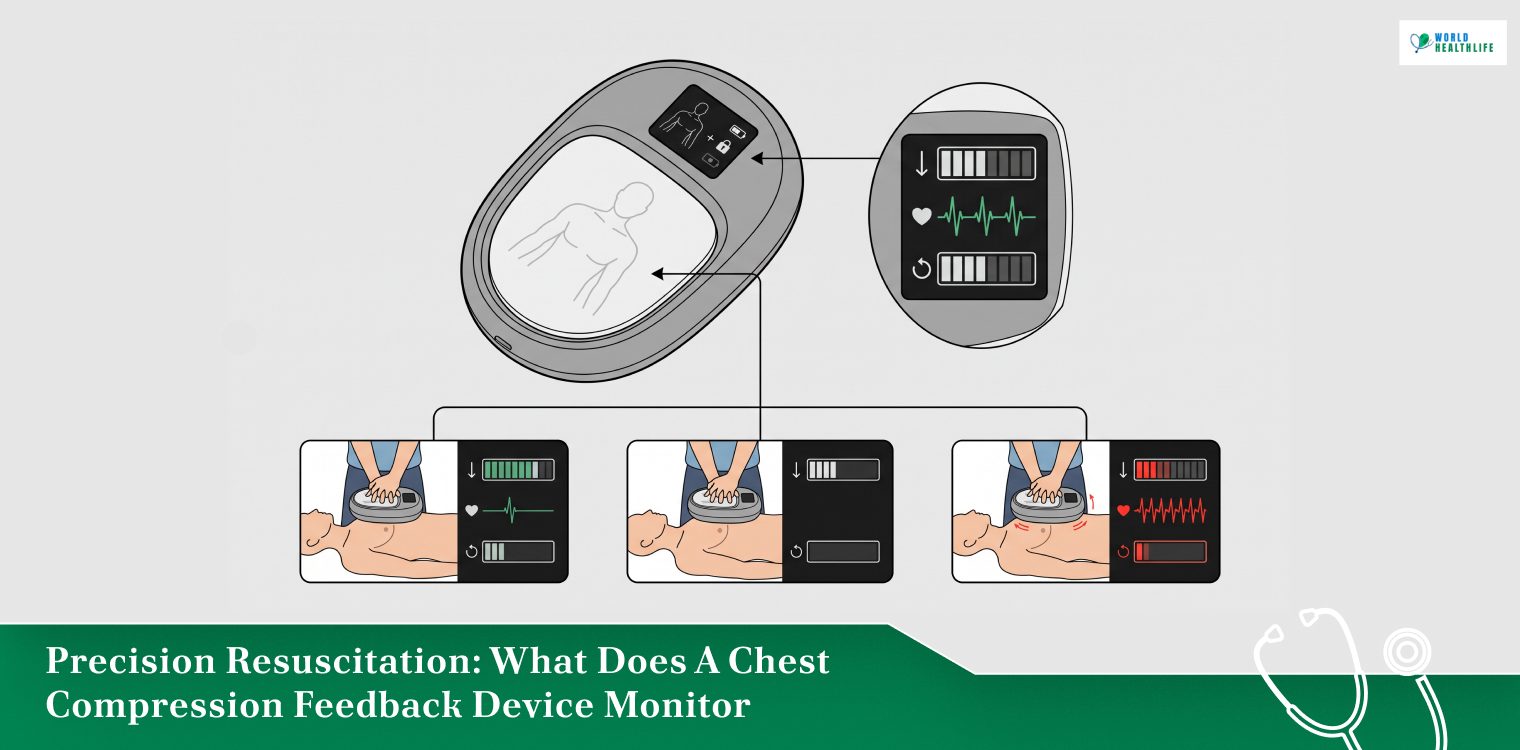
When medical professionals and emergency coordinators ask what does a chest compression feedback device monitors, they are looking at a specialized technological interface.
Moreover, this is designed to track, calculate, and guide the precise mechanical metrics of chest compressions.
These compact, advanced devices employ precision multi-axis accelerometers and micro-force sensors. Ultimately, it ensures to continuously measure your rescue inputs.
Understanding these underlying sensor mechanics sets the stage for exactly what these machine monitors during a sudden cardiac crisis.
Thus, let us dive straight into the explicit data points and mechanical layers these tools track to keep a patient alive.
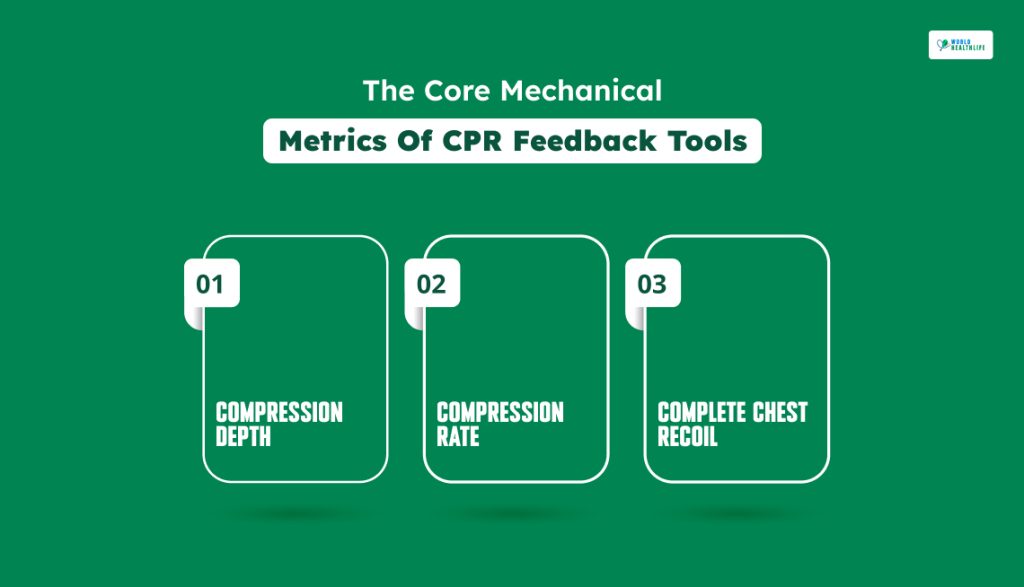
The Core Mechanical Metrics Of CPR Feedback Tools
A high-quality feedback device does not just track random movement.
Instead, it systematically monitors five distinct mechanical metrics that directly dictate how effectively oxygenated blood flows to the brain and myocardial tissues.
Compression Depth
Achieving the proper depth is paramount to mechanically squeezing the heart against the spine. This forces trapped blood out into the systemic circulatory system.
The feedback monitor utilizes a predefined displacement algorithm to track exactly how many millimeters the chest wall travels downward with every single thrust.
In case your compressions are too shallow, the blood pressure inside the coronary arteries fails to reach the critical threshold required to preserve brain function.
Conversely, if your strokes are excessively deep, the device flags an immediate structural warning. This helps to prevent internal thoracic trauma, such as fractured ribs or lacerated organs.
Compression Rate
The speed and pacing rhythm of your rescue efforts completely dictate cardiac output.
The device monitors the exact frequency of your downward strokes per minute. Moreover, maintenance of a consistent and regulated tempo is vital.
Compressing the chest too slowly fails to generate sufficient forward blood flow. On the contrary, pushing too fast transforms your efforts into an ineffective vibration.
As a result, this prevents the heart chambers from physically having enough time to open and fill between strokes.
Complete Chest Recoil
One of the most frequent errors made by exhausted or anxious rescuers is leaning on the patient’s chest during the upward phase of a compression cycle.
A chest compression feedback device monitors whether the rescuer completely releases their downward force at the peak of each stroke.
Full decompression allows the chest wall to spring back into its natural position.
This creates a negative internal pressure vacuum that draws blood back into the heart chambers.
If the monitor senses even minor residual weight lingering on the sternum, it will flag a correction alert to prevent a progressive drop in total blood circulation.
Global Standards: The Resuscitation Metrics Matrix
For maximizing survival outcomes during out-of-hospital cardiac arrest events, feedback tools calibrate their internal sensors.
This is done to mirror the rigid technical standards set by the leading global emergency networks.
Target Performance Parameters
The following is a breakdown of the explicit performance targets a high-quality feedback monitor used to evaluate your manual inputs.
| Monitored Performance Metric | Global Resuscitation Target Parameter | Underlying Sensor Mechanism | Real-World Clinical Impact |
| Compression Depth | 5.0 to 6.0 cm (2 to 2.4 Inches) | Double-integration 3-axis accelerometer tracking. | Generates necessary systolic pressure to sustain brain viability. |
| Compression Rate | 100 to 120 compressions per minute | Electronic internal timing clock and processor counters. | Establishes an optimal cardiac cycle rhythm for tissue perfusion. |
| Chest Recoil Force | Complete release (0 g residual pressure) | Mechanical micro-strain gauge or force sensor plates. | Allows full ventricular refilling before the next downward stroke. |
| Chest Compression Fraction (CCF) | Minimum 60% (80% target optimized) | Cumulative time tracker measuring active vs. inactive states. | Minimizes blood pressure drops caused by unnecessary pauses. |
Advanced Metrics Monitored By Enterprise Equipment
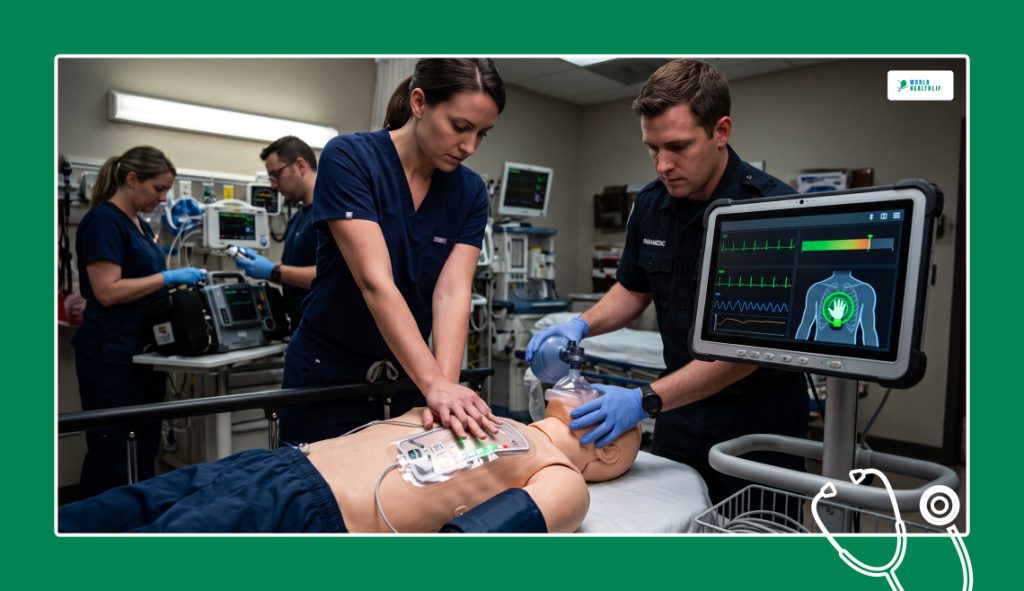
Entry-level consumer models focus strictly on basic depth and rate.
Conversely, professional-grade medical devices integrate sophisticated processing layers to track advanced physiological variables. This is during complex and multi-person code responses.
Chest Compression Fraction (CCF) Tracking
The CCF measures the exact percentage of total resuscitation time spent performing active physical compressions versus the time lost to pauses.
For instance, this includes changing rescuers, analyzing heart rhythms, or delivering ventilation breaths.
Coronary perfusion pressure drops to zero within seconds of halting compressions. Thus, advanced feedback modules continuously calculate your cumulative CDF.
Correct Hand Placement And Anatomical Drift
Maintaining your hands squarely over the lower half of the sternum ensures that your downward force hits the strongest structural zone of the chest cage.
Advanced feedback pads use multi-sensor arrays. This helps to detect if a rescuer’s hands are drifting off-center during fatigue.
By flagging spatial misalignments early, the tool keeps your compressions highly efficient while minimizing the risk of broken ribs or internal injuries.
Real-Time Guidance: How The System Instructs The Rescuer
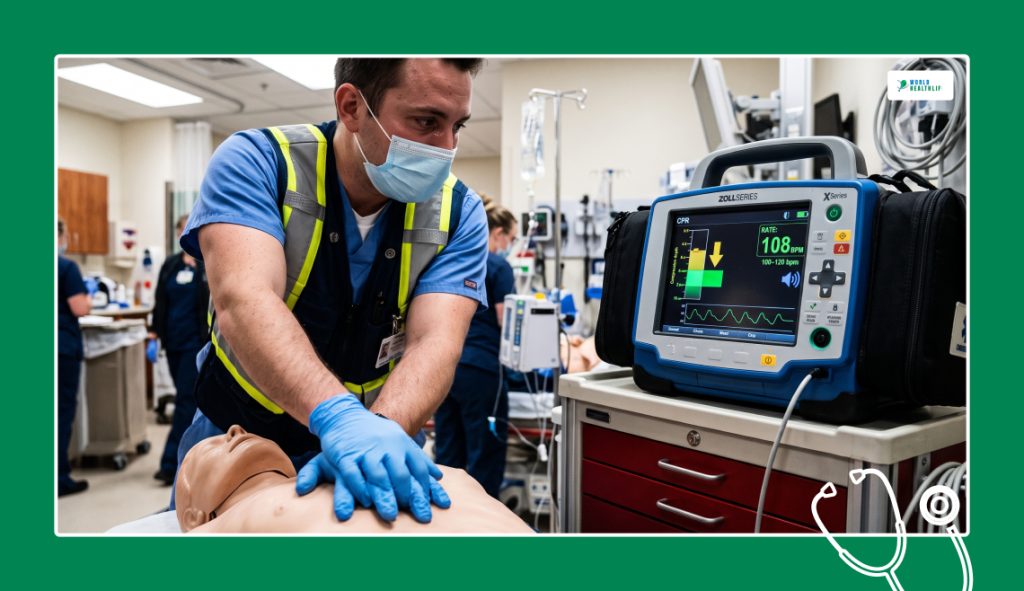
A monitor is only useful if the person performing CPR can instantly understand its feedback under intense emergency room or field pressure.
Modern units translate complex sensor measurements into clear and actionable commands.
Visual Display Scales
Advance systems utilize high-contrast LED meters or dynamic digital screens to guide the user’s hands.
If your compressions fail to reach the proper depth, a distinct yellow warning arrow illuminates on the screen. This is basically prompting the user with explicit text commands like “compress deeper.”
The target zone lights up green only when your stroke mechanics hit the perfect global standard window.
Auditory Metronome Pacing
To maintain an ideal and unwavering rhythm, the device features a built-in electronic metronome. This emits a steady rhythmic beep at a precise cadence between 100 and 120 beats per minute.
Rescuers sync their physical compressions directly to these audible tones.
As a result, this ensures the rate never wanders out of the optimal clinical range due to fatigue or adrenaline spikes.
Optimizing Resuscitation Performance Outcomes
Deploying a chest compression feedback device represents an intentional shift.
That is away from subjective, unverified manual resuscitation toward data-driven, precise medical care.
The emergency medicine landscape has evolved past the era. Once, we used to simply hope our manual stroke technique was effective enough to sustain a life during a crisis.
However, now we can measure physical depth with millimeter accuracy, track rate cadences through internal processors, monitor chest recoil pressure, and maximize total compression fractions.
Moreover, these tools remove the dangerous guesswork from life-saving care.
Managing a sudden cardiac event with real-time feedback ensures every downward stroke delivers the maximum volume of oxygenated blood to the brain and heart.
It requires dedicated training and rigorous device maintenance. But it allows your emergency response team to step out of the dark.
Thus, it gives your patients the highest possible chance of survival, neurological recovery, and long-term health.
Disclaimer: The information provided in this article is for general informational purposes only. It does not, and is not intended to, constitute medical or health advice. Please consult a qualified healthcare professional for medical guidance or expert health assistance.


