
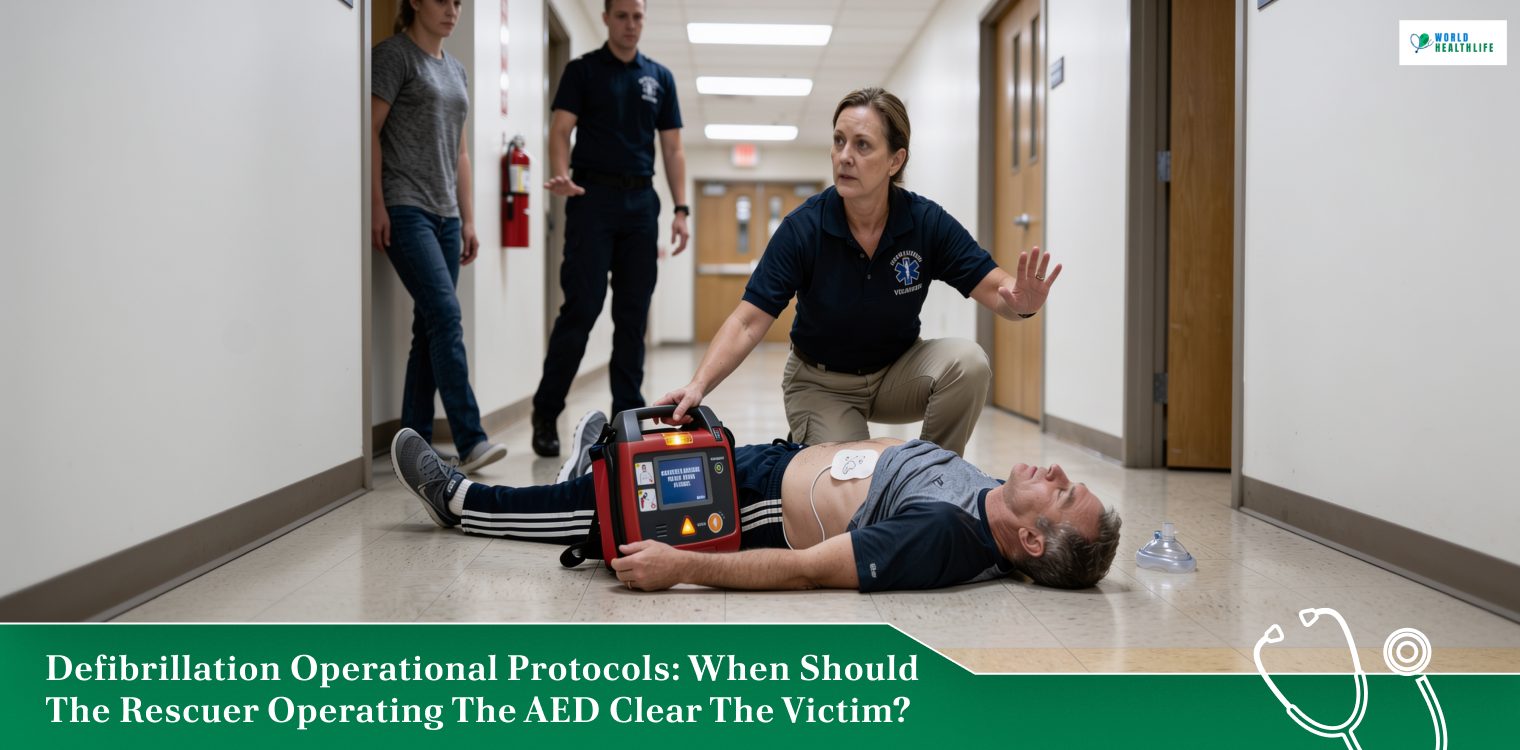
In the critical timeline of sudden cardiac arrest resuscitation, the automated external defibrillator (AED) functions as the definitive clinical intervention to reverse fatal arrhythmias.
Continuous cardiopulmonary resuscitation (CPR) maintains baseline metabolic perfusion to vital organs. However, it cannot restore an organized heart rhythm on its own.
Maximizing a patient’s survival probability requires seamless integration between manual compressions and automated device steps.
When analyzing when should the rescuer operating the AED clear the victim, the definitive clinical guidelines dictate that the operator must ensure absolute physical separation from the patient at two precise checkpoints.
One, during the heart rhythm analysis phase. And two, immediately prior to shock delivery.
Failing to enforce complete clearance during these specific windows introduces high vectors of rescuer hazard and can severely compromise the device’s diagnostic software.
Managing a cardiac emergency safely requires a thorough understanding of the physiological and technological reasons for these clearing steps.
Moreover, it also requires strict physical clearance protocols and secondary adaptations for special patient populations.
The Primary Clearing Checkpoints During Resuscitation
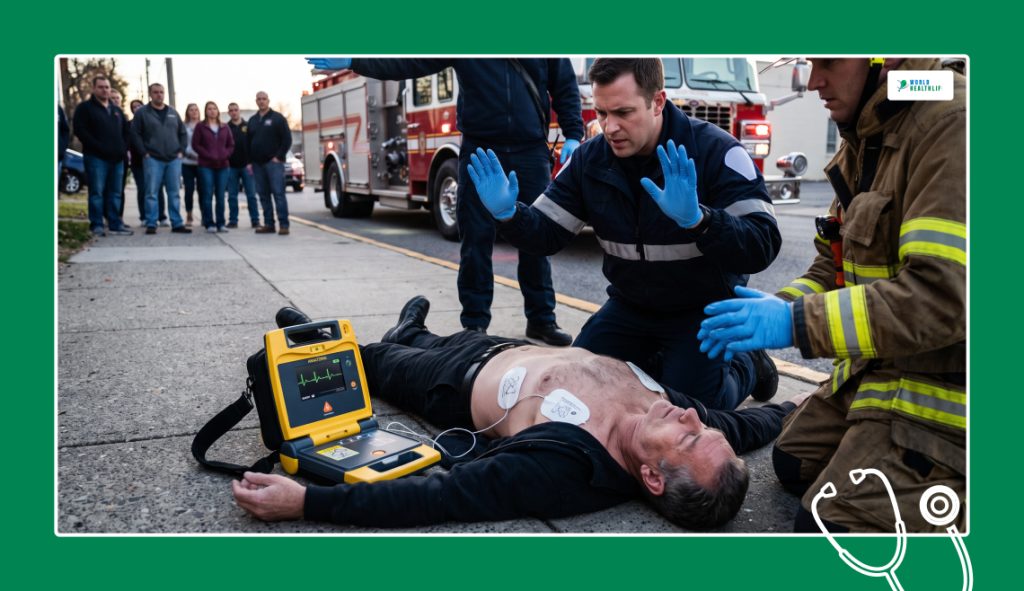
An AED is a computer-driven diagnostic matrix that relies on absolute data precision to compute whether a life-saving shock is indicated.
The device guides rescuers using audible voice prompts.
However, the human operator holds the ultimate physical responsibility for managing the safety boundary around the patient.
Checkpoint 1: During Heart Rhythm Analysis
The initial window where the operator must clear the patient occurs the exact second the AED initiatives its cardiac electrical assessment.
The device measures micro-electrical voltage variations passing across the adhesive electrode pads to map out the heart’s active waveform.
Preventing Diagnostic Motion Artifacts
If any individual touches, leans on, or continues chest compressions while the device is analyzing, the physical motion generates static electrical noise. This is known as a motion artifact.
The software can easily misinterpret a rescuer’s physical hand movements as a shockable rhythm, leading to an inappropriate shock delivery.
Conversely, human movement can mask ventricular fibrillation (VF). This causes the machine to signal “no shock advised” when a life-saving current is desperately needed.
The Analytical Window Timeline
Depending on the specific manufacturing model deployed on the scene, the heart rhythm analysis phase takes anywhere from 5 to 15 seconds to complete.
During this entire evaluation window, all active rescue tasks must cease completely. This includes ventilation breaths and chest compressions.
Checkpoint 2: Immediately Prior To Shock Delivery
The second non-negotiable clearance window occurs immediately following a “shock advised” automated notification.
Once the device’s internal capacitors complete charging, it holds a high-energy electrical current ready for release.
Mitigation Of Electrical Transfer Hazards
If a rescuer or bystander remains in physical contact with the victim when the shock button is pressed, the human body acts as a natural electrical conductor.
A portion of the defibrillation current will instantly transfer through the contact point into the bystander. As a result, this potentially triggers a secondary cardiac event, electrical burns, or severe neurological shock in the rescuer.
Ensuring Complete Energy Transfer
Furthermore, when external bodies touch the patient during a shock, they divert a percentage of the calculated electrical energy away from the victim’s myocardium.
This energy loss means the current hitting the heart muscle may fall below the therapeutic threshold required to stun the erratic cells.
Moreover, it supports restoration of a normal pacemaker rhythm.
Chronological Operational Flow Of A Multi-Rescuer Response
To ensure critical clearing steps happen without unnecessary delays in manual circulation, rescuers must use a highly disciplined, synchronized operational loop.
Resuscitation Timeline And Clearance Sequence
The matrix below maps out the exact sequence of physical interventions from the moment the device arrives at the patient’s side.
| Phase of Operation | Active Rescuer Intervention | Core Clearance Command | Required Visual & Physical Check |
| 1. Pad Deployment | Rescuer 1 continues high-quality CPR; Rescuer 2 opens the AED casing and applies adhesive pads to a bare, dry chest. | No command required; continue manual compressions. | Verify proper anatomical pad placement while avoiding any interruption to compressions. |
| 2. Rhythm Analysis | Rescuer 1 immediately lifts their hands clear of the patient’s torso the moment the device prompts analysis. | “Clear the patient!” or “Stand back!” | Perform a rapid visual scan from head to toe to verify that no clothes, hands, or tools are touching the victim. |
| 3. Capacitor Charging | The device analyzes the rhythm and charges the internal capacitor banks if a shockable rhythm is confirmed. | Keep the area clear. | Ensure that bystanders or incoming medical staff do not accidentally step into the active zone. |
| 4. Current Delivery | The AED button flashes; Rescuer 2 hovers their hand over the trigger without touching the patient’s skin. | “I’m clear, you’re clear, everybody clear!” | Execute a physical look-around check to confirm that everyone has stepped back before pressing the shock button. |
| 5. Post-Shock Loop | The shock is successfully delivered; the device instantly updates its audio prompt commands. | No command; immediately return to the chest. | Rescuer 1 immediately places their hands on the center of the sternum to resume high-quality chest compressions. |
Technical Coordination Protocols For The Safe Clearance Phrase
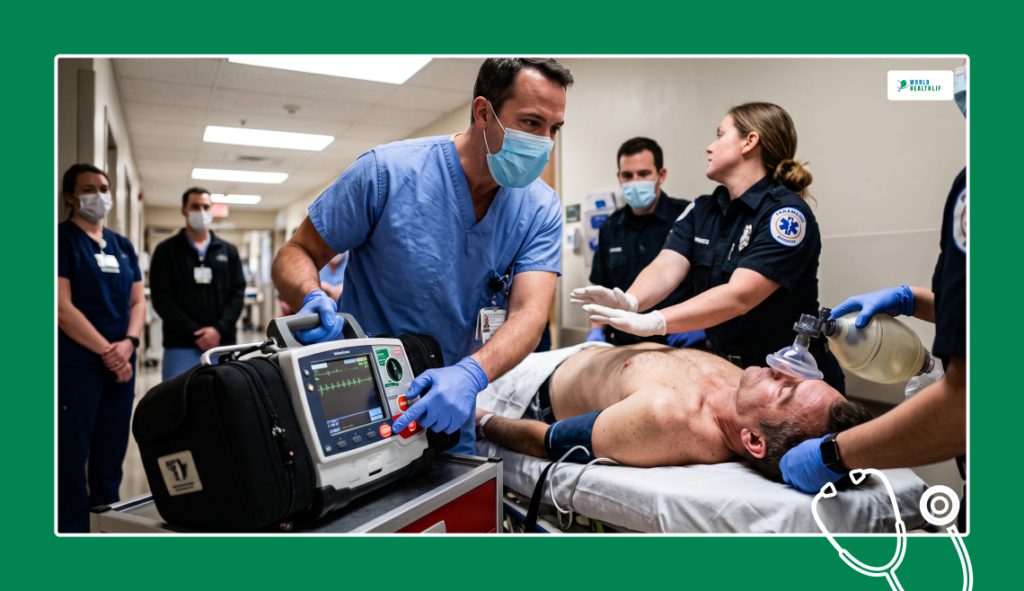
Verbally shouting a command is not enough. The rescuer operating the machine needs to follow a strict multi-sensory protocol to guarantee that the scene is physically secure before initiating an electrical charge.
The Loud Verbal Announcement
The moment the device signals an analysis or a shock phase, the operator must project their voice clearly and aggressively.
Utilizing standardized phrases such as “Clear!” or “Stand clear of the victim!” warns bystanders and alerts other rescuers to immediately freeze and pull their hands back.
The Physical Visualization Scan
While shouting the command, the operator must perform a physical head-to-toe scan of the patient’s body.
Accordingly, this rapid visual check confirms that the person performing compressions has fully lifted their hands. Also, it denotes that the rescuer is not touching the pocket mask or bag-valve mask.
Zero bystanders are touching the patient’s clothing or extremities.
The Final Mechanical Execution
Only after the operator has both spoken the command and visually verified complete physical separation should they press the physical flash button to deliver the shock.
The operator’s own body must remain completely clear of the patient throughout this mechanical execution.
Critical Environment And Population-Specific Adaptations
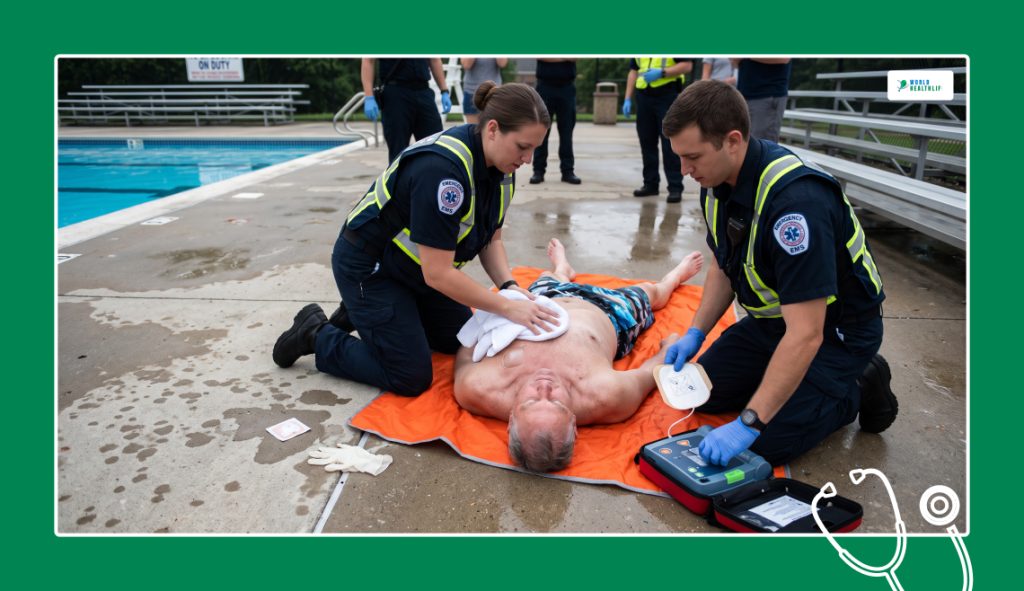
Specific emergency conditions introduce unique electrical conductivity hazards, requiring the operator to enforce additional safety precautions before clearing the area.
Moisture And Environmental Wetness
If a sudden cardiac arrest happens on a wet surface, near a swimming pool, or in heavy rain, surface water creates a major electrical conductivity hazard.
Before applying the adhesive pads, rescuers must quickly move the patient to a dry area if possible and thoroughly wipe the chest completely dry with a towel.
When clearing the patient, the operator must make sure that no puddles of water create a continuous fluid connection between the victim’s body and the rescue team.
This is because it could conduct the current outward.
Transdermal Medication Patches
Many patients wear specialized transdermal patches to deliver medications. For instance, nitroglycerin, nicotine, or hormone treatments.
If an electrode pad is mistakenly placed directly over a medication patch, the high-voltage electrical current can arc across the foil backing.
Consequently, it can trigger severe, deep tissue burns or block the energy transmission entirely.
Thus, rescuers must use a gloved hand to peel away any visible patches and wipe the skin completely clean before tracking the standard clearing checklist.
Implanted Pacemakers And Defibrillators
If a patient has a pre-existing implanted pacemaker or an implantable cardioverter-defibrillator (ICD), you will notice a distinct, hard lump beneath the skin.
In addition, this is usually right below the left or right collarbone, accompanied by a small surgical scar.
The operator must ensure that the adhesive pads are placed at least one inch away from this internal device.
During the clearing check, the operator must watch the patient’s torso closely.
If the internal ICD is currently firing its own automated shocks, everyone must stand back and let the internal cycle finish. This is done before letting the external machine run its analysis.
Minimizing Post-Shock Delays
A frequent mistake made by anxious or untrained rescue teams is staying clear of the patient for too long after a shock is delivered.
While clearing the area is a life-saving safety step during the active analysis and shock delivery windows, prolonged hesitation after the current passes drops your total chest compression fraction significantly.
As a result, this directly stalls vital blood flow to the brain.
Once the machine completes the electrical delivery, the residual current is fully absorbed and disappears instantly. Moreover, the patient’s body does not retain any static electricity.
Thus, rescuers do not need to wait for a voice prompt or complete a slow pulse check.
The team must step back onto the chest immediately. They should resume high-quality compressions to maintain continuous circulation until the machine signals its next automated two-minute analysis window.
Balancing absolute safety during the shock window with immediate, high-velocity action between cycles is the definitive path to protecting human life during a sudden cardiac crisis.
Disclaimer: The information provided in this article is for general informational purposes only. It does not, and is not intended to, constitute medical or health advice. Please consult a qualified healthcare professional for medical guidance or expert health assistance.


