Medical Disclaimer: The information in this article is for general informational purposes only and is updated to reflect the 2026 ACC/AHA/HFSA guidelines. It is not intended to substitute for professional medical advice, diagnosis, or treatment. It is further advised to seek medical information from a professional.
Heart failure is considered a chronic and progressive condition. Additionally, it imposes a massive and growing burden on individuals’ health, longevity, and overall well-being.
To have a full and true understanding of the clinical trajectory of this complex cardiovascular syndrome, it is absolutely essential to answer a fundamental question.
That is, what are the stages of heart failure?
Each phase of this condition is characterised by distinct clinical features, specific structural changes to the heart muscle and critical implications for long-term medical management.
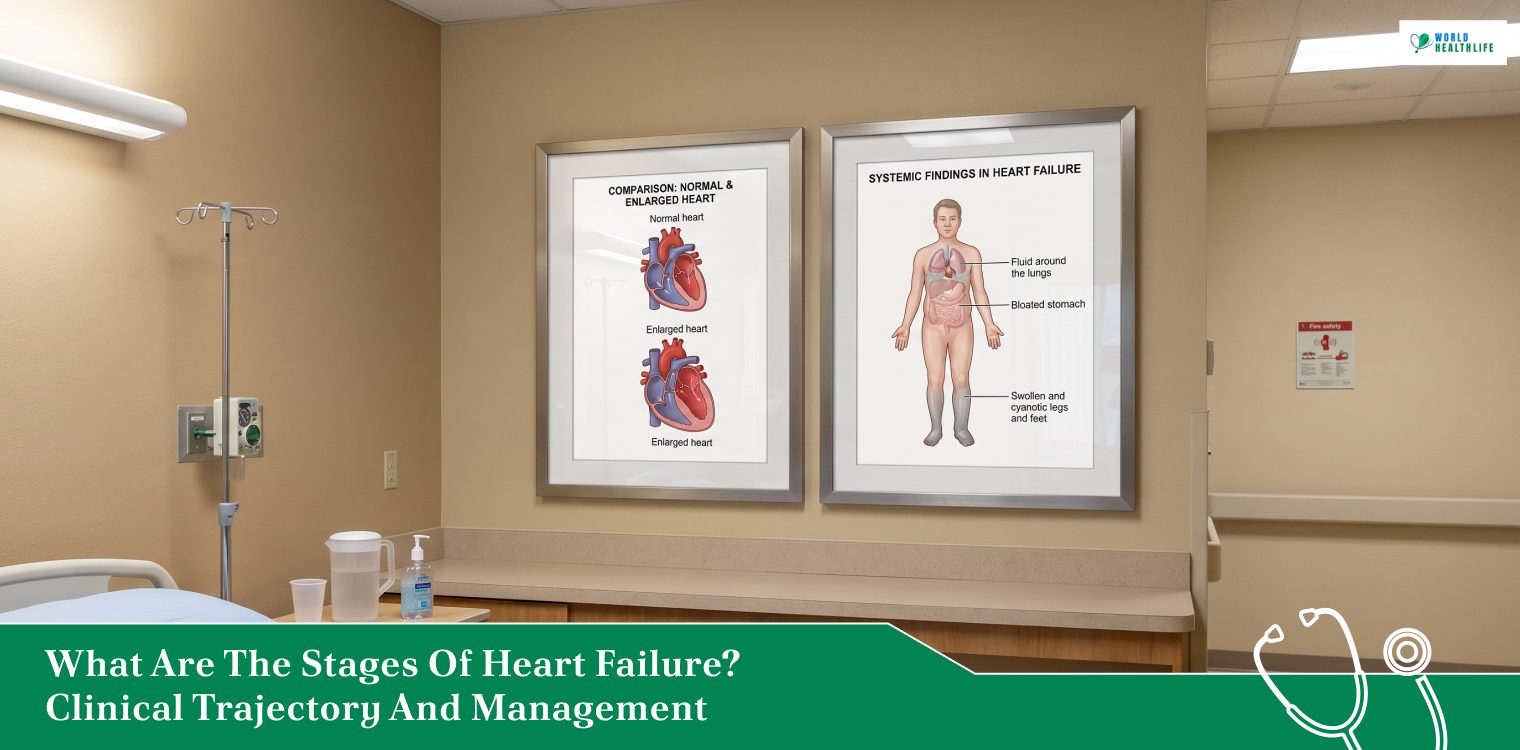
This comprehensive illustration provides a highly strategic roadmap through the intricate stages of heart failure offers a highly strategic roadmap through the intricate stages of heart failure.
Furthermore, it would shed light on the exact challenges faced by patients and healthcare providers in their continuous pursuit of optimal life-saving care.
As we navigate the updated 2026 medical landscape, our understanding of cardiovascular disease has shifted from a reactive treatment model to a proactive, preventative approach.
Modern diagnostic tools now allow clinicians to identify cardiac changes at a microscopic level. That is before physical symptoms ever manifest.
Consequently, the following article will explore the stages of heart failure and how it can be aggressively managed using the latest guideline-directed medical therapies.
The particular focus is on how the disease structurally progresses over time. Furthermore, it will delve on how you can recognize the earliest warning signs through both physical changes and advanced biomarker tracking.
Besides that, it will give a detailed understanding on how early clinical intervention can halt or even reverse cardiac remodeling.
In addition, the systemic, economic, and adherence challenges that are currently being faced by patients and healthcare experts alike will be highlighted at the end of the article.
What Is Heart Failure?
When users ask “what are the stages of heart failure,” they must first understand the modern definition of the condition itself.
Heart failure is a clinical syndrome marked by the heart’s inability to pump blood effectively to meet the body’s demands. Furthermore, it is also the inability to do so without abnormally elevating its filling pressures.
It can result from various cardiovascular conditions, including coronary artery disease, hypertension, and valvular disorders.
As the heart’s pumping capacity diminishes, a cascade of physiological responses ensues, leading to symptoms such as fatigue, shortness of breath, and fluid retention.
The most commonly reported heart failure type is left-sided heart failure. Furthermore, there are two types of left-sided heart failure. These include systolic and diastolic heart failure.
Besides that, these signs are clinically classified by your healthcare provider as Heart Failure with Reduced Ejection Fraction (HFrEF) and Heart Failure with Preserved Ejection Fraction (HFpEF).
Why Are There Stages Of Heart Failure?
When a condition is said to have “stages” it is usually implied that there is a progression of the disease that occurs.
Most chronic conditions have a pattern. This is the way in which you would see how far along the condition has progressed. Your physician will consider this as the telltale sign for your deteriorating health.
According to the updated AHA/ACC guidelines, the syndrome is categorized into four distinct structural stages. These are A, B, C, and D.
Unlike other functional staging systems, these stages are progressive. Once a patient advances to a later stage, they cannot move backwards to an earlier stage.
That is because structural changes to the heart muscle cannot be completely reversed.
The Four Stages Of Heart Failure
Heart failure progresses through four distinct stages. Moreover, these track the development from structural changes to advanced cardiovascular decline while guiding necessary medical interventions.
The following framework helps clinicians move from lifestyle modifications to aggressive treatment as functional impairment increases.
Summary Matrix: The Four Stages Of Heart Failure At A Glance
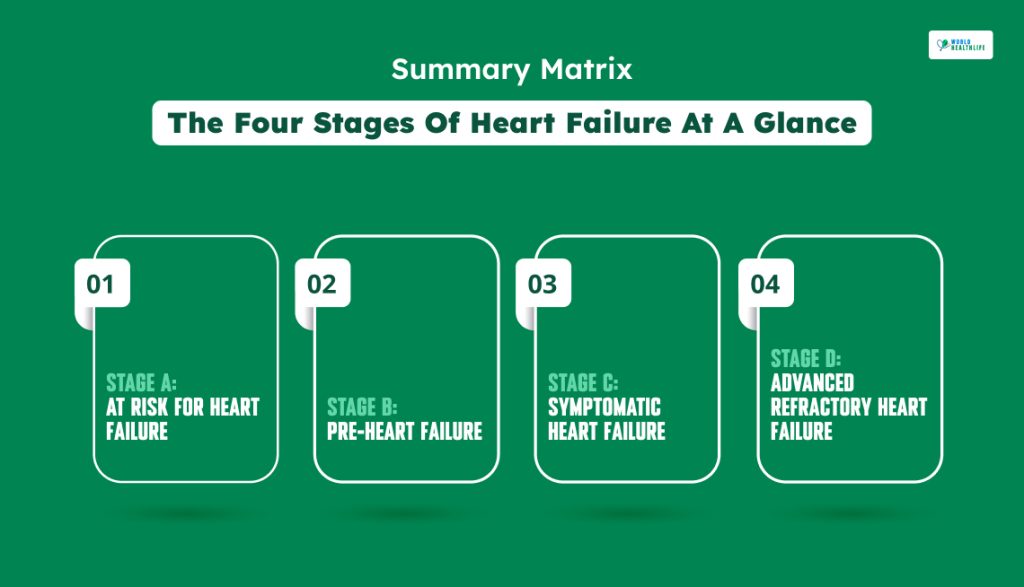
To help you quickly visualise what are the stages of heart failure and how it evolves, the following comparison table breaks down the entire cardiovascular landscape by structural damage, symptoms and core 2026 treatment strategies.
| Stage | Official 2026 Classification [1] | Structural Heart Disease Present? | Symptoms Present? | Primary Management Focus |
| Stage A | At Risk for Heart Failure | No | No | Risk factor control, lifestyle fixes, and SGLT2i/GLP-1 RA evaluation. |
| Stage B | Pre-Heart Failure | Yes (e.g., low EF, hypertrophy) | No | ACEi/ARB/ARNI, Beta-blockers, and preventing symptom onset. |
| Stage C | Symptomatic Heart Failure | Yes | Yes (Current or past symptoms) | The Four Pillars of GDMT, diuretics, and device therapies (ICD/CRT). |
| Stage D | Advanced Heart Failure | Yes (Severe) | Yes (Refractory to standard treatment) | Heart transplant, LVAD, continuous inotropes, and palliative care. |
Stage A: At Risk For Heart Failure
The first stage has officially been designated as “At Risk for Heart Failure”. Furthermore, individuals here are identified at high risk for developing heart failure.
However, they do not exhibit structural heart abnormalities, elevated cardiac biomarkers or symptoms yet.
Risk Factors
Risk factors include the following.
- Hypertension
- Diabetes
- Coronary artery disease
- Metabolic syndrome
- Obesity
- A family history of heart failure
Symptoms
In this stage, watch out for the following symptoms.
- By clinical definition, Stage A features absolutely no symptoms
- If you are experiencing shortness of breath or swelling at this point, this condition has already progressed to a later stage.
Management
The emphasis in this stage is on aggressive preventive measures, risk factor modification and lifestyle interventions to mitigate the progression to structural heart damage.
- Focusing on the management of risk factors, such as strict blood pressure control (targeting below 130/80 mmHg).
- Implementing lifestyle modifications including regular aerobic exercise, sodium restriction, and smoking cessation.
- Additionally, the proactive use of modern medications like SGLT2 inhibitors or GLP-1 receptor agonists for patients with type 2 diabetes and established cardiovascular disease to prevent hospitalization.
Stage B: Pre-Heart Failure
Stage B is now officially termed “Pre-Heart Failure.”
Here, individuals experience structural heart abnormalities or evidence of increased filling pressures. Moreover, this includes elevated BNP/NT-proBNP levels or left ventricular hypertrophy.
However, they remain completely asymptomatic. Despite the absence of symptoms, these structural changes indicate a heightened risk of future clinical heart failure.
Symptoms
There are no symptoms displayed by people who have progressed to this stage of the condition.
In addition, it is often caught incidentally during an echocardiogram or routine blood work.
Management
- Addressing the underlying structural issues
- Optimizing medical therapy
- Prescribing evidence-based medications. Furthermore, that includes ACE inhibitors (or ARBs) and Beta-blockers for patients with a reduced ejection fraction (EF ≤ 40%) to prevent remodeling.
- Implementing strategies to prevent symptom development and slowing down the physical deterioration of the heart muscle.
Stage C: Symptomatic Heart Failure
“Stage C” marks the onset of symptomatic heart failure.
Here, patients exhibit signs and symptoms related to heart dysfunction.
This is directly related to the structural heart disease.
Symptoms
- Fatigue and generalized weakness
- Exertional dyspnea (shortness of breath during mild physical activity)
- Orthopnea (difficulty breathing when lying flat in bed)
- Fluid retention leading to rapid weight gain
- Swelling (edema) in the hands, ankles, legs, and abdomen
- Decreased exercise tolerance
Management
- Implementing the fundamental “Four Pillars” of Guideline-Directed Medical Therapy (GDMT) to reduce mortality:
- Angiotensin Receptor-Neprilysin Inhibitors (ARNI – Sacubitril/Valsartan) as the preferred first-line therapy over standard ACE inhibitors.
- Evidence-based Beta-blockers (e.g., Metoprolol Succinate, Carvedilol).
- Mineralocorticoid Receptor Antagonists (MRA – e.g., Spironolactone).
- Sodium-Glucose Cotransporter-2 Inhibitors (SGLT2i – e.g., Empagliflozin or Dapagliflozin). Additionally, these are now standard care for both reduced and preserved ejection fraction.
- Pharmacological interventions such as a prescription of diuretics for active fluid volume management.
- Consideration is also given to implantable cardioverter-defibrillators (ICD) for sudden death prevention. On the other hand, cardiac resynchronization therapy (CRT) is considered for heart synchronization.
- Lifestyle modifications, daily weight tracking, and close monitoring to enhance quality of life and prevent further deterioration.
Stage D: Advanced Refractory Heart Failure
The final stage, “Stage D,” represents advanced heart failure.
Furthermore, it is characterized by severe, refractory symptoms despite optimal, maximally tolerated standard medical therapies.
In this stage, individuals in this stage face extreme challenges with daily activities and experience recurrent hospitalizations. Despite being on the highest doses of target medications, it is still needed.
Symptoms
- Severe difficulty in breathing despite resting
- Shortness of breath that causes disruptions in sleep, i.e., paroxysmal nocturnal dyspnea
- Pronounced swelling in hands, arms, legs and ankles
- Nausea and a persistent loss of appetite due to fluid buildup in the GI tract
- Chronic fatigue amd an inability to walk short distances
- Unexplained or rapid weight gain from fluid accumulation
- Light-headedness or low blood pressure (hypotension)
- Rapid or irregular heartbeat. Furthermore, that includes atrial fibrillation
- Persistent cough with pink or white phlegm
Management
Advanced therapeutic options become essential considerations in managing this critical stage.
- Evaluation for heart transplantation for eligible candidates.
- Moreover, considering mechanical circulatory support devices such as Left Ventricular Assist Devices (LVADs) as a bridge to transplant or as destination therapy.
- Continuous intravenous inotropic infusions (such as Milrinone or Dobutamine) that can help the heart squeeze harder and maintain organ perfusion.
- Comprehensive palliative care and hospice options to manage symptoms and focus explicitly on patient comfort and dignity.
Transitional Stages And Dynamic Progression

It is crucial to understand and recognize that heart failure symptoms are dynamic. Despite structural staging moving in only one direction, symptoms remain dynamic.
While a patient cannot transition back from Stage C to Stage B structurally, their functional symptoms can be highly variable.
For instance, a patient in Stage C can achieve a complete remission of symptoms through strict adherence to the Four Pillars of GDMT. In addition, this moves into what clinical guidelines call “Heart Failure in Remission.”
This dynamic progression underscores the need for ongoing assessment and personalized management approaches.
What Helps A Patient With Heart Failure?

Here are certain things that help an individual suffering from heart failure.
Emerging Concepts And Precision Medicine
Recent advancements in understanding heart failure’s molecular and genetic underpinnings have paved the way for precision medicine approaches.
Tailoring therapies based on individual characteristics holds promise for optimizing treatment efficacy and minimizing adverse effects.
Additionally, these include genetic markers, proteomic staging, and specific phenotypes. Besides that, this ensures that the patient is receiving treatment that suits them best.
Patient-Centered Care And Shared Decision-Making
Throughout the stages of heart failure, a patient-centered approach is paramount.
Shared decision-making, involving patients in their care plans, helps align medical interventions with individual preferences and goals.
This is also considered a best practice for patients with chronic disease as their quality of life should be prioritized.
Education, telehealth monitoring tools, emotional support, and collaborative care partnerships contribute to empowering patients and improving overall outcomes.
Challenges And Opportunities
Despite progress in heart failure management, challenges persist. In addition, these include disparities in access to care, adherence to treatment plans, and the need for innovative therapies.
Moreover, addressing these challenges requires a multifaceted approach. Also, it requires combining medical advancements, healthcare system improvements, remote patient monitoring and community-based initiatives.
The Road Ahead In Cardiovascular Care
Understanding what are the stages of heart failure is a cornerstone in providing comprehensive and individualized care.
Furthermore, mastering the exact progression of this chronic syndrome is the ultimate cornerstone for deploying aggressive, stage-specific medical interventions.
That is, before irreversible cardiac damage can occur.
From early risk mitigation to intensive management of late-stage structural decline, every milestone on this roadmap represents a critical clinical window to stabilize the heart muscle and preserve systemic organ function.
Moreover, as modern clinical research continues to rapidly dismantle the molecular complexities of heart muscle failure, the clinical reality becomes more tangible each day.
This consists of earlier interventions, precision phenotyping and highly targeted therapeutic options. This progressive condition requires successful navigation
In addition, it requires an unwavering commitment to proactive and collaborative management with cutting-edge medical guidelines. With this, a continuous focus on maximizing both patient survival and daily quality of life is needed.
What strategies or therapeutic breakthroughs have you experienced in your journey with cardiac arrest? Share your insights and join the discussion in the comments section below.