
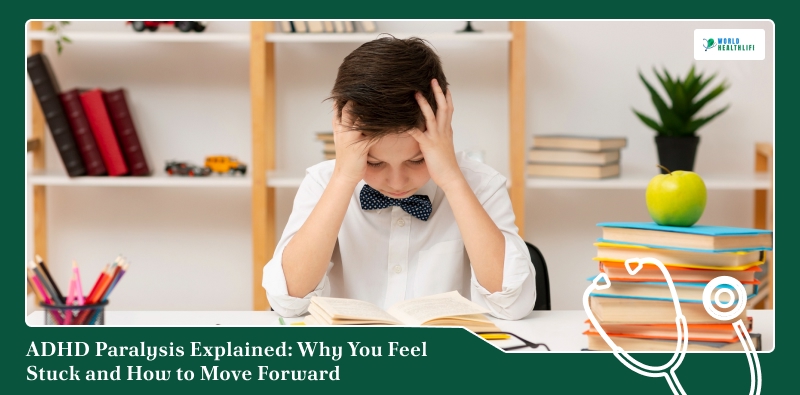
You might feel frustrated when you know exactly what you need to do and still don’t do it. It is not because you don’t care or you’re lazy. Rather, it happens because your brain has parked itself in the middle of the road and won’t budge.
For instance, you open the laptop, stare at the tab, and maybe check your phone for “just two minutes.” This way, somehow, an hour disappears.
ADHD paralysis is the feeling of being mentally stuck, overwhelmed, or frozen. In general, it happens when it is time to start, choose, or finish something important.
Mostly, it looks like avoidance or being careless. Minsan nga, even the person experiencing it starts believing those labels too.
However, ADHD paralysis is more tangled. At the outset, it is tied to overwhelm, executive dysfunction, and emotional stress. Moreover, it depends on the way an ADHD brain handles attention, planning, and motivation.
Therefore, read on to get a better idea of what ADHD paralysis means.
| Quick Overview Attention Deficit Hyperactivity Disorder paralysis, or ADHD paralysis, is not about being lazy or unproductive. It’s when your brain struggles to bridge the gap between intention and active even though you want to complete the task. ADHD paralysis is a feeling of being mentally stuck despite wanting to get something done. Instead of simply getting the task done, people with ADHD paralysis often struggle to initiate a start, make decisions, and move past the feeling of being overwhelmed. Common symptoms may include: Freezing before starting work Overthinking every step Getting distracted by less important tasks Feeling guilty over the lack of progress Understanding why it happens is the first step towards managing it more effectively. |
What Is ADHD Paralysis?
At its core, ADHD paralysis is that stuck feeling where action doesn’t match intention.
For instance, you may want to start and care a lot about the outcome. However, the bridge between “I need to do this” and actually doing it just sort of collapses.
In fact, some people freeze before beginning a task. Meanwhile, others get buried under too many thoughts and too many options. Moreover, some feel emotionally flooded to the point where even a small responsibility suddenly feels like a burden.
Hence, ADHD paralysis is not literal paralysis. Rather, it does capture the mental freeze. Parang gusto mong umusad, pero ayaw makisama ng utak mo. (It seems like you want to move forward, but your brain doesn’t want to cooperate)
Of course, you know the task matters and know time is moving. Still, there you are, circling the same thought, doing small, unrelated things, or just sitting in that uncomfortable tension.
Signs You May Be Experiencing ADHD Paralysis
Have you lately had the feeling that you are quite irregular with your tasks? Do you feel overwhelm and guilty at the same time?
Let’s talk about some signs that indicate ADHD paralysis:
- Staring at one task for hours without initiating it
- Constantly switching between small tasks, often finding difficulty picking one.
- Feeling overwhelmed by small decisions
- Tendency to be a perfectionist, having a fear of judgment, rejection sensitivity
- Spending hours thinking of doing something
- Difficulty in maintaining focus
- Brain fog, time blindness
- Often feeling guilty of delaying the task even when it’s important
- Constantly switching between apps repeatedly without making progress.
ADHD Paralysis At Different Ages
ADHD Paralysis might have similar symptoms, but different tasks and triggers in children and in adults. Let’s understand with this table:
Adhd Paralysis In Children Vs Adults
| Children | Adults |
| Might avoid homework or classroom work despite understanding them | May stare at one email or task for a long time |
| Often appear as daydreaming, distraction, or emotional meltdowns over small reasons. | Often appears like procrastination, burnout, or “being lazy, doing nothing” |
| Need multiple reminders and external structure to begin tasks | May rely on reminders, calendars, alarms, or body doubling |
| Frustration through cry, anger, or refusing to participate | Anxiety, guilt, perfectionism, self-criticism |
| Often noticed by parents or teachers | Adults notice it themselves after pattern recognition and prolonged missed deadlines |
How Does ADHD Paralysis Feel In Real Life?
If you are concerned that your loved one might have ADHD paralysis, the best help you can do is understand when they are having their “freeze moment,” and it’s better not to convince them with “Can you just simply start?” or “hurry up”. That might worsen the scenario.
Someone with ADHD paralysis might:
| At Home | At School | At Work |
| Ignoring dishes | Unable to begin assignments | Missing schedule |
| Skipping meals | Studying at eleventh hour | Avoiding emails |
| Messy rooms | Switching between subjects | Postponing presentations |
| Forgetting groceries | Delay in meetings |
- Sit in front of their laptop blankly with an email opened, and the cursor blinking
- Ignore texts they genuinely want to reply to
- Delay their doctor’s appointment week after weeks
- Stare at the dishes, ignoring the laundry
- Oscillate between several tasks, failing to prioritize one over the other.
- Self-criticize for not being productive the whole day.
Why Is ADHD Paralysis Not the Same as Laziness
Most people mistake ADHD paralysis for poor discipline or low effort. However, the subject keeps leading back to the same point.
It’s not laziness. Rather, it is more closely related to executive function challenges, sensory overload, overwhelm, and stress responses. When the brain struggles to prioritize, organize, decide, and regulate emotions, even simple tasks feel heavy and unfair.
Kasi nga, if people keep telling you to “Just do it!”, eventually you start wondering why you can’t. That self-criticism builds fast. Then the shame makes starting even harder.
As a result, the task gets bigger in your head than it probably is in real life. Suddenly, the whole thing becomes one long loop of pressure and avoidance.
Types of ADHD Paralysis

Obviously, not every stuck moment feels the same. That is part of why this issue can get confusing. The following are the types of ADHD paralysis:
1. Mental Paralysis
Some people deal mostly with mental paralysis. That shows up when thoughts pile up so fast. In those cases, nothing feels organized anymore. Also, it feels like brain fog, racing thoughts, or just too much internal noise.
2. Choice Paralysis
It is sometimes called analysis paralysis. In this case, too many options stop movement before it starts. Hence, picking the best option becomes its own exhausting project.
3. Task Paralysis
Task paralysis might be the most recognizable version. In this situation, you cannot seem to begin a task even when it’s urgent or important.
4. The Emotional Layer
Some people experience what could be called emotional paralysis. In this situation, the following aspects wrap around a task:
- Anxiety
- Frustration
- Fear of doing it wrong
- Embarrassment.
Hindi naman sa ayaw mo. Essentially, it is more like the task comes with emotional static. That static is loud enough to block momentum.
What Causes ADHD Paralysis?

A variety of reasons might be the cause of ADHD Paralysis. However, the following are the major ones:
1. Executive Dysfunction
In general, ADHD affects skills like planning, prioritizing, organizing, time management, and task initiation.
Sometimes, a person is faced with too many moving parts, unclear instructions, or an overstimulating environment. This is where the brain simply stalls. Also, add perfectionism into the mix, and things get even more complex.
In fact, if starting means risking imperfection, some minds would rather avoid the whole experience than do it badly.
2. Overwhelm
This is another major trigger. This is where too many tabs open. It is because there are too many chores, messages, and decisions. Although it sounds ordinary, for someone prone to ADHD paralysis, that ordinary clutter can hit like a wall.
Moreover, sensory overload makes it worse, too. This way, you receive noise, interruptions, time pressure, and visual mess. These push the brain from “I’m trying” to “I’m shutting down!”
3. Time Blindness
Time blindness happens when a task feels endless because your brain can’t estimate it well. As a result, it starts looking bigger and scarier than it probably is.
Ang totoo, sometimes the work is not impossible. Rather, it merely feels impossible when your mind can’t measure it properly.
ADHD Paralysis vs. Procrastination vs. Hyperfixation
| Pattern | What It Usually Looks Like | What Is Often Going On |
|---|---|---|
| ADHD Paralysis | Feeling frozen, overwhelmed, or unable to start despite wanting to. | Executive dysfunction, overload, fear, or under-stimulation can block action. |
| Procrastination | Delaying a task and putting it off for later. | Delay may be more voluntary, though still shaped by stress or motivation. |
| Hyperfixation | Intense focus on something highly engaging while other tasks fade out. | Attention is captured by interest, not evenly distributed across all responsibilities. |
Why Hyperfixation Confuses People
This is where outsiders get especially judgmental. They see someone with ADHD deeply focused on one thing and then assume the person could focus on everything if they “really wanted to.” But that’s not how it works.
In fact, ADHD involves trouble focusing on low-stimulation tasks and intense focus on highly interesting ones. It’s inconsistent, yes. However, inconsistency is part of the picture, not proof that the struggle is fake.
Honestly, that contrast can be maddening for the person living it. You think, “So I can focus. Why not on this thing that actually matters?”
Ayun na nga. That question can become its own burden, and it usually doesn’t help. In fact, shame rarely makes the brain more cooperative.
How ADHD Paralysis Can Affect Daily Life
This isn’t just about productivity hacks or messy desks. ADHD paralysis can bleed into work, school, household responsibilities, and relationships.
For instance, a person may miss deadlines, avoid emails, put off basic errands, or feel constantly behind. Not because they don’t understand the consequences, but because the act of starting feels so much harder than it “should.”
That gap between intention and action can chip away at self-trust over time.
Then comes the emotional spillover. Along with it comes frustration and guilt. The habit of calling yourself irresponsible before anyone else gets the chance. Some people start withdrawing because explaining the stuck feeling is exhausting in itself.
That may be one of the harshest parts. Essentially, ADHD paralysis make ordinary life feel like something you’re always slightly late to, always slightly apologizing for.
What Can Actually Help When You Feel Stuck

Not every strategy works for every person, and that’s worth noting up front. Still, certain approaches come up again and again because they reduce friction.
1. Small Steps Beat Grand Plans
At the outset, big tasks tend to invite shutdown. Meanwhile, smaller steps invite movement. So, instead of “finish the presentation,” it helps to shrink the ask.
- Open the file
- Write the heading
- Fix one slide.
That may sound too simple, but when the brain is overwhelmed, simple is not childish. In fact, one tiny completed step can create enough momentum to get the next one moving.
2. Lower the Activation Energy
The five-minute rule works for a reason. Tell yourself you only need to do the task for five minutes. Just give yourself five minutes. Madalas, the hardest part is the entry point. In fact, once you’re in, the resistance shifts a little. Also, if five minutes is all you do, that still counts.
3. Reduce Decisions Before They Happen
In general, choice paralysis feeds on too many options, so it helps to make fewer decisions in the moment. So, pick one next action the night before. Then, lay out what you need.
Also, use timers and body doubling if that helps. Moreover, use a planner if it works for you, or sticky notes if it doesn’t. The point is not to look organized. You have to reduce the mental load of getting started.
| Common Trigger | What It Can Feel Like | A More Helpful Response |
|---|---|---|
| Too many tasks at once | “I can’t even choose where to start.” | Pick one visible next step and ignore the rest for ten minutes. |
| Perfectionism | “If I can’t do it well, I don’t want to begin.” | Aim for a rough first pass, not a polished outcome. |
| Under-stimulating chores | “This is so boring I want to disappear.” | Add music, movement, or a small reward after. |
| Emotional overload | “I’m too frustrated to think straight.” | Pause, reset, and come back once the nervous system has settled a bit. |
4. Self-Compassion Is Not Optional
This part sounds soft, but it’s practical. Beating yourself up doesn’t reliably end ADHD paralysis. It usually deepens it.
Resetting your environment, taking a walk, lying down for a bit, changing locations, or giving your senses a break helps more. It is better than forcing yourself through a wall that isn’t moving.
If the pattern is significantly affecting daily life, support from a clinician, therapist, or ADHD coach can make a real difference.
5. Apply Pomodoro
Sometimes committing to an entire task feels overwhelming. Instead of focusing on everything, focus on the short burst of work.
The Pomodoro Technique involves working for around 25 mins, followed by a 5-minute break. After completing 4 sessions that a long break.
It can prevent mental fatigue and keep long tasks from feeling endless.
Small Shifts That Make ADHD Paralysis Feel Less Powerful
To be honest, ADHD paralysis doesn’t always disappear in one neat breakthrough. Sometimes you learn to catch it earlier. At other times, you build routines that soften the impact. In some cases, the win is simply noticing, “Oh, this is happening again.”
That matters more than people think. Kasi, when you stop framing yourself as lazy, you create room for better strategies. You get curious instead of cruel, make the task smaller, reduce the noise, and start messy.
This way, little by little, the freeze stops feeling like your whole identity. It becomes a problem to work with, not a personal failure to carry around all day.
Frequently Asked Questions (FAQs)
Of course, it is. It is widely described as a real ADHD-related experience. It happens even though it is not an official, standalone diagnosis.
Not exactly! ADHD paralysis feels more involuntary. Also, it is linked to overwhelm, stress, or executive dysfunction.
Yes, it does. Even small chores can trigger it when the task feels boring, unclear, or emotionally loaded.
ADHD can involve both intense focus on engaging tasks and difficulty starting less stimulating ones.
Try one tiny next step, a five-minute start, and fewer choices. In fact, a short reset if you feel overloaded.


