
Body-change content online went beyond fitness or health. Now, it is about angles, cheekbones, and a jawline that finally shows. Then the term Starvemaxxing is marketed as a hack, not a warning sign. It spreads fast because it sounds simple: eat less, look sharper.
The purpose here is to slow down that logic. It is important to separate trend claims from body reality. Also, men who are already conditioned to treat discomfort as proof of progress need to learn the unavoidable risks.
What Is The Starvemaxxing Trend?
At its core, Starvemaxxing is intentional, extreme calorie restriction done for a specific aesthetic goal. In general, it is about the face. Note that it is not “cutting” for sports, improving nutrition, or learning portion sizes.
Basically, it borrows energy from looksmaxxing culture. This is where appearance becomes a project with constant upgrades. Essentially, this trend is built around stripping down, sometimes past the point where the body can negotiate or recover cleanly. [Source: The Conversation]
How Did The Starvemaxxing Trend Spread?

Social media serves as a lab for rapid belief formation, especially when content is short and decisive. In fact, short videos reward bold claims like “do this for two weeks and your jaw will pop.”
For instance, a montage of before-and-after shots does more persuasion than a long explanation ever will. In fact, some posts rely on the same rhythm. They include a moody intro, a glow-up beat drop, and a comment section pushing the idea that hunger equals discipline.
However, the platform does not need to be malicious for harm to spread. Rather, it only requires engagement. Actually, extreme restriction content comes preloaded with urgency and insecurity.
Why Do Men Try Starvemaxxing?
The “why” is usually buried under bravado. Men are not immune to body image stress, but it often gets renamed into something more socially acceptable.
For instance, instead of “I feel ugly,” it becomes “I need to optimize.” Also, instead of “I hate my face,” it becomes “I’m fixing my bone structure.”
In some spaces, discipline is treated like proof of masculinity. As a result, deprivation starts to look like achievement. Moreover, some of the other things that add to it include;
- Influencer culture.
- Dating-app photos.
- Gym-mirror standards.
This way, the whole thing becomes a pressure cooker. Thereby, the face becomes a résumé. Meanwhile, the body is treated like a disposable draft.
The Science Behind Starvemaxxing: Facial Fat And Appearance
Fat loss is not a targeted tool, and it rarely behaves like a clean, predictable switch. In fact, the face can change with body weight. However, it changes unevenly and not always in ways people expect.
Some men lose facial fullness and look sharper. Others look tired, older, or stressed out, with duller skin and deeper shadows. Essentially, what most people label as jawline isn’t fat at all. Rather, it includes mere bone structure, dental alignment, posture, tongue position, and soft-tissue draping.
Moreover, calorie restriction can reduce overall mass. However, it cannot redesign a skull. That mismatch between expectation and biology is where frustration becomes obsession.
Claim vs. Reality Check
| Social Media Claim | What Often Happens In Real Life | Why It Matters for Men’s Health |
| “Less food equals a chiselled face.” | Weight drops; face may look gaunt; skin may look dull; under-eye shadows pop. | Looking “lean” overlaps with looking unwell, and the body feels it. |
| “Hunger is the proof that you’re doing it right.” | Hunger turns into irritability, poor sleep, binge cycles, or anxiety. | Mood and impulse control take a hit. This affects work, relationships, and training. |
| “This is just discipline.” | It can become rigid eating, social withdrawal, and obsessive checking. | Mental health costs hide behind grindset language. |
| “You can stop anytime.” | Restriction patterns can stick even after the trend fades. | The brain learns extremes fast, especially when validation is involved. |
Risks and Dangers of Starvemaxxing
The body does not reward extreme restriction with clean outcomes. Rather, it adapts underneath. This way, energy drops and is labeled as willpower. As a result, strength declines and is framed as “cutting.” In addition, sleep worsens, and it gets blamed on stress.
With Starvemaxxing, the central risk is that the goal is visual and immediate. So, harm gets rationalized as temporary. Yet the body does not treat it as temporary. In fact, it treats it as a threat.
1. Physical Health Risks
The following are the major phsycial health risks of Starvemaxxing:
- Nutrient gaps include hair thinning, lingering fatigue, low libido, slower recovery, and increased injury risk.
- Muscle loss accompanies fat loss, especially when protein intake is inconsistent and training remains intense.
- Metabolic slowdown is a predictable response to perceived scarcity.
- Hormones can shift, too, including testosterone, thyroid function, and stress hormones.
- Some men notice a flatter mood, a shorter temper, or frustrating workouts.
Basically, according to the American Psychological Association, the body feels less capable and less resilient. [Source: The Psychology of Hunger]
2. Psychological Risks
At the outset, restriction changes the mind. This way, thinking narrows. Moreover, food becomes a scoreboard, and social life starts to feel complicated. In fact, the mirror turns into a daily audit, scanning for proof that the suffering is working.
The danger zone is when the pattern starts to resemble disordered eating, even if it never gets called that. Body dysmorphia also might happen because chasing a “fixed” face trains attention onto micro-flaws.
Unfortunately, men often mask the distress with humor or gym talk. However, the inner experience can still be heavy.
Starvemaxxing vs. Healthy Lifestyle Changes
Most men who pull into face-focused restrictions are not lazy or careless. In fact, the effort is strong, and so is the desire to feel confident. Rather, the issue is direction.
Hence, a sustainable approach builds structure around eating and training instead of tearing it down. Also, it treats appearance as a side effect of health.
| Approach | Primary Goal | Typical Method | Short-Term Feel | Long-Term Outcome Tendency |
| Extreme restriction | Fast visual change | Aggressive calorie cuts, skipping meals | Quick drop, mood swings | Rebound cycles, reduced performance, and higher obsession risk |
| Balanced nutrition | Stable health and body composition | Adequate protein, fiber, and regular meals | More stable energy | Better training consistency, fewer crashes |
| Strength training + posture | Structural look and capability | Progressive overload, mobility, core work | Slower visual change | More durable physique, better joint health |
| Skincare + dental care | Facial presentation | Routine basics, hygiene, professional care | Subtle, steady | Improves appearance without systemic harm |
Expert Perspectives
In general, most clinicians and coaches who work around nutrition and mental health converge on a blunt point. They say extreme restriction is rarely just about food. Rather, it links to control, anxiety, perfectionism, and social validation.
Moreover, influencers may not intend harm, but intent is not the same as impact. In fact, a post that says “I did this and now my jawline is insane” might become a blueprint for someone already vulnerable. Also, media literacy matters here.
How To Recognize Potential Eating Disorders?
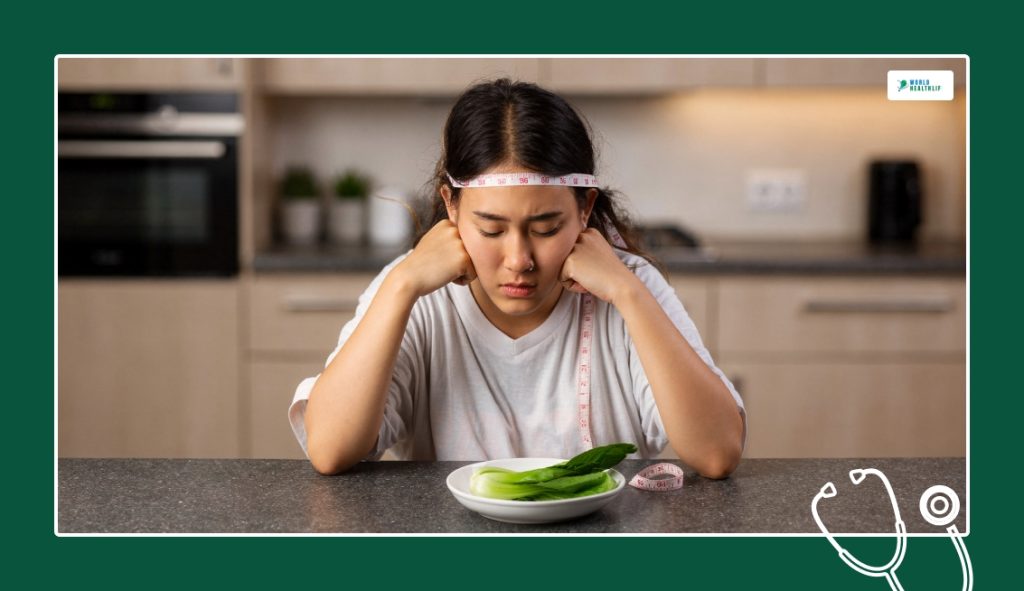
If the behavior is rigid, secretive, and emotionally loaded, it deserves attention. In fact, earlier intervention is much easier than crisis repair. This is necessary when restriction has started to shape identity.
The following are some signs that show up:
- Meals become something to earn, and normal eating triggers guilt or panic.
- Calorie tracking turns obsessive, and the numbers never feel low enough.
- Social plans get avoided because food is involved or the menu feels out of control.
- Self-worth rises and falls with weigh-ins or daily sharpness checks.
What To Do If You Are Affected?
Start with the simple basics, since it is stable at the outset. Take the following steps early:
- Always treat regular meals, adequate protein, and sleep as non-negotiable.
- Focus on training and exercises. They work better if you focus on strength and performance rather than punishment.
- Manage social media triggers by changing the environment. Try unfollowing, muting, resetting the feed, and taking breaks that feel uncomfortable at first.
That discomfort is often withdrawal from comparison habits, not failure. If the loop feels stuck, look for professional support. In fact, you might reach out to a registered dietitian familiar with men’s fitness culture. Also, a therapist can untangle the control and anxiety piece without moralizing it.
Frequently Asked Questions (FAQs)
Not always, but overlap is common. In fact, a practical question is whether the behavior is harming health, relationships, or the ability to think clearly. If your daily life revolves around restriction and checking, take it seriously.
Sometimes facial fullness changes. However, improvement is subjective, and the trade-offs can be steep. Many people confuse being depleted with being defined. The result may look sharper, but it can also look unwell.
Comparison works like a habit, not a moral failure. Try to reduce exposure. However, it is not only about deleting apps. It is also about noticing which content produces shame, restlessness, or compulsive checking. Try to replace that input with things that support capability, health, and real confidence.
Seek professional help in those situations:
• Loosening food rules causes anxiety
• Mood and sleep are sliding
• Training performance drops
• Friends notice changes
• Eating normally feels scary.
Early support tends to be simpler and less disruptive than waiting for a crash.
Take Your Health Seriously
Men deserve better than trends that turn hunger into a personality trait. Basically, the face being judged is attached to a nervous system, a heart, hormones, and a mind that needs steadiness, not constant alarm.
Additional Reading:


