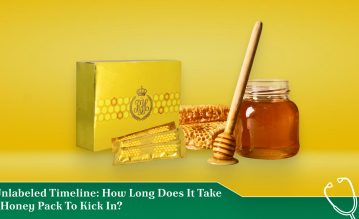
They promise you 72 hours of peak performance in a single natural sachet. But do you know what happens when the buzz fades, and the risks start to set in?
Manufacturers design honey packs as single-serve sachets that blend pure honey with herbal extracts such as ginseng, maca, or guarana.
Moreover, the product is marketed towards men who are in search of something that enhances their energy, libido, and stamina.
For consumers who evaluate these supplements, understanding how long does a honey pack lasts is essential.
There is a critical difference between a product’s physical shelf life on a cupboard shelf and the actual duration of its metabolic effects after consumption.
When you misunderstand these timelines, it can cause financial waste, diminished results, or adverse health risks.
Using expired packs or overconsuming the mixture increases the likelihood of side effects, making an objective and fact-based breakdown vital for safe consumer choices.
What Is a Honey Pack?

Sold in small 15-to-25-gram sachets, honey packs are widely available in retail shops and online marketplaces.
Marketing campaigns make frequent promises of rapid and long-lasting performance enhancements under the guise of “natural” and “safe” formulations.
However, consumers are required to treat these items as unregulated dietary supplements instead of clinical medications. No major medical or regulatory groups endorse their health claims.
How Long Does A Honey Pack Last: Two “Lasts” To Understand

The word “lasts” can confuse people because it has two different meanings. First, it can mean shelf life. For instance, how long an unopened pack stays safe to use. Second, it can mean how long the effects last after you take it. These two are completely different.
Shelf life is about preventing spoilage. Effect duration is about what a user might feel, if anything. So let’s clear this up now. The next sections explain each one separately.
Lasting In Terms Of Expirations And Shelf Life: Safety Timelines
Pure, unadulterated honey has an exceptionally low moisture content and low pH, which is around 3.9. Accordingly, this prevents bacterial growth indefinitely. However, packaged honey packs do not share this eternal shelf life.
The inclusion of plant extracts, herbal stabilizers, and moisture-rich flavorings means the mixture will eventually degrade.
A factory-sealed honey pack typically remains safe and stable for 12 to 24 months. That is, if kept in a cool, dry environment below 77°F (25°C).
After this 1-to-2-year window, the herbal additives lose potency, and the risk of fermentation or mold growth increases significantly.
Consuming an expired pack can cause acute stomach irritation, cramps, and nausea.
Thus, always check the “Best Before” date on the foil packaging before use. Moreover, shelf life is a strict safety boundary, instead of just a flexible suggestion.
Lasting In Terms Of Effect Duration: Reality Vs. Marketing Claims
Promotional ads often assert that a single sachet delivers 24 to 72 hours of heightened stamina.
From a medical standpoint, there is no clinical evidence supporting these long-term physiological changes.
If a user experiences an initial surge in energy or performance within 30 to 60 minutes of consumption, it is typically driven by standard metabolic factors:
- the rapid absorption of simple sugars on an empty stomach
- a caffeine boost from ingredients like guarana
- a strong placebo effect.
These verified physiological responses peak within 1 to 2 hours and completely fade within a maximum of 4 hours.
Daily or frequent consumption is highly discouraged by clinicians, as regular use increases exposure to untested ingredient combinations.
Why Doctors Are Cautious About Honey Packs
This is the part most supplement marketing skips.
From a medical point of view, honey packs raise concern because they promise sexual or energy benefits without strong clinical evidence. Unlike prescribed treatments, these products are not required to prove safety or effectiveness before being sold.
That’s why doctors and public‑health sites tend to approach honey packs carefully. Not because honey itself is dangerous, but because some products have later been found to contain hidden prescription‑strength ingredients.
In short, the caution isn’t about honey. It’s about what else might be inside the sachet.
Shelf Life: How Long Does a Honey Pack Last Before It Expires?

Pure honey lasts almost forever. But packs change that. Meanwhile, that raises the question: how long does a honey pack last? Let’s see the details.
General Shelf Life of Honey
How long does a honey pack lasts is debatable. But pure honey never spoils if stored right. But why? Firstly, because it has low water, about 18 percent. This low water concentration prevents bacteria from accumulating. It also stops bacterial invasion from outside.
The acid level is low, too. In addition, the pH is 3.9. A sealed jar in a dark spot works quite well to improve the shelf life. In the same vein, archaeologists found edible honey in old tombs. That is a real fact, not a myth.
Packaged Honey Pack Shelf Life
When companies mix herbs into honey packs, the product simply doesn’t last as long. Those plant extracts lose their strength faster than honey does. The kind of packaging matters too.
Foil packets help keep out air and light. Two things that make the mixture spoil sooner. And nothing ruins a pack faster than a hot or humid place.
Most of these sachets last about a year or two, depending on who makes them and what they put inside. That’s why the expiry or “best before” date is worth checking every time.
For storage, a normal room‑temperature shelf works fine. Keep it dry and below roughly 77°F (25°C). Heat above 95°F (35°C) can break down the herbs, and moisture encourages mold. Different brands have their own guidelines, so it’s always smart to follow whatever the box or pouch suggests.
Evaluating Contamination And Product Spoilage
Because dietary supplements do not face rigorous pre-market approval from regulatory agencies like the FDA, public health organizations approach honey packs with high caution.
Laboratory testing has repeatedly revealed that multiple brands contain undeclared prescription-strength drugs, such as sildenafil or tadalafil. This is the active pharmaceutical ingredients in erectile dysfunction medications.
These hidden compounds pose severe cardiovascular risks, particularly for individuals taking nitrate medications or blood pressure pills, as they can cause a dangerous, sudden drop in blood pressure.
To ensure safety, inspect the packet before opening. Discard the sachet immediately if it exhibits any of these signs of spoilage:
- A sour, alcoholic, or fermenting odor.
- A darkened, uneven, or faded color profile.
- A separation of texture that makes it overly watery or yields gritty deposits.
- Structural bloating, swelling, or leaks in the foil packet.
Note: Natural crystallization is common in honey and can be reversed with mild warmth, but visual mold growth or bubbling means the pack must be thrown away.
Shelf Life vs Safety: Why Expired Packs Are Riskier Than They Look
Expired honey packs aren’t just weaker. They may be unsafe.
Once herbs degrade, moisture increases, or fermentation begins, irritation and stomach upset become more likely. Mold growth, even in tiny amounts, can cause reactions that feel far worse than “no effect.”
Medical sites tend to be strict about this: If a supplement has expired, don’t “test” it. Discard it. Remember, shelf life is not a suggestion. It’s a line.
Effect Duration: How Long Does a Honey Pack Last After Consumption?

Most ask this for performance. What time do benefits stay? The answer is tricky. Yet, there is no strong proof that they work.
Clarifying Expectations
Users expect an energy surge, a libido boost, and increased stamina. Ads claim 30 minutes to start, hours long. Pero, no clinical trials back this. In the same vein, note that the FDA has found no evidence for the claims. There are subjective feelings only.
What Medical Editors Agree On (A Reality Check)
Across reputable health sites, there is broad agreement on a few key points:
- Honey packs are not proven treatments for sexual dysfunction
- Reported benefits vary widely and are often short‑lived
- Any “effect” usually fades within a few hours if it appears at all
- Long‑term safety data are lacking
This doesn’t mean every product is harmful. It means evidence is thin, and expectations should stay grounded.
Medical editors focus less on whether something might work once, and more on whether it’s safe and reliable to use repeatedly. That’s where honey packs fall short.
Perceived Effects vs. Actual Physiology
If you are expecting real effects from honey, the sugar rush it can give you can. As a result, you will get a quick rush of energy around 1 to 2 hours. After that, what you experience is the placebo effect only.
But what are the other factors that create a difference? Firstly, there is ginseng, the product that adds value. It can boost your libido even if mildly. However, if you want more pep, you can get that too.
The guarana contains caffeine that gives the pep. Yet, you must know that there is no clear or direct connection between the same and sexual performance.
If you are on an empty stomach, your body will absorbthe elements really quickly. In fact, your performance may boost in 30 to 60 minutes after consumption. After that, it fades away within a span of 4 hours max.
When a Honey Pack Is the Wrong Tool Altogether
A honey pack is especially the wrong choice if:
- Erectile problems are ongoing or worsening
- Performance issues are linked to stress, diabetes, heart disease, or hormones
- You need predictable, repeatable results
In these cases, masking symptoms with supplements delays proper care. That’s why medical guidance consistently points men toward professional evaluation instead of self‑experimentation.
Temporary boosts, real or perceived, don’t replace diagnoses.
Safety Considerations

Safety first, always. Risks hide in many packs.
The FDA And Regulatory Reality (Why Oversight Is Limited)
Honey packs are sold as dietary supplements. That label matters.
In the U.S. and many other countries, supplements are not approved by regulators before they hit the market. Agencies like the FDA step in after problems are found—usually through consumer complaints or lab testing.
This is why you’ll see repeated public warnings about honey‑based enhancement products. Tests have uncovered undeclared drugs like sildenafil or tadalafil in some brands.
These substances can lower blood pressure and interact dangerously with heart or nitrate medications. When they’re hidden on the label, users can’t make informed choices.
That risk is why medical sites consistently advise caution, even if some users report short‑term effects.
Potential Risks
FDA finds hidden drugs in the composition of some brands, like sildenafil or tadalafil, as there is in Viagra. None of these elements is listed. Such compositions can easily cause headaches, low BP, and heart issues.
However, some people also have allergic reactions to bee parts. Remember that mixing honey packs with meds is dangerous. Especially, don’t take it with nitrates or BP pills. Long-term daily use is also untested.
Why “Natural” Claims Can Be Misleading
“Natural” doesn’t automatically mean harmless. In the same vein, remember that honey is natural. At the same time, herbs are natural. But once ingredients are concentrated, processed, or combined, their effects change. The body doesn’t distinguish between “natural” and “synthetic” the way marketing does.
Some honey packs lean on nature‑based language to imply safety. In reality, safety depends on dose, purity, and transparency. None of which are guaranteed in loosely regulated supplements.
This is one reason medical editors emphasize skepticism. Claims should always be backed by testing, not branding.
How to Store a Honey Pack to Maximize Longevity
To safely preserve unexpired sachets for their full intended lifespan, keep them in a cool, dry place at standard room temperature. This includes areas such as a dark pantry or kitchen cupboard.
Avoiding direct sunlight is crucial. This is because ultraviolet rays actively break down the delicate plant molecules and herbal nutrients.
Consequently, it severely diminishes the potency of the mixture.
Storing the packets inside their original box provides an effective secondary barrier against light exposure.
Finally, establish a routine to physically inspect your inventory once a month for any subtle leaks, bloating, or texture changes.
That is to be done while ensuring the product remains safe before use.
Optimizing Storage And Seeking Sustainable Care
To safely maximize the longevity of unexpired packs, store them away from direct sunlight. This actively breaks down organic nutrients and diminishes product stability.
Keep the sachets inside their original box to provide a secondary light barrier, and inspect your inventory monthly for physical changes.
Ultimately, temporary dietary supplements are the wrong tool for addressing chronic health issues.
Masking the symptoms with a sachet delays necessary medical treatment if stress, diabetes, cardiovascular disease, or hormonal imbalances cause performance challenges or low energy.
The safest, most reliable path to sustained vitality involves evidence-based lifestyle changes:
- Prioritizing consistent sleep hygiene and stress management.
- Conducting a professional medication review to identify side effects from existing prescriptions.
- Seeking clinical screenings for blood pressure, blood sugar, and hormone levels.
- Using targeted, professional therapies supervised by a qualified healthcare provider.
Always Keep Realistic Explanations About Effectiveness
Honey packs have two different meanings of “lasts.” The first is shelf life, which usually ranges from 1–2 years when stored properly in a cool, dry place. Checking dates and packaging helps prevent spoilage or mold. Moreover, now you know how long does a honey pack lasts.
The second meaning is how long the effects last after taking one. Most users report 2–4 hours, but that’s only if they feel anything at all. There’s no solid scientific evidence that honey packs improve performance, so expectations should stay low.
Safety matters most. Watch expiration dates, be cautious of hidden drugs, and talk to a healthcare professional if you have ongoing sexual health concerns like erectile dysfunction. Labels help, but not all brands are trustworthy.
Trends come and go. However, facts and your health stay.
Disclaimer: The information provided in this article is for general informational purposes only. It does not, and is not intended to, constitute medical or health advice. Please consult a qualified healthcare professional for medical guidance or expert health assistance.