
Misdiagnosis is one of the most terrifying hurdles a patient can face in modern medicine. That is especially true when a rare disease successfully disguises itself as a common neurological condition.
One such condition is Susac syndrome, which is a prime example of this medical trickery. The disease quietly orchestrates an attack on the body’s smallest blood vessels while presenting symptoms leaving doctors baffled.
Due to these similarities, Susac syndrome frequently mimics Multiple Sclerosis (MS) during initial clinical testing. As a result, this leads to dangerous treatment delays while the body actively attacks its own sensory organs.
In order to prevent permanent and irreversible loss of function, catching this deceptive illness in its earliest stages is absolutely paramount.
In order to help you understand this complex condition, we have put together a comprehensive guide detailing everything you need to know.
From identifying the very first warning signs to exploring the latest medical therapies, this overview covers the essential facts. Read on to discover how modern medicine tackles this rare autoimmune challenge.
Fast Facts About Susac Syndrome
| Feature | Description |
| Disease Type | Rare autoimmune endotheliopathy (blood vessel lining disease) |
| Primary Targets | Brain, retina (eyes), and cochlea (inner ears) |
| Classic Hallmark | The clinical triad of encephalopathy, BRAO, and hearing loss |
| Main Mimic | Frequently misdiagnosed as Multiple Sclerosis (MS) |
| Average Duration | Active disease usually lasts between 1 to 3 years |
Susac Syndrome: A Deep Dive
First, let us understand Susac syndrome.
It is a rare autoimmune disease that primarily affects the smallest blood vessels in the human body. Specifically, the condition targets the tiny capillaries that supply blood to the brain, eyes and the inner ears.
When these microscopic pathways become blocked, cells start to starve for oxygen while losing their ability to function properly.
Medical experts categorize Susac syndrome as an occlusive microvascular endotheliopathy.
While that medical term sounds incredibly complicated, it simply means that the inner lining of small blood vessels becomes swollen and blocked.
Consequently, patients experience a very specific combination of neurological, visual, and hearing issues. Medical professionals often classify the ailment as a self-limiting disease.
Eventually, the disease runs its course and stops attacking. However, the active phase can last for several years, causing significant harm if left untreated.
Thus, understanding the underlying mechanism is the first step towards effective illness management.
The History Behind The Name: Where It Originates From
The name of this condition traces back to Dr. John Susac, an American doctor who first discovered the disease in 1979. He noticed a strange pattern of brain and eye issues while treating two young female patients.
Consequently, another famous physician named Dr. William Hoyt officially labeled the disease “Susac syndrome” to honor this breakthrough.
Today, medical professionals all around the globe recognize this name.
Breaking Down the Medical Jargon
Doctors often use a much longer, twenty-six-letter name for this condition. That is retinocochleocerebral vasculopathy. While this word intimidates many people, a medical description actually just glues three body parts together.
Specifically, “retino” means the eye, “cochleo” means the inner ear, and “cerebral” means the brain. Ultimately, adding “vasculopathy” to the end simply means that a blood vessel disease is damaging those three specific areas.
The Classic Triad Of Symptoms
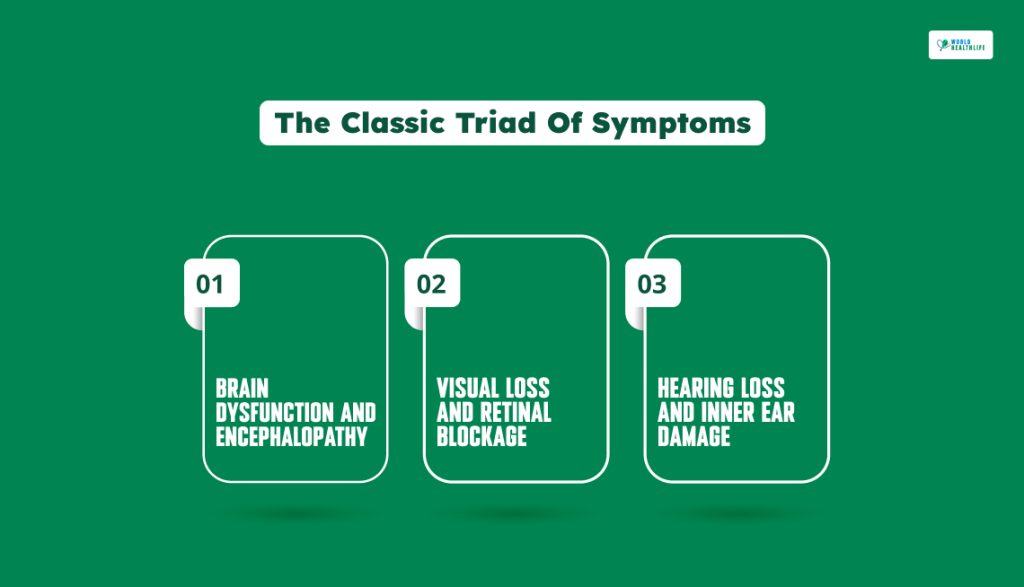
Recognizing the symptoms of Susac syndrome can be quite a challenge. The reason behind this is that they do not always appear at the exact same time. Doctors refer to the signature presentation of this condition as the classic triad.
Here, the triad represents the three main areas of bodily damage. Consequently, a patient might visit three different specialists before anyone connects the dots.
To make matters more confusing, some individuals only develop one or two of these signs during the early stages of their illness. Nevertheless, understanding each component of the triad is vital for an accurate and timely evaluation.
Let us take a closer look at how the disease alters the brain, eyes and ears.
Brain Dysfunction And Encephalopathy
The neurological portion of this disease can cause sudden and terrifying changes in a person’s daily cognitive abilities.
Because blocked capillaries deprive the brain of oxygen, individuals often experience severe and constant headaches or migraines.
Additionally, patients may suffer from memory loss, confusion, personality changes or even psychiatric symptoms such as paranoia. These mental shifts can happen rapidly, making it difficult for the person to work or communicate normally.
Visual Loss And Retinal Blockage
The visual symptoms are usually caused by a specific issue known as Branch Retinal Artery Occlusion. People often abbreviate this as BRAO.
When the tiny arteries in the retina become blocked, sections of the eye’s light-sensing tissue begin to fail.
As a direct result, patients will notice dark spots, blind spots, or a sudden painless loss of vision in one or both eyes. Medical intervention must restore blood flow quickly to prevent permanent vision gaps.
Hearing Loss And Inner Ear Damage
The final part of the symptom triad involves the inner ear, which relies heavily on microscopic blood vessels for oxygen. When these vessels clog, patients usually suffer from sudden hearing loss.
Usually, this targets low-frequency sounds first.
Furthermore, this damage is frequently accompanied by a constant ringing in the ears. Doctors medically know this symptom as tinnitus.
Many individuals also experience severe dizziness or vertigo. Consequently, this makes it incredibly hard to maintain physical balance while walking.
What Causes Susac Syndrome?
The exact root cause of Susac syndrome remains a mystery to the global medical community. However, researchers know that it is an autoimmune disorder instead of an inherited genetic mutation or an infectious illness.
Thus, you cannot catch this condition from someone else, nor do you pass it down to your children.
In a healthy body, the immune system creates specialized proteins called antibodies to fight off dangerous invaders such as viruses.
But in this specific condition, the immune system mistakenly creates autoantibodies that target the body’s own healthy tissue.
Specifically, these rogue proteins attack the endothelial cells that form the smooth inner lining of your blood vessels.
Damaged endothelial cells swell up and trigger tiny blood clots that block the flow of blood entirely.
Although doctors still have no exact knowledge on what triggers this autoimmune mistake, early intervention can successfully calm the immune system down.
| Vessel Condition | Endothelial Cell Status | Blood Flow Status | Oxygen Delivery |
| Healthy Capillary | Smooth, undamaged inner lining | Flows freely and constantly | Normal delivery to brain, eyes, and ears |
| Susac Syndrome Capillary | Swollen and inflamed from autoantibody attacks | Blocked by tiny micro-clots | Severe oxygen deprivation leading to tissue damage |
How Is Susac Syndrome Diagnosed
Diagnosing Susac syndrome requires a highly detailed medical investigation because its symptoms look identical to other neurological conditions.
For instance, doctors initially tell many patients they have Multiple Sclerosis (MS), acute disseminated encephalomyelitis, or even a stroke.
Because of these similarities, doctors must use a combination of advanced diagnostic tests to confirm the truth. By gathering evidence from the brain, eyes, and ears simultaneously, they can establish a definitive diagnosis.
To solve this medical mystery, physicians evaluate all three parts of the classic symptom triad using specialized equipment. Let us look at the specific tests used to identify how this condition leaves its unique fingerprint across the body.
| Diagnostic Test | Target Organ | What Doctors Look For | MS Differentiation |
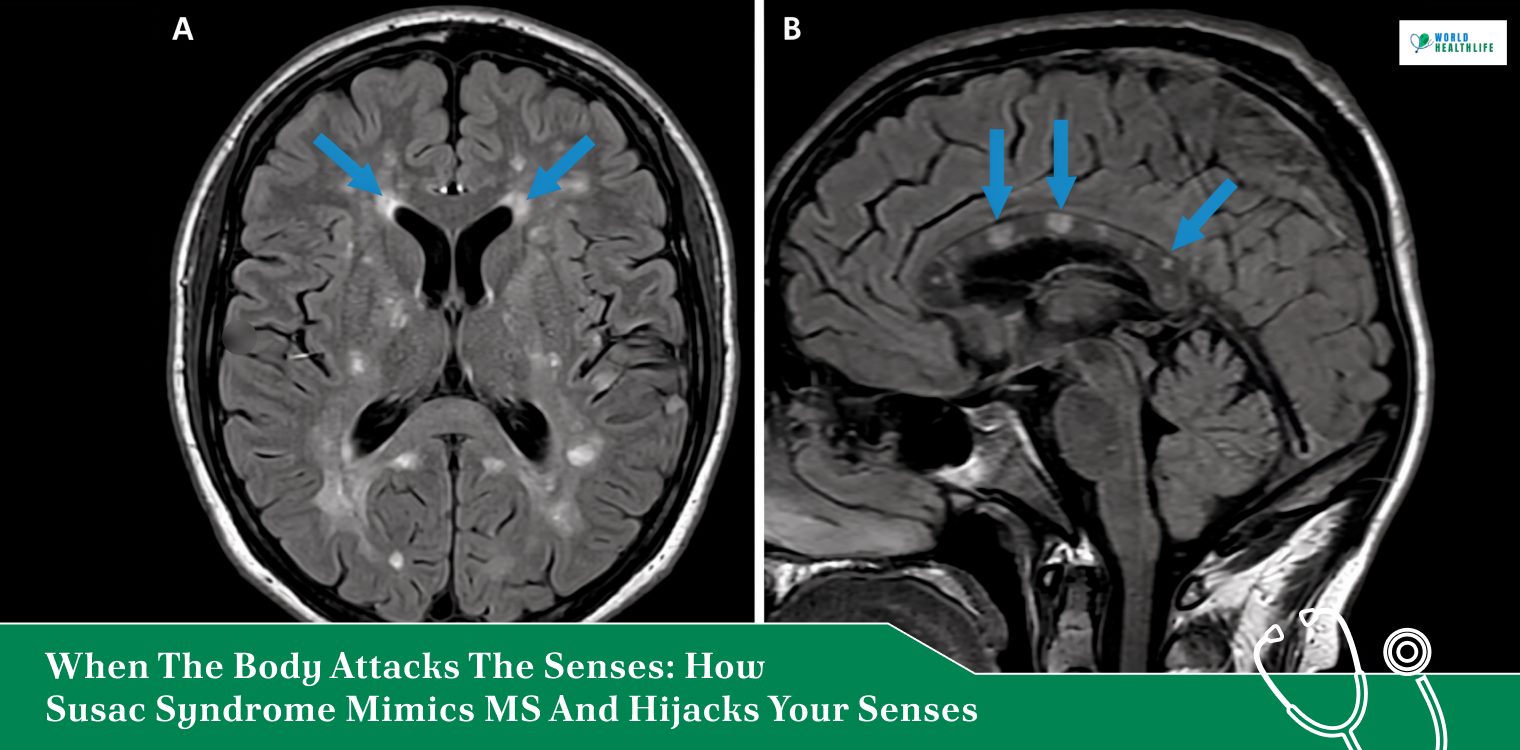
| Advanced Brain MRI | Brain | Central “snowball” lesions specifically in the corpus callosum | MS lesions usually appear in different brain regions |
| Fluorescein Angiography | Eyes / Retina | Blocked retinal arteries (BRAO) via a glowing fluorescent dye | MS does not cause branch retinal artery blockages |
| Comprehensive Audiogram | Inner Ears | Sharp drop in the patient’s ability to hear low-frequency sounds | MS hearing loss is rare and rarely targets low tones |
Treatment Options And Outlook
Treating Susac syndrome requires an aggressive approach to suppress the overactive immune system and protect vital organs from further damage.
Because every patient experiences a slightly different level of severity, treatment plans must be customized by a team of medical specialists.
Thankfully, modern therapies are highly effective at stopping the progression of the disease.
The primary goal of medical therapy is to reduce blood vessel inflammation and prevent new blockages from forming in the capillaries.
Let us examine the standard medications and long-term expectations for individuals living with this rare condition.
| Medication Category | Common Examples | Primary Purpose in Treatment |
| Corticosteroids | Methylprednisolone, Prednisone | Quickly lowers severe inflammation during an acute attack |
| Immunosuppressants | Rituximab, Mycophenolate Mofetil | Suppresses the immune system long-term to prevent relapses |
| Immunoglobulins | IVIg (Intravenous Immunoglobulin) | Provides healthy antibodies to reset the immune system |
| Antiplatelet Therapy | Aspirin | Keeps blood flowing smoothly and prevents capillary clots |
The Long Term Outlook: Living With Susac Syndrome
Doctors generally project a positive long-term outlook for individuals with this condition, provided they diagnose and treat the illness early.
For the vast majority of people, the active disease process naturally burns out completely after one to three years.
However, any damage done to the eyes or inner ears during the active phase can sometimes be permanent. While vision can often stabilize, some patients may require hearing aids or cochlear implants to regain their hearing.
In summary, Susac syndrome is a rare but manageable autoimmune condition that demands quick medical attention.
By recognizing the classic triad of brain, eye, and ear symptoms, doctors can implement life-changing treatments before permanent damage occurs.
If you or a loved one are experiencing unexplained neurological changes alongside vision or hearing issues, seek expert medical advice immediately.
With the right combination of modern therapies, patients can successfully navigate this rare disease and look forward to a full recovery.
References:
- Karalok ZS, Taskin BD, Guven A, Ucgul CA, Aydin OF. Susac’s Syndrome (Retinocochleocerebral Vasculopathy): Follow-up of a Pediatric Patient. J Pediatr Neurosci. 2017 Oct-Dec;12(4):374-377. doi: 10.4103/jpn.JPN_128_17. PMID: 29675082; PMCID: PMC5890563.
- Branch retinal artery occlusion – EyeWiki. (2025).


