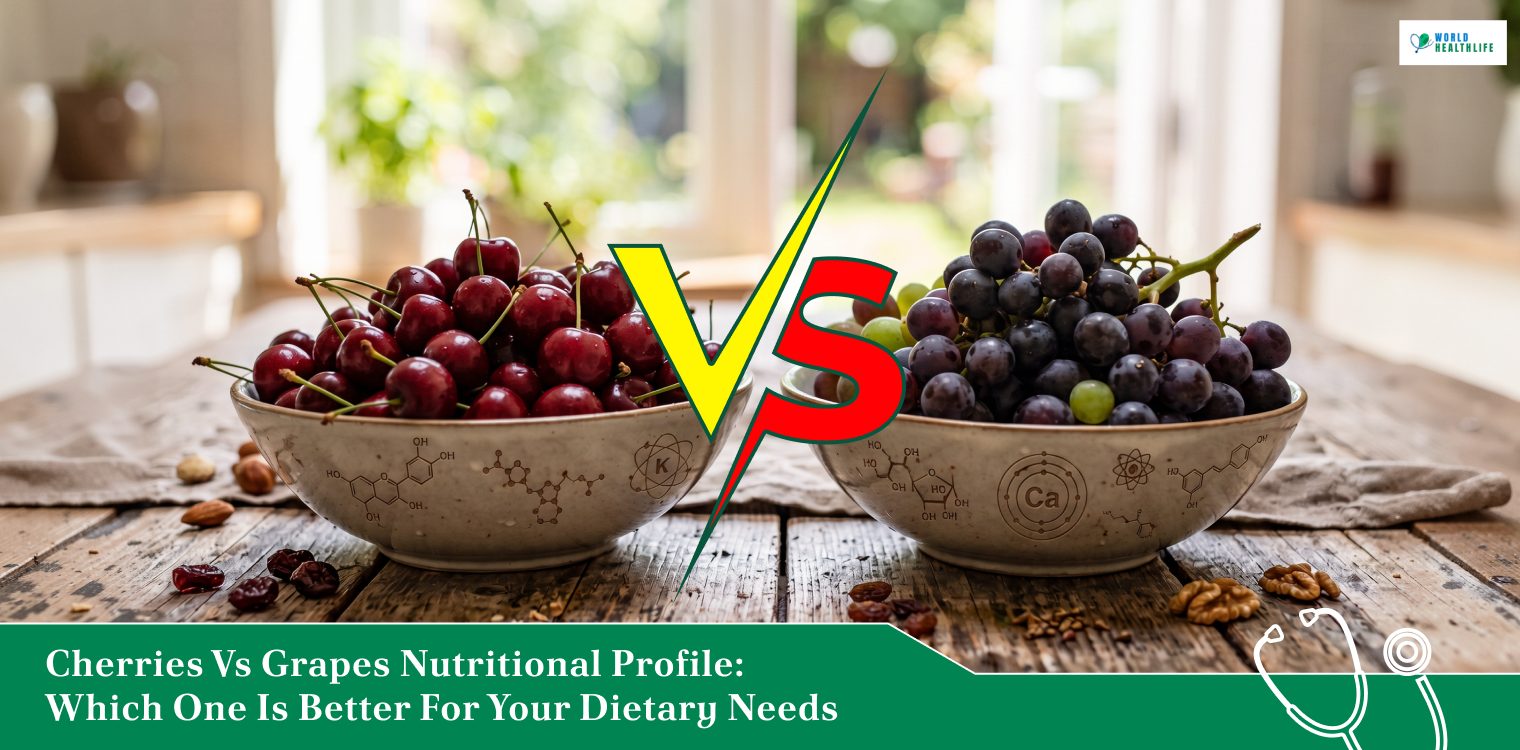
Every time I walk into the produce section, the massive wall of colorful fruit options waiting for us blows me away.
Among all these choices, I always find myself reaching for the two classic crowd-favorites. They are fresh cherries and juicy grapes.
They both look like the perfect and easy snack to toss into your cart. Also, they give you that amazing burst of natural sweetness and deep color that tells you they are loaded with healthy plant nutrients.
However, if you look past the glossy skin, these two fruits actually work in completely different ways once they enter your body.
Choosing between them is a choice that directly impacts your daily energy, blood sugar stability, and long-term health goals.
But to really see how they affect your metabolism, we need a close look at the cherries vs grapes nutritional profile.
This comparison will show that one will usually serve your body much better than the other, depending on your needs.
The Macro Battle: Calories, Carbohydrates, And Fiber
To discover a food’s true ingredients, I check the macronutrients first.
Checking the balance of energy, carbs, and sugars gives you a perfect roadmap of the way your body will process it.
People usually make assumptions that all small fruits have the same amount of calories. Even a 100-gram serving reveals some very interesting differences.
Let us examine how fresh and raw sweet cherries stack up against raw red or green European-type grapes in their base components.
| Macronutrient Element (Per 100g) | Cherries | Grapes |
| Total Energy (Calories) | 71 kcal | 69 kcal |
| Total Carbohydrates | 16.2 g | 18.1 g |
| Dietary Fiber Content | 2.1 g | 0.9 g |
| Net Available Carbs | 14.1 g | 17.2 g |
| Total Protein | 1 g | 0.7 g |
| Total Lipids (Fat) | 0.2 g | 0.2 g |
| Total Sodium | 0mg | 0mg |
Energy Density And Caloric Volume
As you can see in the data, grapes and cherries have a similar calorie count, with just a slight difference. Despite cherries having a slightly higher calorie count at 71 kcal against the grapes’ 69, the two are close to even.
There is only a two-calorie difference between the two fruits.
Cherries can be seen to have a higher dietary fiber content, 2.1g, compared to that of grapes, which is less than 1g. That leaves us with grapes having higher net available carbs.
Net carbs are the actual sugars your body absorbs and turns into daily fuel after subtracting the fiber.
Since cherries have fewer net carbs and slightly more protein, they offer a much more balanced setup for low-carb goals. That is, despite the lower calorie difference.
The Structural Satiety Power Of Dietary Fiber
The most profound metric in this initial macro battle is the stark disparity in dietary fiber content.
Cherries contain more than double the structural fiber found in an identical portion of grapes. Fibre serves as the ultimate metabolic brake pad in nutrition. This actively slows down the rate at which stomach contents empty into your small intestine.
This structural difference means that a serving of cherries provides prolonged physical satiety. It signals your brain that you are full and effectively prevents the urge to overeat later in the day.
Conversely, the lower fiber architecture of grapes means they pass through your digestive system much faster, making them a less efficient tool for sustained appetite control.
Glycemic Index And Blood Sugar Dynamics
For anyone tracking prediabetes, type 2 diabetes, or just making efforts to avoid energy crashes, sugar speed is everything.
Every single carb you consume eventually turns into simple sugar. But the speed of that shift changes your whole day.
This determines whether you get a steady stream of smooth energy or a wild ride of insulin spikes or crashes.
In order to track this, we have to look at the Glycemic Index (GI). This rates food on the basis of how fast they raise blood sugar.
When we analyze the Nutritional profile of cherries vs grapes through a glycemic lens, we discover one of the most dramatic differences in the entire fruit kingdom.
Sweet cherries boast an incredibly low Glycemic Index rating. Typically, this hovers around 22 to 25. If you opt for tart cherry varieties, that number drops even lower.
This remarkably low score means that the sugars present in cherries are bound tightly within a complex fibrous matrix.
It also requires significant digestive processing before entering the bloodstream.
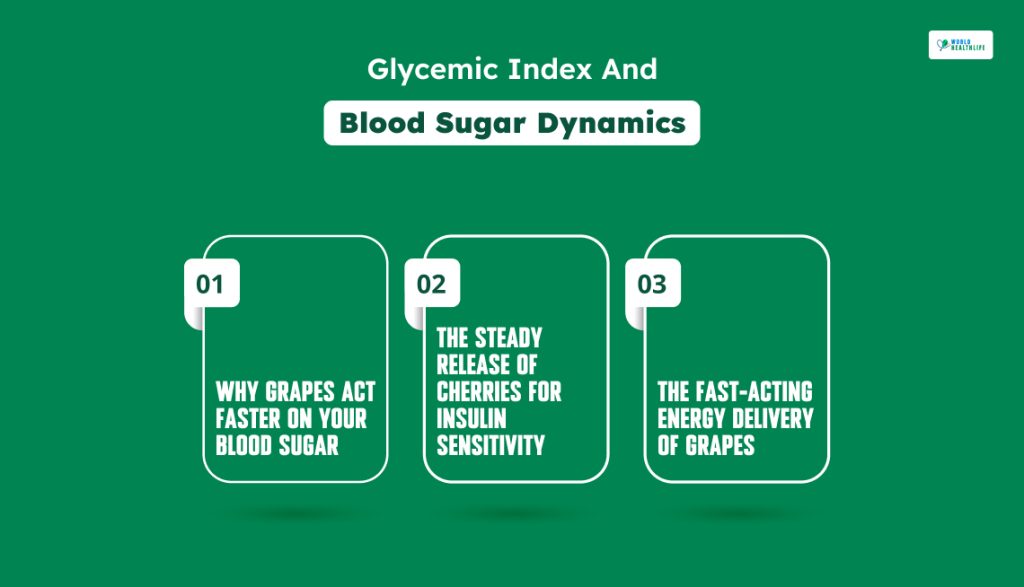
Why Grapes Act Faster On Your Blood Sugar
Grapes occupy a completely different space on the glycemic spectrum, registering a moderate GI score of approximately 53.
While still technically classified as a low-to-moderate GI food compared to refined white bread or tropical fruits like mangoes and pineapples, grapes behave much more aggressively in your body.
The primary sugars in grapes are glucose and fructose in nearly equal proportions. Since they lack a heavy fiber barrier, they enter your bloodstream with minimal systemic resistance.
This swift absorption triggers a faster, more pronounced release of insulin from your pancreas to clear that glucose from circulation.
The Steady Release Of Cherries For Insulin Sensitivity
Since cherries rank so low on the Glycemic Index, they offer a protective effect for your pancreas.
By preventing sudden surges in blood glucose, your body releases less insulin overall.
This helps preserve long-term insulin sensitivity along with preventing weight gain around the abdomen.
The Fast-Acting Energy Delivery Of Grapes
For an endurance athlete, or anyone who needs to bounce back quickly after a hard session, the fast delivery system of grapes is a real advantage.
The easily accessible simple sugars replenish depleted muscle glycogen without overworking an already tired digestive tract.
If your primary goal is to minimize pancreatic strain, maintain perfect daytime energy, and prevent the cellular inflammation associated with frequent glucose swings, cherries are the uncontested winner of this round.
Micronutrient Blueprint: Vitamins And Minerals
Beyond the world of calories and macronutrients lies the complex realm of micronutrition.
Vitamins and minerals act as the essential co-factors for thousands of enzymatic reactions.
They keep your cells running efficiently, supporting everything from cellular respiration to bone matrix mineralization.
A deep dive into the cherries vs grapes nutritional profile reveals that neither fruit is universally superior across the board.
Rather, they have evolved to specialize in completely different micronutrient categories.
Let us look closely at how a standard serving provides for your daily nutritional requirements, highlighting the percentage of your daily recommended intake for key elemental assets:
| Micronutrient Value (Per 100g) | Sweet Cherries (% Daily Value) | Fresh Grapes (% Daily Value) |
| Vitamin C (Ascorbic Acid) | 10% DV | 4% DV |
| Vitamin K (Phylloquinone) | 3% DV | 12% DV |
| Vitamin A (Beta-Carotene) | 1% DV | 1% DV |
| Potassium (Electrolyte) | 5% DV | 4% DV |
| Copper (Trace Mineral) | 4% DV | 6% DV |
| Manganese (Enzyme Activator) | 4% DV | 4% DV |
Where Cherries Dominate: Immunity And Blood Pressure
| Nutrient Focus | Why Your Body Needs It | Why Cherries Are the Winner |
| Vitamin C & Immunity | Builds skin collagen and helps your white blood cells fight off winter bugs. | Gives you more than double the amount of Vitamin C found in grapes. |
| Potassium & Heart Health | Relaxes blood vessels to keep your daily blood pressure numbers balanced. | Packs a heavy hit of 230mg of potassium to flush out excess dietary sodium. |
Where Grapes Dominate: Bone Density and Blood Flow
| Nutrient Focus | Why Your Body Needs It | Why Grapes Are the Winner |
| Vitamin K & Bones | Acts like a traffic cop for calcium, guiding it straight into the bone matrix. | Delivers a solid 12% of your daily required intake per single serving. |
| Copper & Metabolism | Essential trace mineral needed for iron absorption and daily energy production. | Offers a superior concentration to support blood circulation and red cells. |
Bone Matrix Mineralization With Vitamin K
Grapes stage a major comeback when we shift our focus toward bone density as well as blood coagulation metrics.
Grapes are an elite source of Vitamin K. It also offers an impressive 12% of your daily required intake per 100 grams. This vitamin is a fat-soluble one, acting as the primary traffic controller for calcium in the human body.
When you do not have adequate Vitamin K in your body, the calcium you ingest cannot be properly bound to your skeletal matrix. The risk of arterial calcification and bone fragility increases.
Grapes also offer a superior dose of copper along with a trace of minerals that are necessary for iron absorption and the production of red blood cells.
Bioactive Phytochemicals: Anthocyanins Vs. Resveratrol
Vitamins are great, but the real magic of these fruits comes from their deep, dark color pigments.
Plants make these unique compounds to protect themselves from harsh sunlight and outdoor stress.
When we eat these fruits, those same protective chemicals turn into powerful shields for our own cells.
The absolute most exciting part of the cherries vs grapes nutritional profile comes down to these unique plant antioxidants.
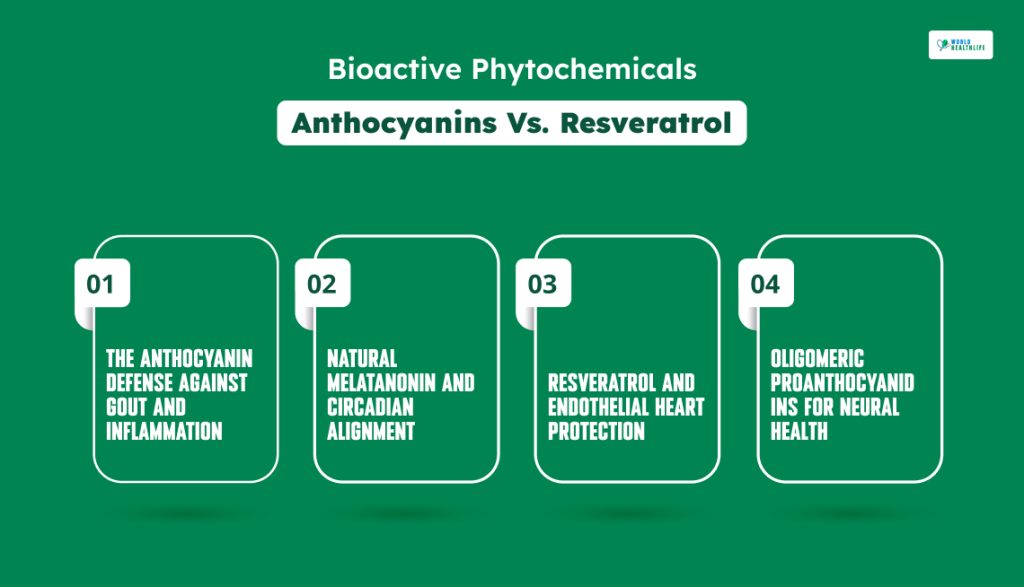
The Anthocyanin Defense Against Gout And Inflammation
The deep red and purple coloration of sweet and tart cherries is driven by a massive concentration of anthocyanins.
These specific polyphenols are legendary in clinical research circles for their profound anti-inflammatory properties.
They act via pathways that mimic those of common over-the-counter pain medications.
Anthocyanins work by selectively inhibiting cyclooxygenase enzymes. These are also the primary pathways responsible for generating inflammatory pain signals throughout your body.
This biochemical action makes cherries an incredibly effective natural remedy for individuals with inflammatory joint disorders, particularly gout.
In this context, gout is triggered by an accumulation of excess uric acid in the bloodstream. Eventually, it crystallizes inside the joints of the feet and hands.
Regular consumption of cherries has been clinically shown to help the kidneys filter out excess uric acid. It also simultaneously calms the local tissue inflammation.
Natural Melatonin And Circadian Alignment
Cherries are one of the incredibly rare and naturally occurring whole-food sources of melatonin.
Melatonin is the foundational neurohormone.
It is produced by your pineal gland to communicate the transition from day to night, directly regulating your sleep-wake cycles.
By introducing exogenous plant-based melatonin into your evening routine through fresh cherries, you can gently support your body’s natural circadian biology.
This paves the way for deeper and more restorative sleep cycles without the grogginess associated with synthetic sleep aids.
Resveratrol And Endothelial Heart Protection
Grapes answer this challenge by offering one of the most celebrated and thoroughly researched longevity molecules in modern medical science. That is resveratrol.
Found predominantly within the delicate skins of red and purple grapes, resveratrol is a specialized stilbenoid compound. Moreover, plants produce it in response to fungal attacks or physical injury.
In human biology, resveratrol acts as a powerful protector of the cardiovascular matrix. It works diligently to defend your blood vessels from everyday wear and tear.
Resveratrol achieves this by stimulating the production of nitric oxide within the endothelial lining of your arteries.
Nitric oxide causes the smooth muscle in your blood vessels to relax and dilate. This is a process known as vasodilation.
When your blood vessels expand smoothly, peripheral resistance drops. It allows your heart to pump blood throughout your systemic loop with significantly less mechanical effort. This lowers overall cardiovascular strain.
Oligomeric Proanthocyanidins For Neural Health
In addition to resveratrol, grape skins and seeds are packed with oligomeric proanthocyanidins. These are often abbreviated as OPCs.
These complex antioxidants are uniquely capable of crossing the blood-brain barrier, providing direct defense to delicate neural tissues against free radical damage.
This neural protection helps slow down age-related cognitive decline while preserving sharp mental acuity.
The specific antioxidant suite found within the grape matrix makes it an elite choice for long-term arterial protection and healthy cellular aging.
Practical Application: Designing Your Fruit Strategy
Now that we have comprehensively unpacked the biochemical architecture of the cherries vs grapes nutritional profile, we can move away from theoretical data. Moreover, we can focus on practical everyday implementation.
Knowing the data is useless unless you can seamlessly translate that information onto your breakfast plate or into your meal prep containers.
Since both fruits offer distinctive biological advantages, the ideal strategy is to match their unique profiles to the specific needs of your daily lifestyle.
What To Choose Then?
Having a calorie count that is close to even, cherries are higher in fiber with less net available carbs.
While cherries are perfect for managing gout, grapes are the ideal choice for post-training metabolic recovery.
Use this quick reference guide to understand which choice will fit your immediate health and lifestyle needs.
| Health Goal or Situation | The Best Choice | Why It Works For Your Body |
| Late-Night Snacking | Cherries | High fiber protects your blood sugar from spiking before bed |
| Pre-Workout Fuel | Grapes | Low fiber allows fast digestion, giving muscles quick glycogen |
| Managing Gout & Joint Pain | Cherries | Active anthocyanins help lower uric acid and curb inflammation |
| Muscle Soreness | Cherries | Dark pigments help reduce post-exercise soreness |
| Post-Training Recovery | Grapes | Fast sugars refill depleted muscle glycogen after hard training |
| Heart & Artery Protection | Grapes | Loaded with resveratrol to boost nitric oxide and relax blood vessels |
| Skeletal Strength & Aging | Grapes | Packed with Vitamin K to guide dietary calcium straight into bones |
A Balanced Approach To Nature’s Candy
When we tally up the final points in the evaluation of the cherries vs grapes nutritional profile, one thing becomes clear.
There is no singular winner or loser in this fruit matchup. Nutrition is never a one-size-fits-all equation.
Instead, we are presented with two highly sophisticated whole-food assets that have evolved to serve completely different functional purposes within the human body.
Both fruits have a similar calorie count. However, they fit different dietary goals.
Cherries are the undisputed champions for glycemic control, digestive satiety, localized pain management, and sleep support.
Grapes are unmatched when it comes to rapid athletic fueling, bone-building Vitamin K delivery, and heart-healthy resveratrol protection.
Rather than permanently restricting your diet to just one option, the smartest path to vibrant health lies in a seasonal, goal-oriented rotation.
By mindfully incorporating both of these options into your meal planning, you can tap into a wide spectrum of essential vitamins, minerals, and life-extending antioxidants.
Listen to your body’s unique signals, evaluate your current metabolic goals, and let this nutritional data guide you toward the perfect choice for your plate.