
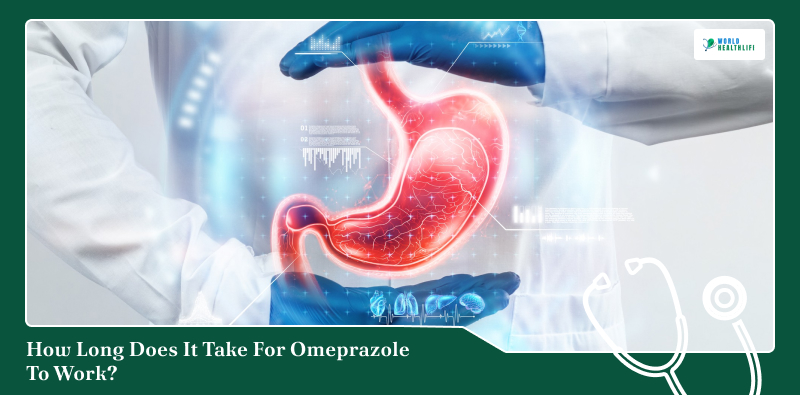
How long does it take for omeprazole to work to stop your burning chest pain?
If you are looking for instant relief, omeprazole is not a quick-fix medication that will make you feel better right away.
Although it is the ultimate over-the-counter (OTC) choice for frequent acid reflux, this powerful drug requires a bit of strategy and patience to kick in.
To achieve the best results, doctors usually recommend taking your pill 30 to 60 minutes before your first meal of the day.
Taking it on an empty stomach is crucial. If you eat food first, the medicine cannot be absorbed properly, drastically reducing its effectiveness.
By taking it before you eat, you give the medication time to pass through your stomach, enter your system, and systematically deactivate the microscopic pumps that create stomach acid.
This specific timing rule is the step most people accidentally miss! To understand exactly how fast omeprazole works over your first few days of treatment, keep reading.
How Long Does It Take For Omeprazole To Work For Heartburn?
When heartburn occurs a few days each week, people usually take one pill a day. But it is better to take Omeprazole occasionally. Not for months. Usually, doctors prescribe for about two weeks.
Nothing big happens right away, though. That’s important to know. However, many people still use it as a quick fix. But let me tell you, Omeprazole does not work instantly.
The Exact Timeline: How Fast Does Omeprazole Work?
Omeprazole belongs to a class of drugs known as Proton Pump Inhibitors (PPIs), which do not just mask the acid. Instead, it turns off the cellular pumps that produce it.
Due to this unique mechanism, the healing timeline breaks down in stages.
- Within an hour: The medication begins absorbing into your system and starts shutting down active proton pumps.
- At 2 hours: The drug reaches its maximum acid-suppressing strength for that single dose. Note: You may still feel heartburn at this point because existing stomach acid is still lingering.
- Days 1 to 4: This is when most people experience noticeable symptom relief. It takes 1 to 4 days of consistent daily use for the drug to deactivate enough pumps to control your baseline heartburn.
- Day 14: By the end of a standard two-week OTC course, recurring daily heartburn is generally resolved for typical sufferers.
What It Feels Like In The First Few Days
On the first day, the medicine starts working inside pretty quickly. Maybe within an hour. But you probably won’t feel much. But there is nothing to be disappointed about.
After a day or two, some people notice the burning is gradually reducing. Or it doesn’t come back as often. This usually happens when you take it the same way every day, not randomly.
By day three or four, it’s more obvious. Most importantly, you feel a perceptible change at this stage. After 14 days, you will observe no recurring heartburn.
What To Do When Reflux Is More Serious?
For people with more severe reflux issues, things slow down even more. The dose is sometimes higher, and it’s taken for longer than two weeks.
Even then, many people start to feel better in a few days, maybe within a week. But that doesn’t mean everything inside is healed. The discomfort going away doesn’t mean the lining is fully okay yet.
That’s why doctors often keep people on it longer. Even when they already feel better.
The Timing Mistake Most People Make
Honestly, one of the biggest reasons people think the pill isn’t working is timing. If you take it right after a big meal or late at night, it doesn’t act the same. The medicine needs a bit of a head start.
That’s why it is better to have an empty stomach. Doctors say that you must take the pill at least 30 minutes before. Taking it around the same time every day helps too. This routine will gradually help you reduce your heartburn problems.
Omeprazole Compared With Other Heartburn Medicines

We now know that Omeprazole does not offer instant relief. So asking how long does it take for Omeprazole to work is redundant. So you may ask what acts faster than Omeprazole.
The answer is simple. Antacids!
Antacids are the fastest. Most importantly, you can see significant results within minutes. But why do we still use Omeprazole? That’s an unusual question I keep hearing. But we all know the answer, right?
Omeprazole offers a sustainable solution. At least you don’t have to fear heartburn coming back anytime soon. But when you have antacids, be sure to take them before heartburn returns. Mostly, it comes back within hours.
But aren’t there other meds that can act as the middle ground? Certainly there is. Let’s talk about H2 inhibitors.
These medicines start working within an hour. However, their effect lasts upto 4 hours. So, the best choice is clear. You have to go for Omeprazole if you need stable and permanent relief.
Omeprazole takes at least 24 hours to act. If symptoms are severe, you may also have to wait 4 days. But when it starts working, you can actually feel the real difference.
So, what should I take if I need instant relief from heartburn? That’s easy. Take Omeprazole in the long run. For the first few days, pop in a few antacids. Don’t ask anymore how long does it take for Omeprazole to work.
Also Read: Famotidine Vs Omeprazole | Which One Is Better?
Heartburn Treatment Comparison
| Medication Type | Onset of Action | Duration of Relief | Best Used For |
| Antacids (e.g., Tums, Mylanta) | Minutes | 1–2 hours | Instant, temporary relief for occasional flare-ups |
| H2 Blockers (e.g., Famotidine) | Within 1 hour | Up to 12 hours | Intermediate, rapid relief for expected triggers |
| PPIs (Omeprazole) | 1 to 4 days | 24+ hours | Sustainable management of frequent heartburn (2+ days/week) |
A Quick Note On Esomeprazole
One of the most common questions on the internet is how long does it take for Omeprazole to work. But a lot of people also ask: Is esomeprazole better than Omeprazole?
I don’t mean to disappoint you. But both meds work almost the same way. However, esomeprazole is somewhat better. How?
It is more refined. Moreover, it stays in the body for a longer period. Meanwhile, it would be active the whole time. That’s why its effects feel more long-lasting.
What do real studies say?
Some studies suggest esomeprazole can lower acid levels quickly. In real‑life use, though, many people don’t feel a big difference between the two.
When Omeprazole Is Used Long-Term?
For people on prescription omeprazole, the time of use doesn’t matter. But why? When the doctor suggests prolonged use, they are aware of the side effects. Firstly, the doctor will give alternatives to overcome the side effects. At the same time, doctors assess your body’s resilience before advising Omeprazole for the long term.
But when do they usually suggest Omeprazole for prolonged use? If you have ongoing reflux, ulcers, or stomach infections, your doctor will do that. In those cases, the medicine isn’t just about feeling better. Instead, your body focuses on permanent healing!
Also Read: Pantoprazole Vs Omeprazole | Which One Is Better?
What Can I Do To Build Resistance?
Doctors often advise antibiotics to overcome the negative effects of Omeprazole on the body. But antibiotics only last a few weeks. After that, your body knows how to cope with the effects of Omeprazole.
Now it’s no longer a matter of how long does it take for Omeprazole to work. Instead, the question should be how long should I take Omeprazole for complete gastric relief?
If you are asking that, know that it depends on your body’s condition. If your acid levels are high, you need:
- Early symptom relief, often around days 3 to 7.
- Longer control, playing out over weeks or even months.
How Long Does Omeprazole Actually Take?
For many people, some relief starts within 1 to 2 days. That answers clearly how long does it take for omeprazole to work. By days 3 to 4, symptoms often feel noticeably better. During a regular 14‑day OTC course, heartburn is usually much less or mostly gone if this medicine is a good fit.
While standard heartburn symptoms often improve within a few days, deeper issues like GERD or stomach ulcers require several weeks of consistent treatment. This will fully heal the esophageal and stomach linings.
If you complete your full medication course and notice little to no improvement, consult a doctor or pharmacist. This allows you to investigate the root cause and adjust your treatment plan.




Omi Tablet: Uses, Benefits, Side Effects, Dosage & Safety
September 23, 2026[…] How Fast Does Omeprazole Work? […]