If you have ever looked at a hospital bill or an insurance statement and thought to yourself about all those random letters and numbers and their meaning, you are not alone.
Actually, these are known as ICD-10 codes, which are short for the International Classification of Diseases. Essentially, ICD-10 is a universal medical shorthand.
So, instead of writing out long explanations every time someone visits a doctor, clinics and insurance companies use these standardized codes to record a diagnosis. As a result, this helps ensure that treatments get covered.
Now, when it comes to Parkinson’s disease, a progressive brain condition affecting movement, balance, and muscle control, having the right code is especially important.
The reason behind this is that Parkinson’s looks different from person to person while changing over time. In fact, there is no single code that fits everyone.
Rather than that, the ICD 10 code for Parkinson’s disease sits inside a group of codes starting with G-20. In order to pick the exact right one, the medical team tends to look at two everyday realities in a patient’s chart.
First is whether they experience uncontrolled, involuntary movements or dyskinesia. Second is whether their medication wears off before the next dose, or as they say: motor fluctuations.
So, here is how those codes break down and what each one actually means in plain English.
What Is ICD-10 And Why Does It Matter?
Before we can dive deep into the specific codes, it would help to know what ICD-10 actually stands for.
Short for the International Classification of Diseases, 10th Revision, ICD-10 is actually the global medical coding system that is used to turn every known illness, symptom, and injury into a standardized letter-and-number code (CDC, 2026).
In the United States, doctors and hospitals use a clinical version known as ICD-10-CM. Whenever you visit a clinic, the medical team attaches these codes to your chart. In this way, insurance companies know exactly what condition is being treated.
Besides that, the following are also assessed:
- Why certain medications or therapies are necessary
- How to process the claim in an accurate manner
Actually, without the right code, medical records stay incomplete, and insurance claims end up getting denied.
What Is The ICD 10 Code For Parkinson’s Disease?
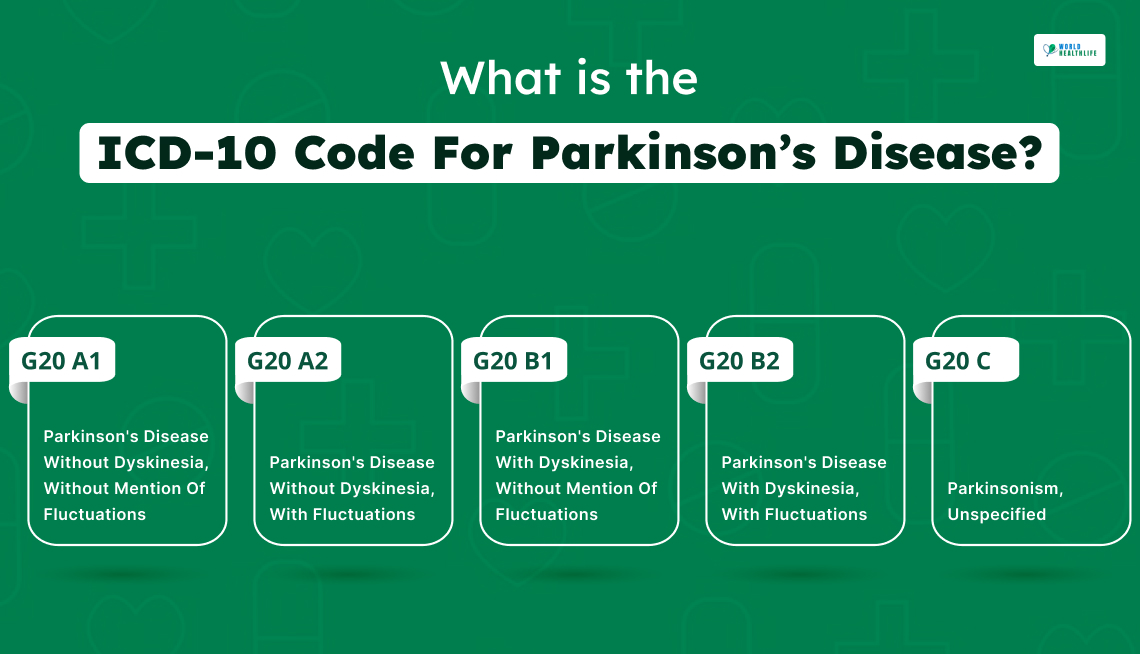
In the ICD-10-CM classification system, G20 serves as the parent category for Parkinson’s disease. However, G20 is not a complete, billable code.
Submitting G20 alone on an insurance claim will result in an automatic rejection for lack of specificity.
In order to bill accurately, medical coders must check the clinician’s notes to confirm whether dyskinesia and motor fluctuations are present.
On the basis of these clinical details, you must select one of five specific billable codes.
| ICD-10-CM Code | Official Description | Billable Status |
| G20.A1 | Parkinson’s disease without dyskinesia, without mention of fluctuations | Yes |
| G20.A2 | Parkinson’s disease without dyskinesia, with fluctuations | Yes |
| G20.B1 | Parkinson’s disease with dyskinesia, without mention of fluctuations | Yes |
| G20.B2 | Parkinson’s disease with dyskinesia, with fluctuations | Yes |
| G20.C | Parkinsonism, unspecified | Yes |
Do note something quite significant. G20.C represents unspecified parkinsonism. Moreover, it is never a valid substitute when a doctor has already confirmed a diagnosis of primary Parkinson’s disease.
Understanding The Different ICD-10 Codes For Parkinson’s Disease

The G.20 family is divided into five subcategories. Therefore, medical records accurately reflect how advanced the condition is and whether medication side effects have developed.
The right choice of subcategory supports medical necessity for specialized prescriptions, physical therapy, and surgical evaluations.
G20.A1: Parkinson’s Disease Without Dyskinesia, Without Mention Of Fluctuations
G20.A1 is known as the standard billable code for confirmed Parkinson’s disease when the medical chart documents neither dyskinesia nor motor fluctuations.
Moreover, it applies most often to newly diagnosed patients or individuals whose symptoms remain stable throughout the day on their current medication.
For example, if a 68-year-old patient has a resting hand tremor that stays well-controlled on carbidopa-levodopa with no involuntary movements, G20.A1 is the exact code to assign here. In fact, the patient may also have wearing-off episodes between doses.
G20.A2: Parkinson’s Disease Without Dyskinesia, With Fluctuations
G20.A2 applies when a patient has confirmed Parkinson’s disease and experiences motor fluctuations or OFF episodes. However, there is no documented dyskinesia.
Motor fluctuations happen when medication benefits fade before the next scheduled dose. As a result, this causes stiffness, slowness, or tremors to return.
A typical chart supporting this code would describe a patient who experiences predictable OFF periods roughly 30 minutes before her afternoon dose. Furthermore, this is marked by increased slowness and gait freezing, with no dyskinesia observed.
G20.B1: Parkinson’s Disease With Dyskinesia, Without Mention Of Fluctuations
G20.B1 is assigned when the provider documents dyskinesia, which refers to involuntary, erratic, or dance-like movements typically linked to long-term Parkinson’s medication, without mentioning motor fluctuations.
Even if fluctuations are absent or unstated in the note, documented dyskinesia automatically moves the code from the G20.A series into the G20.B series.
This applies when an exam reveals mild peak-dose dyskinesia in the arms after morning medication, while overall symptom control remains steady all day without wearing off.
G20.B2: Parkinson’s Disease With Dyskinesia With Fluctuations
In the G20 category, G20.B2 captures the most complex movement profile. In addition, it is used when the clinician documents both dyskinesia and motor fluctuations during the visit. This includes OFF episodes.
Unlike G20.B1, where involuntary movements occur without documented wearing-off cycles, G20. B2 reflects a patient alternating between medication-induced dyskinesia and under-medicated OFF states.
That includes severe peak-dose dyskinesia in the neck followed by sudden afternoon OFF episodes.
G20.C: Parkinsonism, Unspecified
The code G20.C stands for parkinsonism, unspecified.
Parkinsonism is actually a broad clinical term that describes Parkinson-like motor symptoms, such as slow movement, stiffness, and tremor, when the physician has not yet confirmed the primary Parkinson’s disease or identified a secondary cause. Once a neurologist confirms true Parkinson’s disease, coding must switch to G20.A1 through G20.B2.
Difference Between Parkinson’s Disease With And Without Dyskinesia
In clinical practice and medical coding, distinguishing between these two presentations is essential because dyskinesia is a treatment-related complication rather than a baseline symptom of the illness.
| Feature | Parkinson’s Disease Without Dyskinesia | Parkinson’s Disease With Dyskinesia |
| Core Movement Profile | Classic Parkinsonian symptoms such as slowness, stiffness, or a rhythmic resting tremor. | Involuntary, fluid, restless, or twisting movements affecting the face, arms, legs, or torso. |
| Primary Cause | Baseline dopamine loss from the underlying neurological condition. | Treatment-related side effect, usually appearing when levodopa levels peak in the bloodstream. |
| Corresponding ICD-10 Codes | G20.A1 (no fluctuations) or G20.A2 (with fluctuations) | G20.B1 (no fluctuations) or G20.B2 (with fluctuations) |
| Why It Matters for Billing | Establishes baseline diagnosis and routine medication management. | Justifies dose adjustments, add-on therapies, or surgical consultations for deep brain stimulation (DBS). |
What Are Motor Fluctuations In Parkinson’s Disease?
Motor fluctuations are shifts in movement ability tied to medication timing. As Parkinson’s progresses, the brain loses its capacity to store dopamine steadily. This narrows the effective window of each medication dose.
Clinicians describe these daily swings using two distinct phases, where ON periods are the times of day when medications work effectively.
This allows smoother movement as well as reduced stiffness.
OFF periods, also called wearing-off, are the intervals when medication fades before the next scheduled dose. As a result, this causes tremors, rigidity, or slow walking to return.
Under ICD-10-CM indexing rules, documented OFF episodes or wearing-off qualify directly as motor fluctuations. Whenever a provider documents OFF episodes in the note, coders need to select G20.A2 or G20.B2 instead of defaulting to the codes without fluctuations.
Parkinson’s Disease Vs. Parkonism: ICD-10 Coding Differences
Now, it is quite evident. The two terms look remarkably similar. However, Parkinson’s disease and parkinsonism represent distinct medical diagnoses that map to separate ICD-10-CM code blocks.
We have primary Parkinson’s disease on one side. Primary Parkinson’s disease (G20.A1 through G20.B2) is a specific neurodegenerative disorder caused by gradual dopamine loss in the brain without an external trigger.
On the other hand, Parkinsonism is a general clinical syndrome that describes any condition that produces Parkinson-like movement symptoms.
When those symptoms are triggered by an identifiable external cause, such as antipsychotic medications, toxins, head trauma, encephalitis, or small strokes, the condition is classified as secondary Parkinsonism.
Since secondary Parkinsonism stems from an outside factor and may improve if you stop an offending medication, you must never code it under the G20 family.
Instead, it belongs under the G21 category.
ICD-10 Codes For Secondary Parkinsonism
| ICD-10-CM Code | Official Description |
| G21.0 | Malignant neuroleptic syndrome |
| G21.11 | Neuroleptic-induced parkinsonism |
| G21.19 | Other drug-induced secondary parkinsonism |
| G21.2 | Secondary parkinsonism due to other external agents |
| G21.3 | Postencephalitic parkinsonism |
| G21.4 | Vascular parkinsonism |
| G21.8 | Other secondary parkinsonism |
| G21.9 | Secondary parkinsonism, unspecified |
How To Choose The Correct ICD-10 For Parkinson’s Disease
The selection of the exact billable code follows a straightforward verification workflow. So, first start by confirming that the treating clinician explicitly documented Parkinson’s disease instead of Parkinsonism or secondary Parkinsonism.
Next, go on to review the assessment and physical exam for any mention of dyskinesia or medication-induced involuntary movements. Then scan the history for motor fluctuations, wearing-off, or OFF episodes.
Once you combine those findings to pick G20.A1, G20.A2, G20.B1, or G20.B2, check the tabular instructions for any Use Additional Code notes or Excludes1 rules.
Common Coding Mistakes To Avoid
Even experienced billers run into predictable traps when coding neurology claims. One of the most frequent errors is submitting G20 alone, which is a non-billable header code that triggers an immediate rejection.
Another common mistake is assigning G20.C after you have already confirmed primary Parkinson’s disease, or confusing a normal resting tremor with levodopa-induced dyskinesia.
Coders must also avoid making assumptions for motor fluctuations simply because a patient takes extended-release medication. Moreover, they must always sequence the G20 – code first before reporting any associated Parkinson’s dementia codes.
Additional ICD-10 Codes Associated With Parkinson’s Disease
In the ICD-10-CM Tabular List, the G20 category includes a “Use additional code” instruction when Parkinson’s disease causes cognitive decline.
Under etiology and manifestation rules, sequence the appropriate G20.- code first. Following this, use the applicable cognitive code.
| Cognitive Condition / Manifestation | Unspecified Severity | Mild Stage | Moderate Stage | Severe Stage | Coding Notes |
| Dementia without behavioral disturbance | F02.80 | F02.A0 | F02.B0 | F02.C0 | Complete 5-character codes |
| Dementia with behavioral disturbance | F02.81- | F02.A1- | F02.B1- | F02.C1- | Requires a 6th character to specify agitation or other behavioral disturbances |
| Dementia with psychotic disturbance | F02.82 | F02.A2 | F02.B2 | F02.C2 | Includes delusions, hallucinations, or paranoia |
| Dementia with mood disturbance | F02.83 | F02.A3 | F02.B3 | F02.C3 | Includes depression, apathy, or elation |
| Dementia with anxiety | F02.84 | F02.A4 | F02.B4 | F02.C4 | Complete 5-character codes |
| Mild neurocognitive disorder | F06.7- | N/A | N/A | N/A | Due to a known physiological condition; requires a 5th character |
From Clinical Notes To Clean Claims: Wrapping Up Parkinson’s Coding
When you are trying to navigate the G20 ICD-10-CM code family, everything comes down to verifying two clinical details.
Those are dyskinesia and motor fluctuations.
Since G20 is no longer billable on its own, accurate reimbursement is fully dependent on clear provider documentation.
This should be done in such a way that it is able to distinguish stable Parkinson’s disease (G20.A1) from cases involving OFF episodes. On the other hand, it should also differentiate itself from involuntary movements (G20.A2 through G20.B2), as well as unspecified parkinsonism (G20.C).
On a final note, before you submit any claims, remember to always verify code descriptors and additional coding rules against the latest official ICD-10-CM guidelines.
Disclaimer:
The information provided in this article is for general informational purposes only. It does not, and is not intended to, constitute medical or health advice. Please consult a qualified healthcare professional for medical guidance or expert health assistance.
References:
- CDC. (2026, October 29). ICD-10-CM. Classification of Diseases, Functioning, and Disability.
- 2025 ICD-10-CM Diagnosis Code G20.A1: Parkinson’s disease without dyskinesia, without mention of fluctuations. (2024). Icd10data.Com.
- CCO Certified Professionals. (2026, April 22). Parkinson’s Disease. [CCO] Certification Coaching Organization LLC.
- Fekete, R. M. Parkinson disease | MedLink Neurology. MedLink Neurology.
- CDC. (2026, October 29). ICD-10-CM. Classification of Diseases, Functioning, and Disability.