For any new parent, the joy of having a child is truly unexplainable. Their birth should be a day of celebration and joy.
However, when you find out that your baby has an extremely rare genetic condition, it can be heartbreaking.
One such condition goes by the name of Lowe syndrome. Almost exclusively, the condition affects boys.
The syndrome is caused by a mistake or mutation in a gene.
Moreover, the gene is supposed to help the body make a specific enzyme, a protein that helps your cells to work.
However, without this enzyme, cells cannot process certain substances properly. As a result, this leads to health problems.
Since the faulty gene is on the X chromosome, boys tend to get the condition.
The medical name itself may scare a lot of parents. Also, with no cure for the disease, the whole ordeal may seem scary.
However, there have been numerous medical advancements and supportive therapies.
In the following guide, we will be breaking down the complex biochemistry behind the condition while understanding its causes, treatment options, and more.
Lowe Syndrome: A Brief Breakdown
Before you delve deep into the condition, first we need to understand one thing. What exactly is Lowe syndrome?
Simply put, the condition is a very rare genetic health condition that causes medical issues in three main areas of the body:
- Eyes
- Brain
- Kidneys
Because of how it is passed down through genes, it almost exclusively affects boys.
A Brief Overview
| Feature | Details |
| Alternative Name | Oculocerebrorenal syndrome (OCRL) |
| Genetic Cause | Mutations in the OCRL gene (Xq25-q26) encoding a specific cell-trafficking enzyme |
| Inheritance Pattern | X-linked recessive (primarily affects males; females are usually asymptomatic carriers) |
| Prevalence | Approximately 1 in 500,000 people worldwide |
| Eye Symptoms | Congenital cataracts in both eyes (universal), infantile glaucoma, and poor vision |
| Brain / Neuro Symptoms | Severe low muscle tone (hypotonia) at birth, delayed motor milestones, intellectual disability, and behavioral changes |
| Kidney Symptoms | Renal Fanconi syndrome (wasting of nutrients into urine), metabolic acidosis, and progressive chronic kidney failure |
| Other Features | Short stature, weak bones (rickets), dental abnormalities, and seizures |
| Treatment | Symptomatic care only (cataract surgery, physical therapy, management of kidney/electrolyte loss); there is no cure |
The Medical Term: Oculocerebrorenal Syndrome
Medically, Lowe syndrome is called Oculocerebrorenal syndrome.
The name may sound intimidating due to its length. However, if you break down that big word into its Greek and Latin roots, it gives you a literal understanding.
Breaking it down, you get exactly what parts of the body are affected:
- Oculo: the eyes
- Cerebro: the brain
- Renal: the kidneys
A Rare Genetic Disorder
Considered an extremely rare genetic disorder, Lowe syndrome affects an estimated prevalence of about 500,000 people worldwide.
According to the National Organization for Rare Disorders (NORD), while the condition is rare, it is recognized as a pan-ethnic disorder. Meaning it is found across diverse populations globally.
This includes North and South America, Europe, and Asia.
A Disorder That Exclusively Targets The Male Population
The condition affects men almost exclusively. The reason behind this is an X-linked recessive inheritance pattern tied to the OCRL gene located on the X chromosome.
Let us understand the basics first.
Men have one X chromosome and one Y chromosome. In case a male inherits X chromosome with a mutated OCRL gene, he has no second X chromosome to back up or compensate for the damaged one.
This single mutated copy takes the full effect, causing Lowe syndrome.
Women have two X chromosomes.
If a female inherits one mutated X chromosome, her second healthy X chromosome will provide a normal copy of the gene.
This healthy copy will compensate for the faulty one. As a result, the female is generally healthy and free of the full syndrome.
Do Affected Men Pass It To Their Sons
Men pass their Y chromosomes to their sons, not their X chromosome. Since the mutation lives on the X chromosomes, an affected man cannot pass the condition to his sons.
Conversely, an affected man will always pass his single mutated X chromosome to his daughters. Consequently, this makes all of his daughters carriers.
Understanding Female Carriers
Women who have one normal and one mutated X chromosome are called carriers. Additionally, they usually do not show severe symptoms.
However, some may experience minor issues such as tiny clouding spots in the eye lens (lens opacities).
For example, a carrier mother has a 50% chance of passing the altered X chromosome to her children.
If she passes it to a son, he will develop Lowe syndrome. If she passes it to a daughter, that daughter becomes a carrier.
The Main Signs And Symptoms: The Triad
The rare genetic condition, as per its medical term, primarily affects the eyes, brain, and kidneys.
| Primary Areas Affected | Common Symptoms |
| Eye | Congenital cataracts, infantile glaucoma, nystagmus, strabismus |
| Brain | Neonatal hypotonia, developmental delay, intellectual disability, seizures, behavioral problems |
| Kidneys | Renal fanconi syndrome, metabolic acidosis, rickets, chronic kidney disease, kidney stones or nephrocalcinosis |
Oculo (Eye)
A patient with Lowe syndrome has congenital bilateral cataracts universally present at birth, which are dense clouding of the lenses.
Approximately half of affected individuals develop infantile glaucoma, an increased pressure within the eye. Accordingly, this leads to optic nerve damage.
Alongside these symptoms, other abnormalities such as strabismus or lazy eye, nystagmus or involuntary eye movements, and corneal keloids may occur.
Cerebro (Brain And Nervous System)
Infants typically present at birth with severe neonatal hypotonia. This is known as profoundly weak muscle tone or “floppiness.”
There is also a case of areflexia, which is the absence of deep tendon reflexes. This severe weakness frequently causes early breathing and feeding difficulties.
As the child grows, marked developmental delays become apparent, and more individuals experience varying degrees of intellectual disability. This ranges from mild to severe.
Roughly half of all patients are affected by seizures.
Additionally, behavioral challenges typically emerge around age five, presenting as temper tantrums, obsessive-compulsive traits, irritability, or aggressive behaviors.
Renal (Kidney)
The third hallmark is renal Fanconi syndrome.
This is a dysfunction of the kidney tubules that impairs the body’s ability to reabsorb crucial nutrients, salts, and minerals.
As a result, bicarbonate, phosphate, and amino acids leak into the urine, causing metabolic acidosis, chronic dehydration, and frequent urination.
The ongoing loss of essential minerals leads to hypophosphatemic rickets, which causes softened, bowed bones.
Along with that, severe postnatal growth delays, short stature, and an increased risk of bone fractures are also symptoms associated with the kidneys.
Over time, the progressive tubule damage leads to chronic kidney disease and potentially life-threatening end-stage renal failure by early adulthood.
Other Symptoms To Watch Out For
Other symptoms generally involve the musculoskeletal system, growth, behavior, and dental health. Around 80% of affected individuals develop behavioral problems around age five.
This includes severe trauma, obsessive actions, crying, and stubbornness. Besides this, dental issues are also common.
Dental complications and abnormalities can occur as part of the condition’s wider systemic impact.
Diagnosis And Prognosis
Now that we have covered what the condition exactly is and what symptoms you need to evaluate, we should move on to its aftermath and diagnosis.
How Doctors Diagnose The Condition
Doctors look for a characteristic pattern that involves three main areas:
- The bilateral congenital cataracts
- Neonatal hypotonia
- Renal tubular dysfunction
Physical Eye Exams
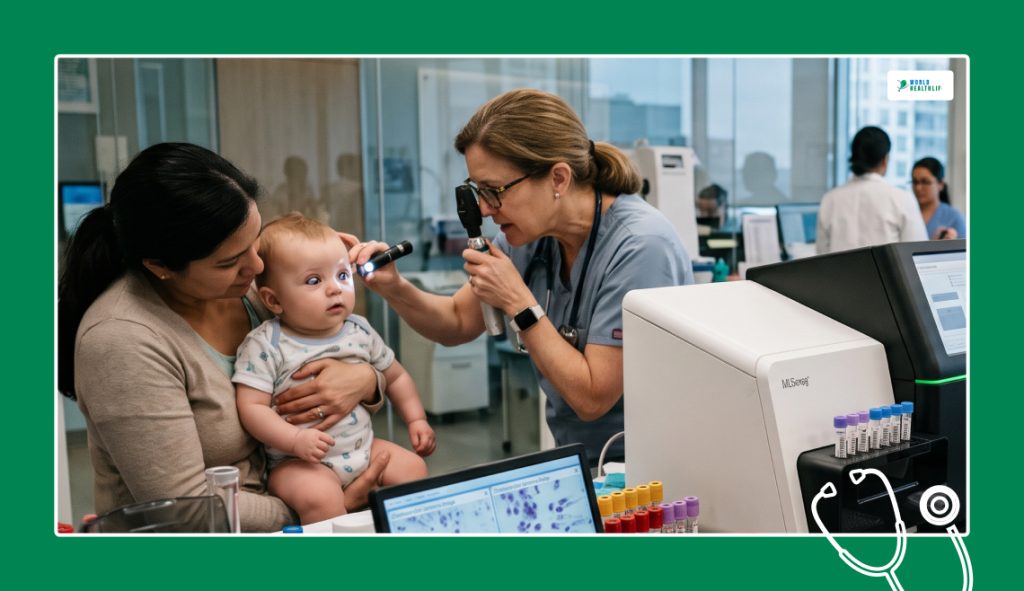
Pediatricians and ophthalmologists perform comprehensive eye checks to detect cataracts and infantile glaucoma.
Blood And Urine Tests
Lab tests check for electrolyte imbalances, metabolic acidosis, and low-molecular-weight proteinuria, which is protein leakage in urine.
This helps in the evaluation of the overall kidney function.
Genetic Testing And Enzyme Assays
To find out for sure if a boy has Lowe syndrome, a doctor will run a genetic test on a blood or cell sample to look for typos in the OCRL gene.
Sometimes, they’ll also take a tiny skin sample. They call this a fibroblast test.
This helps to check if a specific cell enzyme is missing or acting up.
What the Future Looks Like: Prognosis
Let’s talk about what to expect down the road.
The hard truth is that Lowe syndrome cuts life short, with most guys living into their thirties or forties, though a few make it to fifty.
The real trouble comes from the kidneys. They wear out slowly, and by adulthood, many of these young men face total kidney failure, which means dialysis or a new kidney.
On top of that, families deal with intellectual delays that range from mild to pretty severe, along with seizures and some rough behavioral swings.
You’ll need a lifelong lineup of specialists, including kidney doctors, eye experts, neurologists, and physical therapists, working together to keep him comfortable and hitting milestones.
Handling Treatment And Care
Even though nobody has found a cure yet, you can absolutely build a strong plan to take care of your boy.
The whole goal is just tackling the individual symptoms as they show up, protecting his brain, eyes, and kidneys while helping him thrive.
Because this condition hits so many different parts of his body, you absolutely need a team of pediatric eye doctors, kidney specialists, neurologists, and daily therapists working in lockstep.
| Intervention Type | Focus Areas & Specific Examples | Goal of Care |
| Surgeries | Cataract extraction, glaucoma surgeries, gastrostomy tube (G-Tube) placement, orthopedic surgery, corneal and cutaneous procedures | Address structural issues, improve vision, and support physical growth. |
| Medications & Supplements | Alkali supplements, phosphate and Vitamin D supplements, anticonvulsant medications | Manage kidney/electrolyte loss, strengthen bones, and control seizures. |
| Therapies | Physical therapy, occupational therapy, speech-language therapy | Maximize developmental potential, motor skills, and communication. |
Finding Your Footing
Finding out your son has Lowe syndrome completely flips your world upside down.
Honestly, watching your little guy struggle with his eyes, brain, and kidneys tears you apart.
Since there’s no cure, feeling totally lost and crushed right now is completely normal.
But you aren’t completely helpless here.
Once you actually wrap your head around the genetics and how this thing works, the fear starts losing its grip. It gives you a solid starting point to take charge of his medical care.
Getting a good team of specialists in your corner changes everything. Mixing targeted surgeries and daily supplements with steady physical, occupational, and speech therapy does wonders.
It lets you get out in front of the worst complications, keep his symptoms under control, and give him a much better daily life.
Medical research keeps moving forward too, bringing out new ways to support these kids all the time.
When you have the right facts, doctors you trust, and people backing you up, you can handle whatever Lowe syndrome throws your way.
You can absolutely give your boy a wonderful, happy life.
Disclaimer: The information provided in this article is for general informational purposes only. It does not, and is not intended to, constitute medical or health advice. Please consult a qualified healthcare professional for medical guidance or expert health assistance.
References:
- Lowe Syndrome – EyeWiki. (2026). Eye Wiki.
- Alcorn, D. M., MD. (2026). Lowe Syndrome (Oculocerebrorenal Syndrome): background, epidemiology, etiology. Medscape.
- Brewer, E. D. (2025). Clinical variation in Lowe syndrome: what and how? Frontiers in Cell and Developmental Biology, 13, 1720452. Frontiers.