
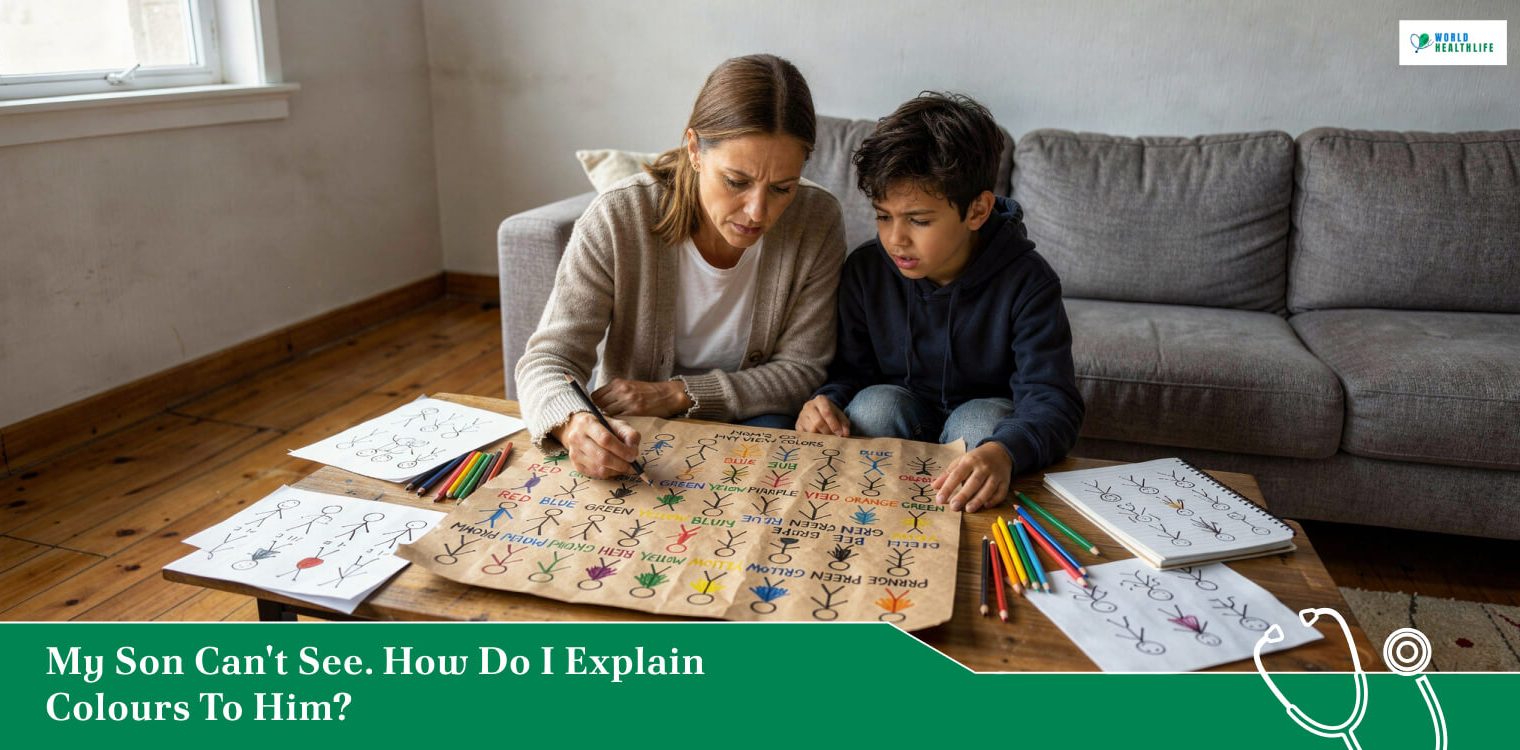
When parents discover their child has limited vision, there’s only one thought: my son can’t see. How do I explain colours to him?
I will share a real-life experience here. My neighbour’s son Aaryan is now 6. His son is completely blind. When he was 4, he started losing his vision.
One day, after coming home from school, he innocently asked his dad, “What’s red? Today, my teacher said you are looking confident in this red jacket!”
He had no power to visually interpret colours. But he understood that there are different colours and that everything has some or another.
At first, my neighbour did not know what to say. He was sad! But he did not give up. He started digging the internet. His query was simple but clear: My son can’t see. How do I explain colours to him?
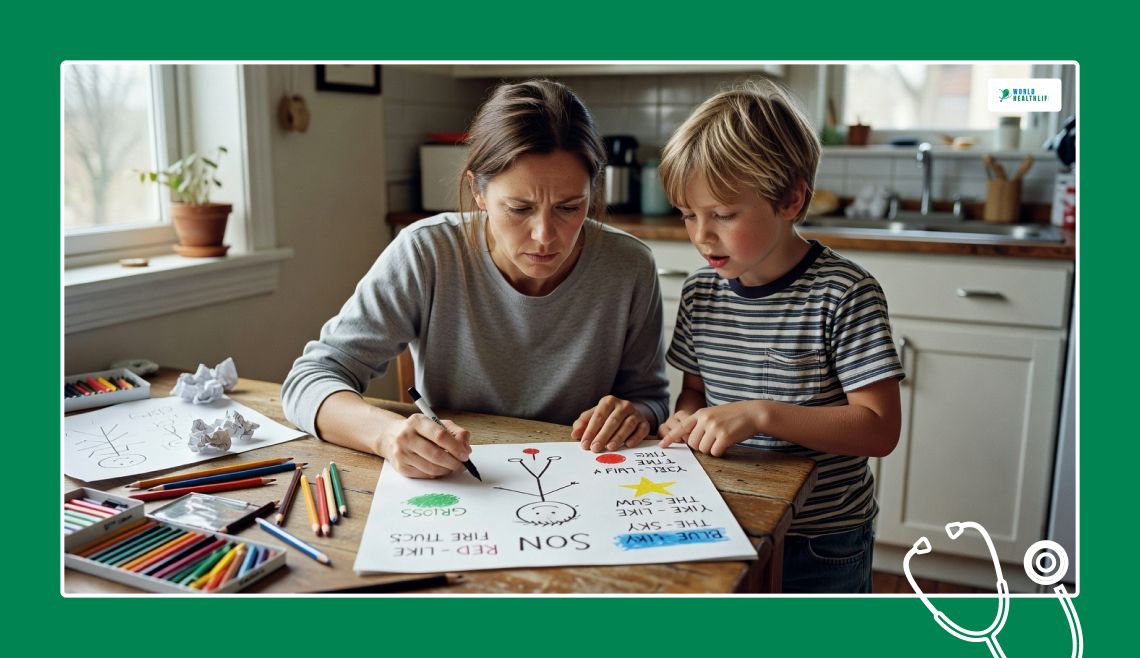
My Son Can’t See. How Do I Explain Colours To Him?
Quick answer for parents running low on time:
So what if your child cannot understand colours by seeing them? There are many other ways, easy and simple:
- Link every colour to something you can sense without your eyes. For example, hot for red
- Use everyday examples. For example, tell your child day in and day out: “Put on your red jacket.” “Where are your black socks?”
- Use the colour names whenever you can deliberately, so that your child forms an image of every colour in their mind
- Start with the basic colours like red, blue, green, and yellow. Etc. Don’t go on to explain “crimson red” or “baby pink” to your child first.
- Don’t give your child a color test every day. Again, don’t keep questioning him: “Do you understand how red looks?” One day, he would naturally be able to distinguish red from blue.
Can A Blind Child Actually Understand Colours?
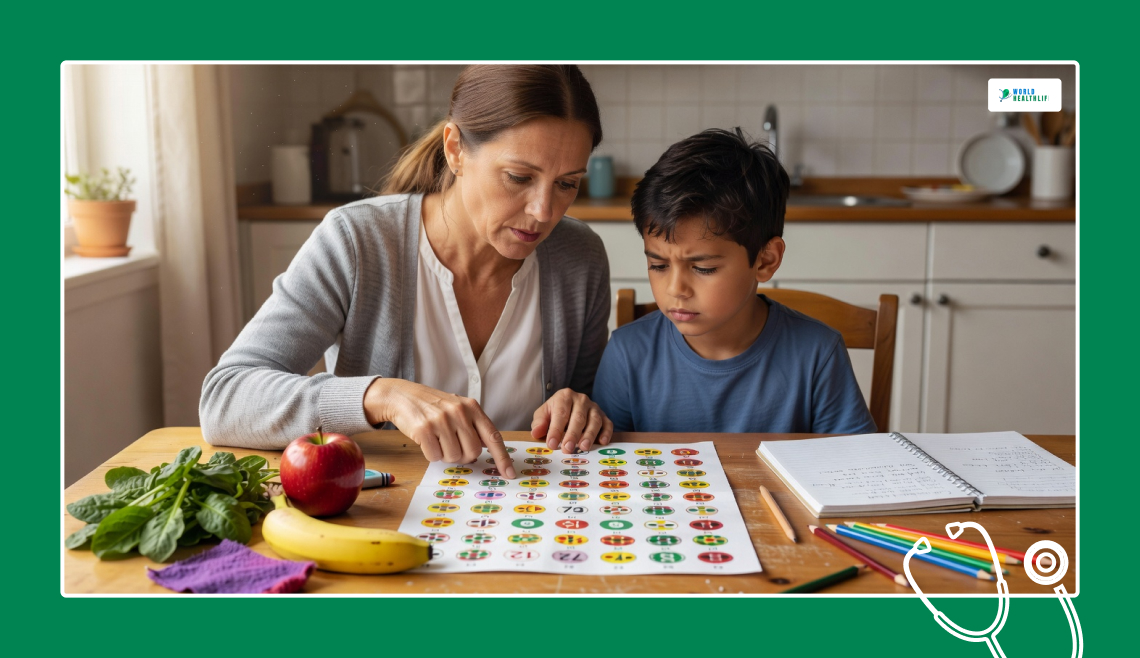
Certainly. A child can actually understand all colours, even without vision. But it will take time. Aaryan’s dad still asks me, ‘My son can’t see? ‘How do I explain colours to him?
My answer is just let him learn his own way.
Yet, there is something you must understand. Your child will not understand red or blue the way you do. But he will surely know what red means. But how is that actually possible?
While talking, you will unknowingly use contexts that relate to Red. For instance, red links with brightness, energy, warmth, and similar feelings. We paint our hearts red. Again, our blood is red.
To sum up, your child will slowly develop a clear understanding of all colours. But in a different way. Blindness is not a barrier. However, we all want our children to be healthy.
To ensure that you have a good diet during pregnancy. Follow the 1 to 3 month pregnancy diet chart seriously.
During pregnancy, high blood pressure can harm the fetus. Learn how to cure high blood pressure in 3 minutes.
A Real Life Example
Have you ever been to Antarctica? No! Right? But when I say it’s so damn cold there that your skin will peel off if it sticks to a metal object. Do you know what that is?
That is called feeling. In other words, you imagined the scenario in your head and tried to feel what it would be like to have your skin peeled away.
It’s the same with colours. In other words, every colour has some emotional and cultural significance. As your child grows and learns, he will naturally be able to tell one color from another.
In medical terms, we call that neuroplasticity. In other words, when one sense does not work, the brain starts to adapt associated things to compensate.
Again, in this case, the child who cannot see will have a rather stronger-than-usual sensory memory. Simultaneously, the child will have a better grasp of language. Simply put, the child’s brain will find a way.
Why You Shouldn’t Avoid Colour Conversations?
Often parents don’t discuss about colours. They feel that their children will feel bad about it. But do you know you can actually help your child learn and differentiate colors by talking about them?
So, don’t hesitate to say “Your hair is pitch black,” This wall is milky white”, or “Your shirt is sky blue.” Whenever you use a colour while speaking, your child starts imagining.
Gradually, he will develop a clear idea of the features of every colour. That’s how your child will know colours.
How Do We Mix Colors In Our Daily Talk?
Imagine you were driving. Suddenly, a bike came across. You avoided a bad accident today. While explaining that to your child, you will say: “The bike came out of the blue.” “The red light was still on.”
It’s not only how we speak. School books also use colours in text. Simply put, the child might not see a colour. But he surely has a conceptual idea of what every color looks like.
Aaryan’s mother also told me the same thing. According to her, “when I started talking about colours candidly, my son stopped feeling colurs are something extraordinary. Now he also understands that every thing has a colour.”
How To Explain Colours Without Sight
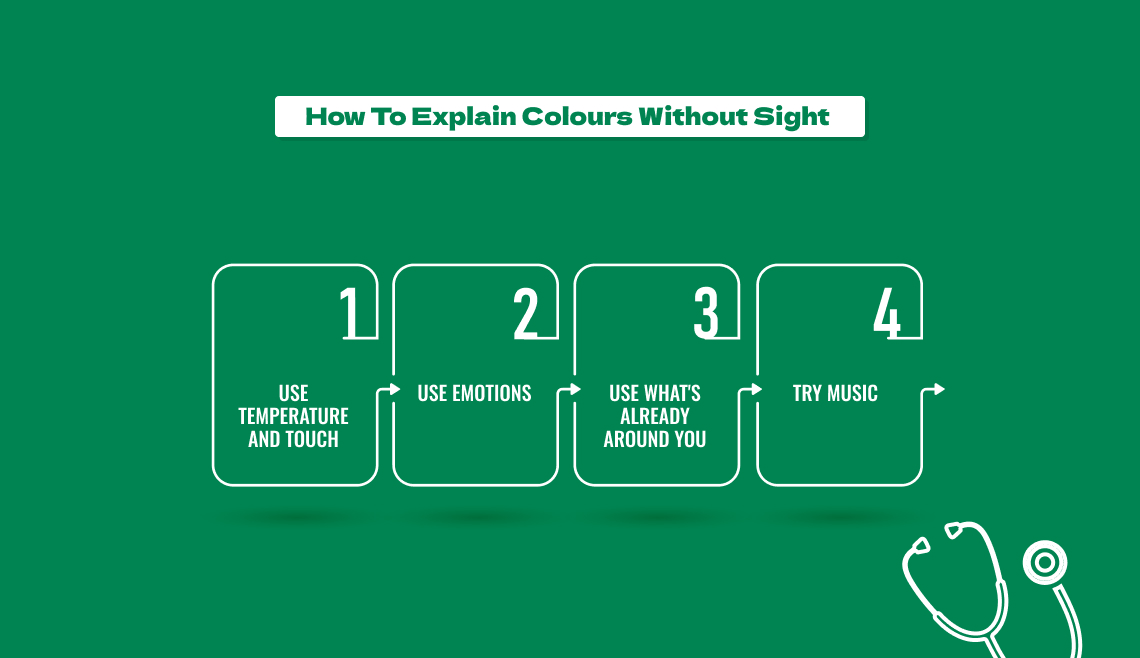
That’s simple. Try to say things to do that relate to specific colors. Here are some day-to-day things that certainly help:
Use Temperature And Touch
This is the most natural starting point. Colours carry temperature associations that most people feel instinctively.
How Do You Explain Red?
Red is warm. You can also relate red to hot. Think of fire, sunlight on your arm, or warm soup on a cold evening.
None of them is red. But you can say they are shades of Red. That is a good starting point for your child to understand red.
You could say: “Red feels like the heat when you stand close to a bonfire. It is intense and powerful.”
How Do You Explain Blue?
Blue is the opposite. To clarify, it represents something cool, calm, and quiet. Think of cold water from a tap, or rain on a window.
You could say: “Blue feels like splashing cold water on your face on a summer afternoon.”
How Do You Explain Yellow?
Yellow sits somewhere between warm and gentle. Like sunlight in the morning before it gets harsh. Again, you can point out things like the banana that are naturally yellow.
Let your child feel warm things, cold things, rough surfaces, and soft fabrics at the same time. Tie everything to colors as you go.
Use Emotions
Every colour carries emotional weight. This is actually something blind children can understand more easily than adults expect. Don’t forget emotions are already their primary way of making sense of the world.
- Red: excitement, urgency, power
- Blue: peace, sadness, calm
- Green: freshness, quiet, growth
- Yellow: happiness, brightness, cheerfulness
- Black: mystery, depth, silence
- White: stillness, cleanliness, calm
When Aaryan’s mum started linking colours to feelings, things clicked for her child. She’d say, “You know how a thick forest feels like? From the outside, it feels dark.”
Emphasize how dark should feel like. When the child asks what color is dark, tell him that it’s black.
He will get it immediately. For your child’s brain development, awareness, and mental vision, good bone marrow baby food is critical.
Use What’s Already Around You
You don’t need special tools. Use what’s in front of you every day.
At mealtimes: “These strawberries are red.” The sentences reflect the same warm, energetic Red as a fire truck.” Let him hold the strawberry. Feel its surface and smell it.
Getting dressed: “You’re wearing your blue sweater today, the cool, calm one.” Over time, he’ll associate that sweater’s texture with blue’s emotional tone.
On a walk outside: Describe what you’re experiencing. “The grass is green right now. It feels so fresh and cool under our feet. That’s the smell of green.”
The repetition of colours in every sentence might seem boring to you. But that’s not the case for your child who is visually impaired. Rather, it’s how his understanding builds.
Try Music
Many people with visual impairments naturally associate colors with sounds. It’s called chromesthesia in its extreme form, but most of us do it a little.
Simply put, red might feel like fast, loud drums. Blue might feel like a slow piano. Again, yellow might feel like children laughing or birds in the morning.
You don’t have to be precise. Just try it! Ask your child: “What does this music feel like to you, warm or cool?” Then share: “To me, this one feels like blue.”
It becomes a game. Again, to your child. This feels like a way of exploring.
What You Can Actually Say: Real Examples
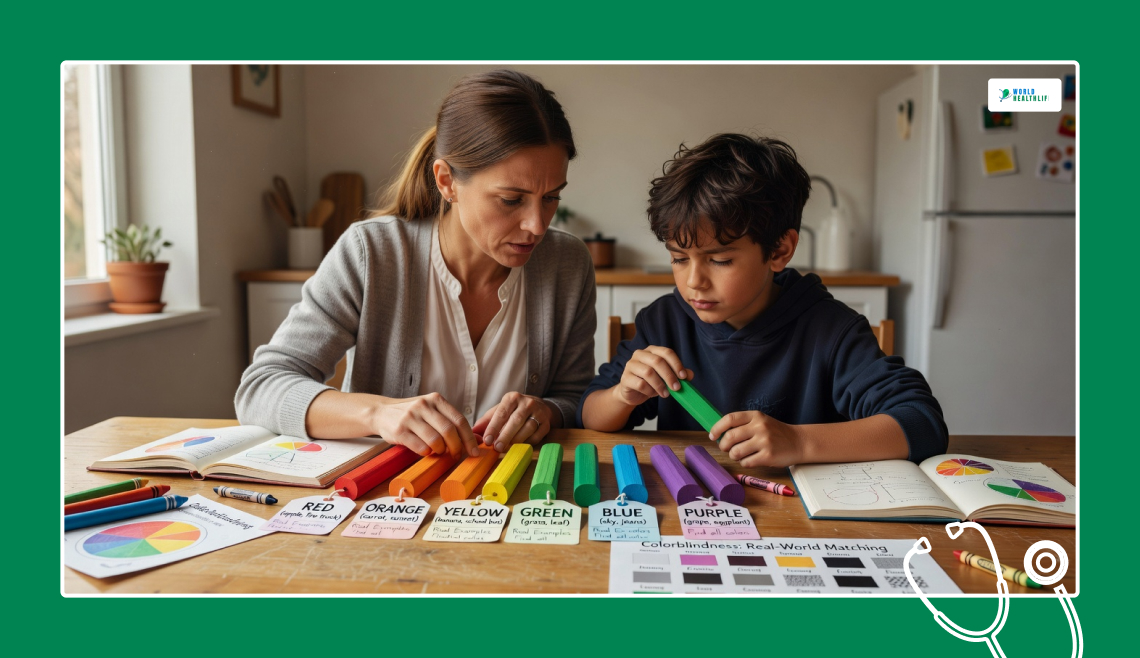
Sometimes you just need the words. Here are some you can use directly:
Red: “The heat you feel when the sun is really strong, that’s red. It’s Powerful and warm.”
Blue: “You know how calm you feel floating in a pool? That quietness is like the blue sky.”
Green: “Smell the grass after rain. That fresh, clean smell is what green feels like.”
Yellow: “That happy feeling on a bright morning when everything feels light. That’s as light as yellow.”
Black: “When everything goes quiet at night, and the world feels deep and still, that’s black.”
White: “A soft blanket fresh out of the wash, clean and peaceful, feels spotless as white.”
None of these is technically correct. All of them are actually comparisons.
A Moment That Changed How I Think About This
A Facebook friend of mine, whose daughter has been blind since birth, told me something I haven’t forgotten.
Her daughter once described her favourite colour as “the one that smells like rain and feels like a cold drink.” She meant blue.
She’d never seen it. However, she still knew it better than most people who have. That is the level of understanding your child can also develop naturally. Just be patient and don’t lose hope.”
Colours don’t live only in the eyes. They live in memory, feeling, smell, and story. Your child has full access to all of that.
What Experts Say (Simplified)
Child development specialists and vision educators consistently point to a few things that help:
- Rich descriptive language, used naturally and often
- Sensory learning through touch, smell, and sound
- Emotional and cultural associations (not just facts)
- Letting the child build their own personal connections over time
The key phrase from most research is “conceptual colour knowledge.” Blind children can develop it fully. It just looks different from the perspective of visual color knowledge. But that’s the only way your child understands colours.
Common Mistakes to Avoid
Don’t say “you can’t understand colours.” That will break your child’s moral strength.
Don’t teach too many at once. Start with red, blue, yellow, and green. Give each one room to breathe.
Don’t quiz. Don’t ask “what colour is this?” and wait for the right answer. Let conversations happen naturally.
Don’t stop using colour words around your child. Saying “the sunset is orange tonight”. Such phrasings help build vocabulary and keep them included in ordinary conversation.
Frequently Asked Questions
Can blind children imagine colours?
Children born blind don’t visualize colors the way sighted people do. But they build rich, meaningful understandings of what each colour represents. The only difference is that they do that emotionally, culturally, and physically.
Is teaching colours confusing or upsetting for blind children?
Usually not. Avoiding the topic is often more disorienting, because colours appear constantly in everyday language and social situations.
When should I start?
You can begin naturally during toddlerhood. Try introducing colours through food, clothing, outdoor walks, and stories. There’s no specific “right age.”
Which colour is easiest to start with?
Red tends to work well first. The association with warmth, heat, and strong feelings is intuitive for most children.
What if my child develops their own color meanings that differ from mine?
That’s fine. In fact, your goal is to ensure the child has a clear understanding. Their understanding is valid. Just check they understand black for black, not blue.
One Last Thing
You’re not going to get this perfect. Neither did Aaryan’s mum nor his dad. She would search for months on Google: “my son can’t see. how do i explain colours to him?” Neither will I if I’m ever in that position.
But the fact that you’re asking is already the most important step.
Colours are warm and cold, loud and quiet, calm and electric. Your son can feel all of that. He just needs someone willing to describe it out loud.
So, start simple. Stay consistent during the child’s learning phase. Trust that understanding grows with time. If you have any queries, you can comment below. We will address all of them.


