

You get one diagnosis and then dozens of coding pathways. Now, see, that is the daily reality of someone who has to navigate peripheral neuropathy ICD-10 guidelines without a clear roadmap.
On paper, G62.9 looks like an easy catch-all for nerve pain. That is exactly why so many charts default to it out of habit.
In practice, when you rely on unspecified codes, it leaves vital clinical context behind while inviting unnecessary payer pushback. This is especially when combination codes or secondary manifestations are required.
You may be coding for Type 2 diabetic polyneuropathy, an idiopathic case, or medication-induced nerve toxicity. Whatever the case may be, precision always matters.
So, below is a practical breakdown of the codes, sequencing rules, and documentation habits you need to get it right the first time.
Key Health Facts:
• G62.9: Unspecified polyneuropathy only (do not use it for focal or cause-specific neuropathy).
• G60.9 / G60.3: Idiopathic peripheral neuropathy (unspecified vs. progressive).
• E08–E13 (e.g., E11.42): Diabetic peripheral neuropathy combination codes.
• G62.0 + Drug Code: Drug-induced neuropathy paired with the causative medication's adverse-effect code.
• Sequencing: Code underlying systemic conditions before manifestation codes (e.g., G63).
But Wait! What Is Peripheral Neuropathy In The First Place?
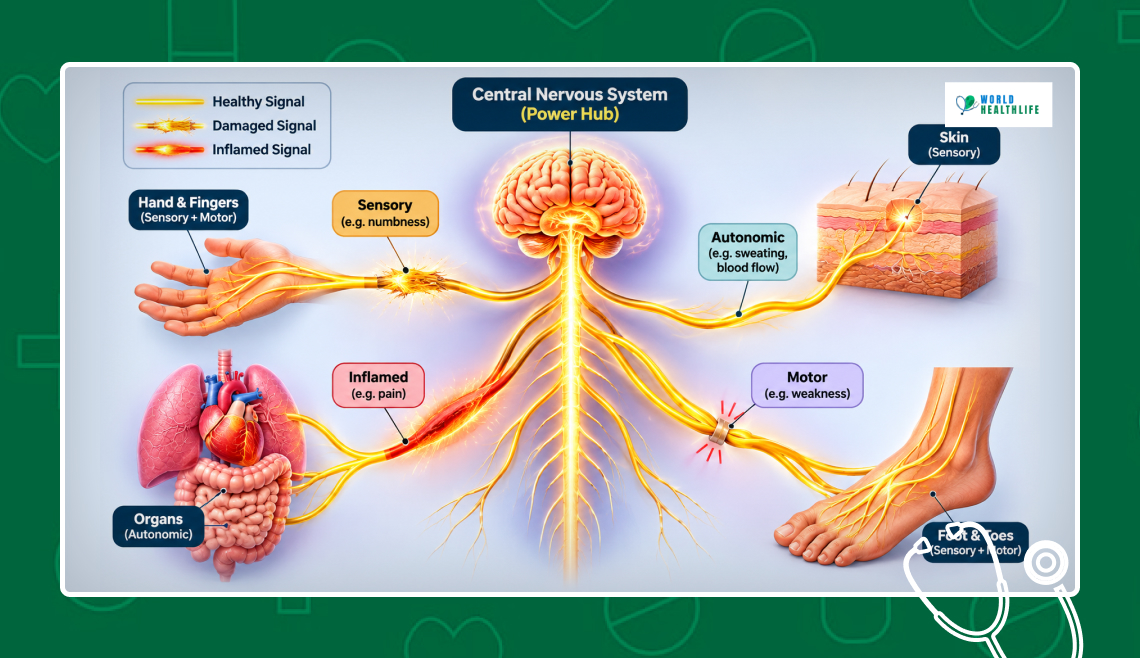
Before we jump into the code sets straight up, it would first help to ground yourself in what is actually happening inside the body. If you put it simply, peripheral neuropathy is basically damage or dysfunction that affects the nerves outside your brain and spinal cord.
To envision that, think of your nervous system as some sort of electrical grid. Your brain and spinal cord act as the main power hub. On the other hand, peripheral nerves are the wires that carry signals out to your arms, legs, skin, and internal organs.
When those outer wires get frayed, compressed, or inflamed, the messages between your body and brain get scrambled or cut off completely.
Depending on whether sensory, motor, or autonomic nerves take the hit, patients might deal with anything from burning foot pain and numbness to muscle weakness or balance trouble.
Because dozens of different triggers can damage those wires, ICD-10-CM refuses to treat peripheral neuropathy as a single and simple condition.
What Is The ICD-10 Code For Peripheral Neuropathy?
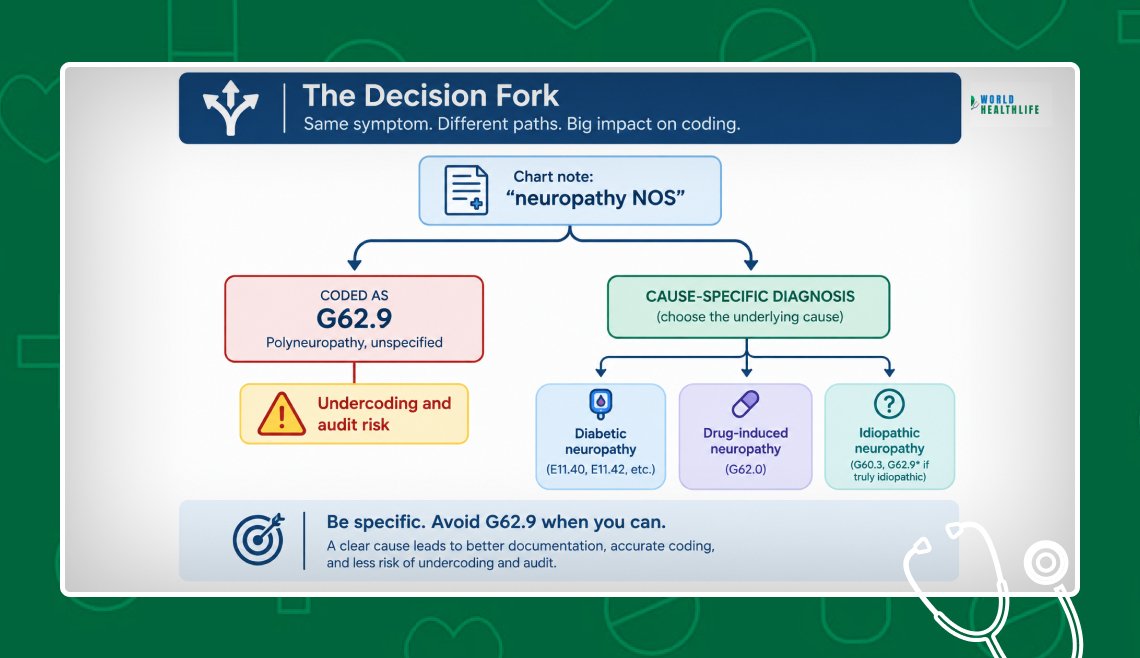
In the case of no specific cause or nerve pattern written in the chart, the default code for peripheral is G62.9, which is Polyneuropathy, unspecified.
When the record confirms general peripheral nerve damage without pinning down why it is happening, then providers and coders tend to use this. Often, you will just see it written down as “neuropathy not otherwise specified (NOS)” without any mention of diabetes, toxicity, heredity, or systemic inflammation.
Now, knowing the line between unspecified neuropathy and a specifically diagnosed one is huge for clean claims. G62.9 only captures broad, undifferentiated nerve damage.
On the other hand, a specific diagnosis ties that nerve damage to a clear trigger or clinical pattern, which shifts you into completely different code categories.
That is the exact reason why thorough provider documentation has to come before you pick a code. If you just slap G62.9 onto a chart just because the words “peripheral neuropathy” show up, you risk undercoding, compliance audits, and messy clinical data.
That is especially if the underlying cause is already sitting right there in the medical record.
List Of Peripheral Neuropathy ICD-10 Codes
Since peripheral nerve damage comes from so many different metabolic, toxic, and inflammatory pathways, ICD-10-CM splits these conditions into separate categories instead of lumping them all under one roof.
| ICD-10-CM Code | Description |
| G62.9 | Polyneuropathy, unspecified |
| G62.89 | Other specified polyneuropathies |
| G62.0 | Drug-induced polyneuropathy |
| G62.1 | Alcoholic polyneuropathy |
| G62.2 | Polyneuropathy due to other toxic agents |
| G62.81 | Critical illness polyneuropathy |
| G62.82 | Radiation-induced polyneuropathy |
| G63 | Polyneuropathy in diseases classified elsewhere |
| G61.9 | Inflammatory polyneuropathy, unspecified |
| G60.9 | Hereditary and idiopathic neuropathy, unspecified |
| G61.81 | Chronic inflammatory demyelinating polyneuritis |
| Note: This table is a focused look at the most relevant codes instead of an exhaustive list. Always double-check final code descriptions, inclusion terms, exclusions, and sequencing rules against the FY2027 ICD-10-CM Tabular List. | |
G62.9: Unspecified Peripheral Neuropathy
Under this code, generalized polyneuropathy is covered, where the chart lacks clinical details on the cause or subtype.
In the ICD-10-CM Alphabet Index, broad phrases such as “neuropathy NOS” and “peripheral neuropathy NOS” point straight to G62.9 whenever there are no modifying terms.
G62.89: Other Specified Polyneuropathies
Coders turn to G62.89 when a physician documents a clearly defined type of polyneuropathy that simply does not have its own dedicated ICD-10-CM code.
Clear clinical notes are a must here. In that way, you can justify why the condition does not fit into unspecified or cause-specific categories.
G62.0: Drug-Induced Polyneuropathy
In code G62.0, peripheral nerve damage triggered by therapeutic drugs such as chemotherapy agents or certain antimicrobials is captured.
Moreover, as per tabular instructions, you should report an extra code from categories T36 through T50. That is, using a fifth or sixth character of 5 for an adverse effect in order to pinpoint the exact medication causing the issue.
G62.1: Alcoholic Polyneuropathy
Heavy and long-term alcohol use leads to the damage of peripheral axons both directly and through secondary nutritional deficiencies.
In order to assign G62.1, the provider must explicitly document the link between the neuropathy and alcohol use. This separates it from idiopathic nerve degeneration.
G62.2: Polyneuropathy Due To Other Toxic Agents
When industrial chemicals, heavy metals, or environmental toxins cause generalized nerve dysfunction, G62.2 is the code you need.
Also, you will need to follow Tabular guidance while adding a code from categories T51 through T65 to specify the exact toxic substance involved.
G62.81 And G62.82: Critical Illness And Radiation-Induced Polyneuropathy
Code G62.81 identifies acute axonal polyneuropathy that develops in severely ill ICU patients, often tied to sepsis or multi-organ failure.
Meanwhile, G62.82 captures nerve damage caused by therapeutic radiation exposure. In fact, it requires an additional external cause code (Y84.2) to show the radiological procedure.
Peripheral Neuropathy ICD-10 Codes On The Basis Of The Underlying Cause
Once the clinical record confirms a clear systemic origin for nerve damage, you have to move away from the overall categories of G62. Instead, you should use cause-specific codes.
Diabetic Peripheral Neuropathy
Diabetic nerve damage requires combination codes instead of G62.9. Additionally, categories E08 through E13 use fourth and fifth characters from .40 through .49 to detail neurological complications.
Try keeping in mind that codes such as E11.40 and E11.4 (which are Type 2 diabetes mellitus with diabetic neuropathy, unspecified and Type 2 diabetes mellitus with diabetic polyneuropathy, respectively) are not interchangeable.
Whenever polyneuropathy is explicitly documented, you have to select E11.42.
Idiopathic Peripheral Neuropathy
When thorough diagnostic testing rules out metabolic, toxic, and hereditary triggers, the condition is labeled idiopathic.
In addition, G60.9 covers unspecified hereditary and idiopathic neuropathy. However, you should use G60.3 for idiopathic progressive neuropathy whenever clinical notes confirm the condition is getting worse without an identifiable cause.
Inflammatory Peripheral Neuropathy
Immune-mediated nerve disorders live inside category G61. Moreover, code G61.9 applies to unspecified inflammatory polyneuropathies.
On the other hand, G61.81 specifically designates chronic inflammatory demyelinating polyneuritis (CIDP), which is a distinct autoimmune disorder that attacks the myelin sheaths.
Neuropathy Associated With Other Medical Conditions
Code G63 works strictly as a manifestation code for polyneuropathy that happens secondary to systemic illnesses such as vitamin B12 deficiency, uremia, amyloidosis, or underlying neoplasms.
Tabular guidelines require you to sequence the underlying disease code first, followed right after by G63.
Peripheral Neuropathy ICD-10 Vs. Other Related Diagnosis Codes
Sensory issues and localized nerve pain often mimic generalised polyneuropathy. Because of that, coders have to separate systemic nerve degeneration from local nerve entrapment and isolated symptoms.
| ICD-10-CM Code | Description |
| G62.9 | Polyneuropathy, unspecified |
| G64 | Other disorders of peripheral nervous system |
| G57.90 | Unspecified mononeuropathy of unspecified lower limb |
| M79.2 | Neuralgia and neuritis, unspecified |
| R20.2 | Paresthesia of skin |
| R20.0 | Anesthesia of skin |
How Does Peripheral Neuropathy Differ From Polyneuropathy And Neuralgia?
| Term | What It Means | Typical Presentation | Example ICD-10-CM Codes |
| Peripheral Neuropathy | Broad umbrella term for any disorder affecting the peripheral nervous system outside the brain and spinal cord. | Varies depending on whether a single nerve, nerve plexus, or multiple nerves are damaged. | G64, G57.90 (mononeuropathy), G62.9 |
| Polyneuropathy | Widespread, typically symmetrical damage affecting multiple peripheral nerves at the same time. | Numbness, tingling, and weakness usually start evenly in both feet or hands. | G62.9, E11.42, G62.0 |
| Neuropathy | Structural or functional pathology inside the nerve fibers themselves. | Numbness, loss of sensation, tingling, and progressive muscle weakness. | G62.9, G60.9, G61.81 |
| Neuralgia | Sharp, shooting pain radiating along a specific nerve pathway without necessarily proving nerve degeneration. | Sudden, stabbing, or burning pain along a nerve track without confirmed axonal damage. | M79.2 |
| Paresthesia (Symptom) | Isolated abnormal skin sensations reported before a definitive nerve diagnosis is reached. | Temporary or unexplained tingling, prickling, or “pins and needles” sensations. | R20.2 |
Symptoms And Causes Of Peripheral Neuropathy
Knowing how the condition actually shows up on a clinical basis helps coders with one thing greatly. They can double-check whether the documented findings actually match the code on the claim.
Common Symptoms
- Persistent tingling, prickling, or numbness starting in the feet or hands
- Burning, throbbing or sharp shooting pain along nerve pathways
- Progressive muscle weakness or cramping in the extremities
- Loss of protective sensation to temperature or light touch
- Impaired balance, unsteady gait, and coordination issues
Common Causes
- Uncontrolled diabetes mellitus and metabolic syndrome
- Chronic alcohol misuse
- Vitamin B12 and other micronutrient deficiencies
- Neurotoxic medications, especially chemotherapy drugs
- Viral or bacterial infections like shingles or Lyme disease
- Autoimmune diseases including lupus and rheumatoid arthritis
- Exposure to heavy metals or industrial solvents
- Inherited genetic disorders like Charcot-Marie-Tooth disease
Read More: Mastering The ICD-10 Code For Parkinson’s Disease: A Practical G20 Coding Guide
What Are The Peripheral Neuropathy ICD-10 Coding Guidelines
Following official ICD-10-CM coding rules prevents claim denials and keeps clinical data clean.
Therefore, always start in the Alphabetic Index, then verify every single code in the Tabular List. In that way, you do not miss key instructional notes. Provider documentation remains the final word.
Unspecified codes such as G62.9 should only be used when clinical records genuinely lack detail. So, never use them as a shortcut when thorough diagnostic notes exist.
Crucially, coders can never assume a link between diabetes, medications, or systemic illnesses and peripheral neuropathy on their own. In fact, the provider has to explicitly document that relationship. This is except where ICD-10-CM “with” conventions automatically presume a link. Say, such as diabetes with neuropathy.
When assigning manifestation code G63, strict “Code first” rules require you to sequence the underlying cause before the neuropathy code. Likewise, drug-induced (G62.0) and toxic (G62.2) polyneuropathies require mandatory secondary codes to identify the exact offending agent.
Disclaimer:
The information provided in this article is for general informational purposes only. It does not, and is not intended to, constitute medical or health advice. Please consult a qualified healthcare professional for medical guidance or expert health assistance.
References:
- 2027 ICD-10-CM Diagnosis Code G62.9: Polyneuropathy, unspecified. (2026). ICD10Data.
- Mirian, A., Aljohani, Z., Grushka, D., & Florendo-Cumbermack, A. (2023). Diagnosis and management of patients with polyneuropathy. CMAJ : Canadian Medical Association Journal = Journal de l’Association Medicale Canadienne, 195(6), E227–E233. PubMed Central.
- Leonard, J. (2017, April 29). What to know about polyneuropathy. Medicalnewstoday.Com; Medical News Today.
- Eske, J. (2019, May 30). What to know about neuralgia. Medicalnewstoday.Com; Medical News Today.
- National Institute of Neurological Disorders and Stroke. (n.d.). Peripheral Neuropathy. National Institute of Neurological Disorders and Stroke.
- Webberley, D. H. (2017, November 27). What is peripheral neuropathy? Medicalnewstoday.Com; Medical News Today.
- What is Peripheral Neuropathy | The Foundation for Peripheral Neuropathy. (2024, October 18). The Foundation for Peripheral Neuropathy.


