

Have you noticed a sudden change on your skin? That feeling can instantly lead to an influx of health anxiety.
When we get a rash or breakout, our first thought is always to get an anti-itch lotion.
But what if the changes you are going through are utterly without physical irritation?
If you get itchy, but no physical need to scratch, on the trunk, arms or legs, and the itch is small and unusual, then any over-the-counter itch remedy is useless.
When you are looking for red small spots on skin which are not itchy, you need to examine your tiny blood vessels.
Likewise, if you find small, dry, non-itchy areas on the skin, this is a good indicator to assess the protective lipid barrier of your skin.
The absence of itching around a red circle on the skin can point to a very specific systemic immune response, even if it is a mysterious Lyme disease red circle.
Any skin anomaly that doesn’t cause itching goes unnoticed by us everyday and so it can go unnoticed until it becomes larger.
These silent changes shouldn’t be ignored or feared, but rather systematically assessed with a medical evaluation to listen to what your body is telling you.
This detailed blog post will discuss the exact biological causes of these spots and patches.
It will also identify the structural causes of their problems and the particular warning signs that indicate that it is time to seek professional evaluation.
Pinpoint Marks: Investigating Small Red Spots On Skin That Do Not Itch
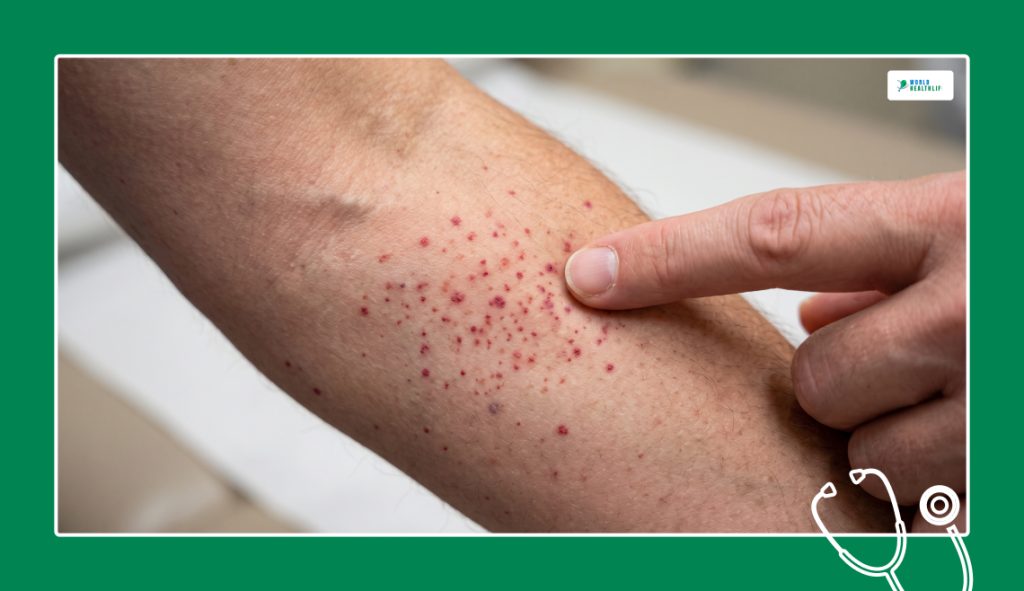
If you attempt to trace the small, non-itchy red dots on your body, the shape of the marks tells a vital story.
If the spots are completely flat, pinpoint, and do not change color when pressed, you are probably dealing with a vascular event.
These are known as petechiae.
The Mechanics Of Petechiae
Petechiae are not a common skin rash. Rather, they are tiny blood spots that develop just under the outermost layer of your skin.
It happens when the smallest blood vessels (capillaries) in your body burst and blood leaks into the surrounding dermal tissues.
This blood is now outside the blood vessels and running your fingers over the spots will confirm that they are flat against the skin.
One of the most common ways to test at home is known as the “glass test.”
When pressed against these red small spots on skin (not itchy), the spots do not turn a pale white color. Instead, they stay bright red or purple.
This indicates capillary bleeding in the area.
Common Triggers For Capillary Leakage
Capillary leakage has some triggers.
Physical Strain
If the coughing fits are prolonged, the vomiting is heavy, or heavy lifting is done, the capillaries in the face and neck may bulge.
This causes clusters of tiny dots.
Medication Side Effects
Some medications, including blood thinners or certain antibiotics, can disrupt the balance of your body’s clotting, making capillaries vulnerable.
Systemic Hematological Conditions
More seriously, a sudden occurrence of petechiae may be a sign of low platelet levels (thrombocytopenia).
Or, it can be a first sign of a bone marrow disease. For instance, leukemia, in which case blood panels should be done immediately.
Texture Shifts: Understanding Small Round Dry Patches On Skin That Do Not Itch
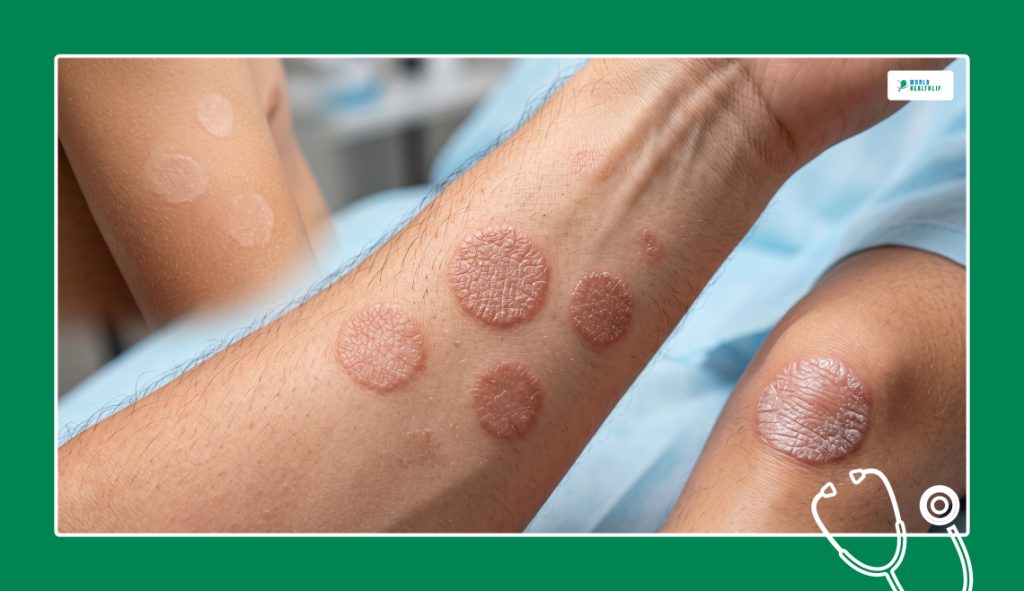
If the skin anomaly changes from flat vascular markings to rough, raised, textured changes, your diagnostic approach needs to shift.
That is due to structural hydration barriers and cellular turnover rates.
The Cellular Barrier Breakdown
The outermost layer of our skin is very dependent on the right balance of lipids and ceramides to maintain the proper moisture level.
This also prevents environmental irritants from penetrating the skin.
If environmental drying or genetic factors structurally compromise this protective lipid shield, moisture quickly evaporates from the tissue.
This is a localized form of dehydration that causes small, round, dry patches on the skin that are not itchy.
These patches are devoid of active allergic histamine release.
Also, it can be completely free of itching or burning sensations, and are a purely cosmetic problem.
Dermatological Lookalikes And Variants
There are some lookalikes and variants you have to take into account.
Pityriasis Alba
This is a harmless problem that mainly affects children and young adults.
Furthermore, it leaves behind light, circular patches on the face or upper arms that are not physically irritating and are light in color.
Nummular Eczema (Early Stage)
The first signs of nummular eczema are dry, non-pruritic (itch-free) patches. These are coin-shaped.
However, as the inflammation develops, the patches will become itchy.
Psoriasis Variants
Plaque or guttate psoriasis may result in distinct, red, scaly circular shapes over the joints or over the trunk.
These patches are caused by a sudden increase in the production of cells. As a result, this causes thick, dry patches that can never trigger an itchy response.
Non-Itchy Lyme Disease Circle: The Anatomy Of Erythema Migrans
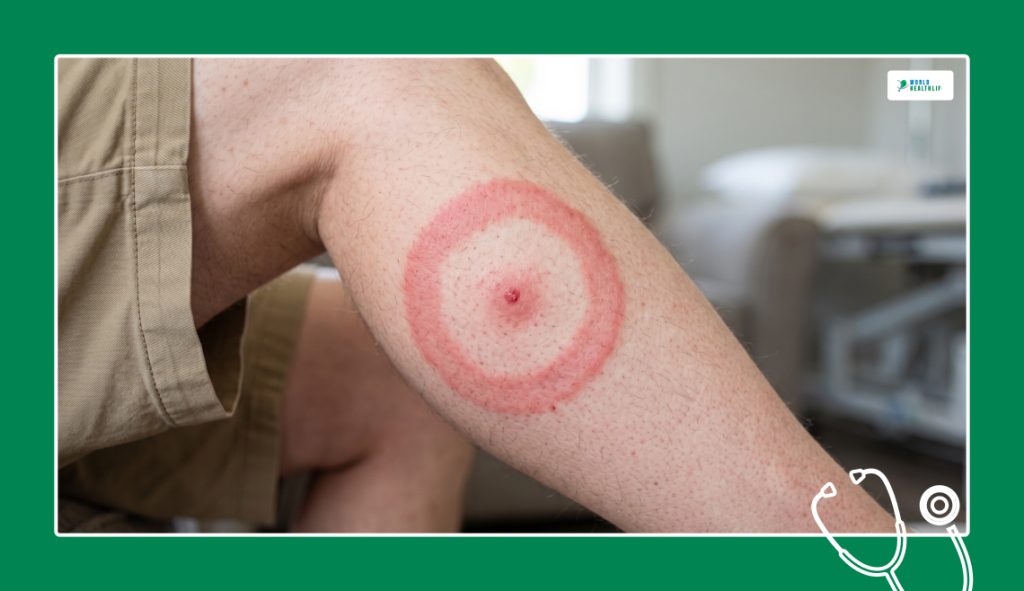
The growing ring-like mark in a circle is a medical condition that is not just silent and non-pruritic.
But it also requires urgent clinical intervention among all the marks that can be found on the human body.
The bacteria Borrelia burgdorferi are spirals that enter the deep dermal layers when an individual is bitten by an infected blacklegged tick.
Your body responds to the bacteria in a localised way as they slowly spread outwards through the tissue.
This movement forms a very distinctive rash called erythema migrans.
Most importantly, this lyme disease rash on the skin is not itchy and slowly increases in size over days to weeks, sometimes reaching 12 inches and more.
The rash may take on a unique “bull’s-eye” shape with a central clearing, or it may be solid and even pink or red.
It doesn’t itch.
Thus, many people think it’s a harmless spider bite. As a result, they end up waiting too long for antibiotics to clear the infection.
Skin Symptom Comparison Matrix
This diagnostic matrix outlines the differences in the visual characteristics, textures, and risk profiles of these silent skin shifts.
This allows you to differentiate them.
Comparing Non-Itchy Skin Anomalies
| Symptom Pattern | Typical Physical Texture | Primary Structural Location | Clinical Priority Status |
| Petechiae | Perfectly flat, pinpoint dots that do not fade under pressure. | Often clusters on the lower legs, arms, or trunk. | Moderate to High (Requires ruling out blood disorders). |
| Xerosis / Pityriasis | Rough, slightly scaly, raised circular shapes. | Commonly settles on the face, arms, or joints. | Low (Usually resolves with rich barrier creams). |
| Erythema Migrans | Flat or slightly raised, expanding target ring. | Expands outward from the direct site of a tick bite. | Urgent (Requires immediate prescription antibiotics). |
Protect Your Dermal Boundaries
On a final note, trying to track changes on your skin proves one thing. Our outer lining serves as a highly sensitive mirror for our internal health.
Non-itchy spots and patches are unique lines of physical communication from your body.
Your system may be responding to a simple hydration barrier breakdown, an isolated broken capillary, or a systemic vector-borne infection.
So, ignoring the warning signs is never the safest path.
Try to monitor your skin closely and run a simple pressure check on flat red marks.
Work with a doctor to get accurate blood tests or diagnostic scans, so your body gets the care it needs.
Take it one step at a time, watch for systemic warning signs, and protect your skin health with confidence.
Disclaimer: The information provided in this article is for general informational purposes only. It does not, and is not intended to, constitute medical or health advice. Please consult a qualified healthcare professional for medical guidance or expert health assistance.


