

Two weeks ago, a sudden physical shift completely disrupted my daily routine. I was sitting at my desk when I went to take a casual yawn.
However, my breath was cut short by a sharp, knife-like pain on the left side of my torso. It did not feel like a dull muscle ache or standard indigestion.
Instead, it felt like an intense internal snag, forcing me to ask myself a terrifying question. Why does my chest hurt when I take a deep breath?
My first instinct, just like anyone else facing sudden chest pain, was absolute panic. Immediately, I started wondering if I was experiencing a silent cardiovascular event.
However, since the sharp pain only flared up at the very top of an inhalation and completely vanished when I held my breath, I realized I needed a precise clinical evaluation.
Instead of relying on a generic online symptom checklist and panicking, I decided to book an immediate appointment with my doctor. What I learned from that clinical visit completely changed how I look at my respiratory anatomy.
My physician explained that a sharp pain during deep inspiration is clinically known as pleuritic pain. Moreover, it is rarely a single, straightforward issue. Rather, it is a highly dynamic warning signal that requires a step-by-step diagnostic breakdown.
The Sandbox Analogy: What My Doctor Taught Me About Pleural Friction
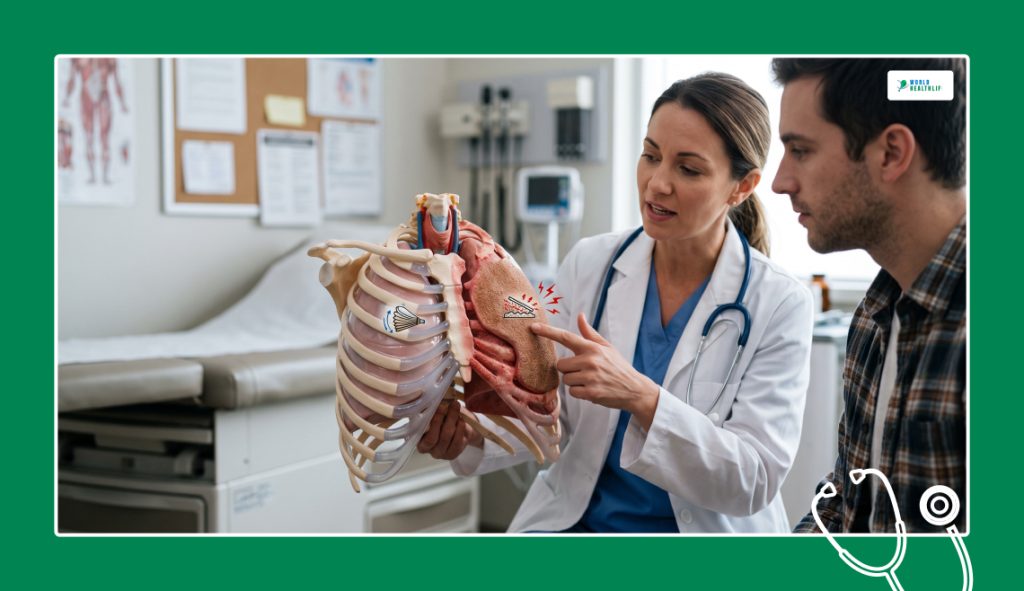
During my physical exam, my doctor took out an anatomical diagram to explain exactly what happens inside the chest during a deep breath.
She told me to stop looking at my lungs as simple empty balloons. Instead, you should look at them as a complex mechanical bellow system.
The lungs are wrapped in two thin protective layers of tissue called the pleura. One layer is securely glued to the outside of the lungs. On the other hand, the other layer lines the inside of the rib cage.
In a healthy body, a microscopic film of slipper pleural fluid sits between these two sheets. This allows your lungs to glide completely frictionlessly against your ribs whenever you breathe.
However, if an underlying bug, an injury, or systemic inflammation strikes this area, the tissue sheets swell and the lubricating fluid dries up.
Instead of gliding smoothly, the two rough layers rub directly against each other like coarse sandpaper the exact millisecond your lungs expand.
The outer lining is packed with highly sensitive pain receptors. As a result, this mechanical friction triggers a sharp and localized sting right at the peak of your inhale.
The Multi-Cause Framework: Realizing It Is Not Just One Issue
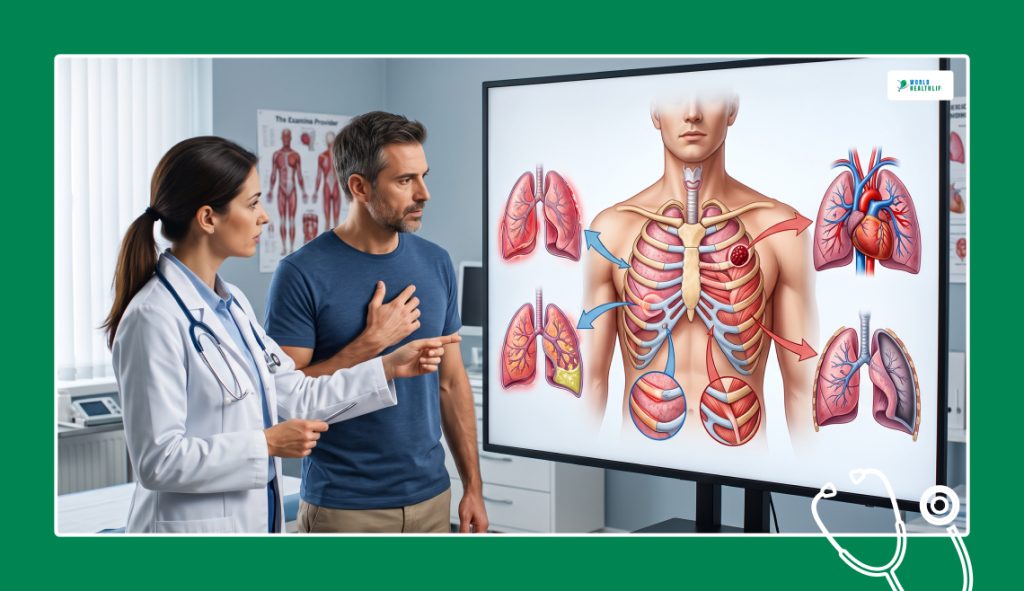
As we walked through my diagnostic options, my healthcare provider emphasized that figuring out why does my chest hurt when I take a deep breath needs a deeper understanding.
It requires sorting through multiple distinct systems inside the body.
Following this, she categorizes the primary drivers of this specific symptom into three major areas. This helped me realize how complex this issue really is.
Infectious And Pulmonary Inflammations
The most immediate suspects behind sudden pleural friction is an active respiratory infection.
Viral Pleurisy
This was a primary consideration for my case. A common viral bug, like the flu or a lingering upper respiratory virus, can settle directly into the lung linings.
As a result, this causes them to inflame and rub together without necessarily showing up as a deep lung infection.
Pneumonia
If a bacterial or viral infection takes root deep inside the lung’s air sacs, the resulting fluid accumulation and inflammation can travel outward to the edge of the lung tissue.
This irritates the nearby pleural wall, causing a painful cough paired with a high fever.
Musculoskeletal And Postural Strains
Sometimes, the pain has absolutely nothing to do with your lungs. Instead, it focuses on the skeletal framework protecting them.
Costochondritis
This condition involves inflammation of the delicate cartilage that connects your ribs to your breastbone.
When you take a deep breath, your rib cage must physically open and expand.
If this joint cartilage is inflamed, that movement triggers a sharp sting right next to your sternum.
Intercostal Muscle Strains
Heavy lifting, a sudden twisting injury, or even a violent coughing fit can pull the tiny muscles sitting between your ribs.
Every deep breath stretches these damaged muscle fibers, causing an immediate ache.
Acute Medical Emergencies
My doctor was highly explicit about the warning signs that require bypassing a standard clinic visit and heading straight to the emergency room.
Pulmonary Embolism (PE)
A PE is considered a highly dangerous blood clot that typically forms in the legs before traveling upward. Moreover, it gets securely wedged inside the main arteries of the lungs.
This blockage starves the tissue of oxygen, triggering sudden, agonizing chest pain on deep inspiration, a racing heart rate, and extreme breathlessness.
Pneumothorax
A condition where a small tear forms in the lung wall, allowing air to escape into the empty space between the lung and the ribs.
The trapped air builds up massive pressure that collapses the lung.
Consequently, it leads to a sudden, sharp one-sided pain that flares violently whenever you try to inhale.
Tracking My Diagnostics And Symptoms
To rule out the most dangerous variables, my medical team had initiated a targeted diagnostic pipeline.
I kept a careful log of my physical symptoms and how they compared across the different potential causes we were tracking.
My Symptom Mapping Matrix
| Investigated Zone | Monitored Condition | My Personal Symptom Presentation | Target Diagnostic Test |
| Pleural Linings | Viral Pleurisy | Sharp, knife-like catch at the peak of an inhale; completely disappears when holding my breath. | High-resolution Chest X-ray or CT Scan. |
| Rib Cartilage | Acute Costochondritis | Intense localized pain right next to the breastbone that hurts violently when the doctor physically presses on it. | Clinical palpation mapping and physical exam. |
| Pulmonary Vessels | Pulmonary Embolism | Sudden crushing pressure paired with an erratic heart rate, severe dizzy spells, and a blue tint on the lips. | CT Pulmonary Angiography (CTPA) and blood D-Dimer test. |
Fortunately, my electrocardiogram (ECG) and high-fidelity chest X-ray came back completely clear.
Also, this safely ruled out any acute cardiovascular emergencies, fluid buildups, or a collapsed lung.
My physician concluded that my symptoms were driven by a self-limiting case of viral pleurisy. Moreover, it simply required targeted rest, anti-inflammatory support, and focused lifestyle tracking while the tissues naturally recovered.
Steps To Reclaim Your Breathing Comfort
My personal journey through this health scare taught me that a sharp chest ache is an active, physical conversation your body is having with you.
The respiratory network cannot maintain its automated rhythms when its protective linings are actively fighting localized inflammation or structural strain.
If you are currently trying to figure out “why does my chest hurt when i take a deep breath,” do not rely on guesswork. Furthermore, do not try to mask the discomfort with random home remedies.
You can successfully take control of these lines of physical communication.
First, keep a rigorous log of the exact timing, location, and movement triggers of your pain. From there, collaborate with a qualified clinical professional to run targeted imaging and build an accurate map of your internal health.
Taking a systematic, step-by-step approach allows you to step out of the pain loop.
Besides that, you can also protect your respiratory system and permanently reclaim your physical peace of mind.
Disclaimer: The information provided in this article is for general informational purposes only. It does not, and is not intended to, constitute medical or health advice. Please consult a qualified healthcare professional for medical guidance or expert health assistance.


