Have you ever noticed a faint twitch in your thumb while resting your hand on your lap? Or have you realized you can no longer smell your morning coffee brewing the way you used to?
When subtle changes start to happen in your body, it is easy to brush them off as stress, fatigue, or simply getting older. However, when those nagging questions bring you online searching for 5 signs you’ll get Parkinson’s, what you are really looking for is clarity. In fact, you also want peace of mind.
So, first take a deep breath. Experiencing one or two unusual symptoms does not mean you are guaranteed to develop Parkinson’s disease. Many early warning signs overlap with completely harmless, everyday conditions.
But Parkinson’s rarely comes to you overnight. In fact, neurologists now know that the condition often whispers through the nervous system for 10 to 20 years before a formal diagnosis ever happens.
A quiet window researchers call the prodromal phase.
Learning how to decide what your body is trying to tell you is not about creating panic. Instead, you would be able to feel empowered.
Spotting subtle patterns early on would give you the power to start protective daily habits. Not only that, but you can also consult the right specialist while protecting your quality of life long before major mobility hurdles appear.
In this guide, we will break down the following:
- How early the symptoms work
- Explore the top five signs linked to developing the disease
- Separate medical facts from common myths
- Show you how to navigate the road ahead with confidence
Motor And Non-Motor Symptoms Of Parkinson’s Disease

In order to have a full understanding of the early warning signs, it would help you to know how Parkinson’s communicates through the body.
According to the American Parkinson Disease Association, the idea that a disease could have such modest changes in who we are can be quite an uncomfortable feeling. But there is no question that the brain is having changes due to Parkinson’s.
So, understand this first. The thing is, Parkinson’s disease is actually a progressive neurological condition, which is driven primarily by the gradual loss of nerve cells that produce dopamine.
Dopamine is actually a vital chemical messenger responsible for coordinating smooth, effortless movement, as well as regulating mood, sleep, and digestion. Now, since dopamine and related brain pathways influence so many systems at once, doctors divide symptoms into two distinct categories.
So, as you can see, understanding both categories is the key to recognizing early patterns. This is because the earliest clues are often the ones you feel rather than the ones you see.
Symptoms: At A Glance
| Feature | Motor (Movement) Symptoms | Non-Motor (Invisible) Symptoms |
| Visibility | Visible physical changes that others can see. | Invisible internal changes felt beneath the surface. |
| When They Appear | Typically noticeable after 50% to 60% of dopamine-producing cells in the movement center decline. | Often appear a decade or more before a tremor or movement issue starts. |
| Primary Areas Affected | The brain’s movement centers (affecting how you move, walk, write, and hold posture). | Nerve endings in the gut, olfactory bulb (smell center), and brainstem. |
| Key Examples | • Tremors (shaking at rest) • Muscle stiffness (rigidity) • Slowed movement (bradykinesia) • Balance and posture changes • Small, cramped handwriting | • Loss of sense of smell • Constipation and digestion changes • Sleep disorders (acting out dreams) • Mood shifts (anxiety or depression) • Unexplained fatigue |
Motor (Movement) Symptoms
These are the visible, physical changes that affect how you move, walk, write, and hold your posture.
Typically, they become noticeable once roughly 50 to 60% of dopamine-producing cells in the brain’s movement center have already declined. This marks the beginning of the clinical parkinson’s disease stages.
Non-Motor (Invisible Symptoms)
These happen quietly beneath the surface and have nothing to do with shaking and stiffness.
Since Parkinson’s can affect nerve endings in the gut, olfactory bulb (smell center) and brainstem years before reaching the primary movement centers, non-motor symptoms frequently appear a decade or more before a tremor even starts.
Top 5 Early Signs Of Parkinson’s Disease
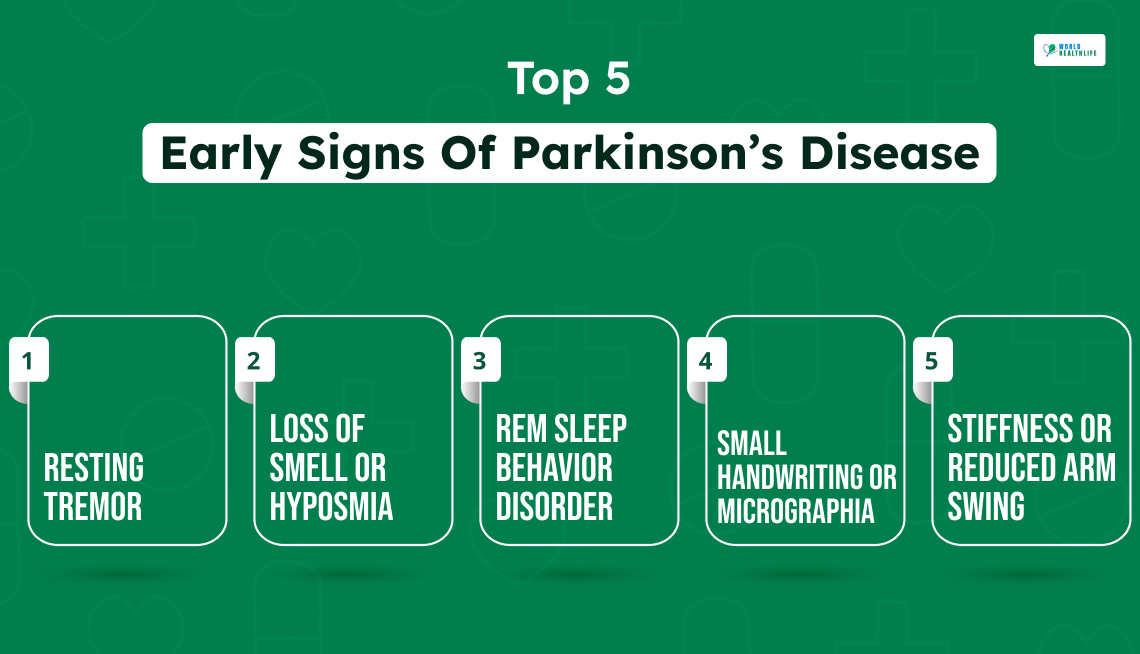
Now, every person’s nervous system is unique. In fact, large-scale clinical studies consistently point to five classic early indicators.
This includes landmark tracking programs from the Michael J. Fox Foundation and The Parkinson’s Foundation, that consistently point to five classic early indicators.
Resting Tremor
A tremor is the symptom most people immediately picture when they hear the word Parkinson’s. However, an early Parkinson’s tremor has a very specific personality.
Unlike shaky hands caused by too much caffeine, low blood sugar, or holding a heavy grocery bag, a Parkinson’s tremor is almost always a resting tremor.
This means the shaking would happen when your muscles are completely relaxed and supported. For instance, say it is when your hand is resting quietly on your thigh while watching television or hanging loosely at your side while walking.
This often begins on just one side of the body. Frequently, this starts as a subtle, rhythmic back-and-forth roll between the thumb and index finger. This is sometimes called a “pill-rolling” tremor.
On an interesting note, the moment you reach out to pick up a cup or actively use that hand, the tremor usually stops or fades dramatically.
Loss Of Smell Or Hyposmia
It almost always comes as a surprise to everyone to learn that your nose can offer one of the earliest clues about your brain health.
In Parkinson’s, one of the most notable signs is hyposmia. This is a noticeable reduction or complete loss of the sense of smell. This affects up to 90% of people who have Parkinson’s, often appearing 5 to 15 years before any movement difficulties emerge.
Unlike a stuffy nose from a seasonal cold or sinus infection, Parkinson’s-related smell loss is gradual and permanent. You might realize you can no longer detect strong, distinct scents such as freshly brewed coffee, bananas, cinnamon, smoke, or sharp perfumes.
This is even when your nasal passages are completely clear. Since smell is deeply tied to flavor, many people initially mistake this symptom for food simply tasting bland or losing its appeal.
REM Sleep Behavior Disorder
Everyone tosses and turns occasionally. In fact, talking in your sleep from time to time is completely normal.
However, a specific sleep condition known as REM Sleep Behavior Disorder (RBD) is considered as one of the strongest non-motor predictors of future neurological conditions such as Parkinson’s
Before we talk about REM, let us understand it first. This is actually the stage where vivid dreaming happens.
During healthy Rapid Eye Movement (REM) sleep, your brain sends a temporary “off switch” to your muscles so your body stays safely still while you dream. However, in people with RBD, that protective switch starts malfunctioning.
As a result, a person physically acts out their dreams. This includes:
- Punching
- Kicking
- Flailing their arms
- Shouting
- Leaping out of bed while still fast asleep
All of these are often done without remembering a thing the next morning. Usually, a bed partner is the first person to notice these intense nighttime movements.
Small Handwriting Or Micrographia
Have you ever looked at a grocery list, birthday card, or check you wrote recently, noticing that your penmanship looks unusual? Like, it looks unusually tiny, cramped, or crowded together.
Actually, doctors have named this condition micrographia, where it is one of the most classic early motor signs of Parkinson’s.
When dopamine levels begins dipping in the brain, fine-motor control becomes subtly restricted. This is the intricate coordination which is required to guide a pen smoothly across paper.
A telltale pattern of micrographia is that your writing might start out at a normal size on the left side of the page, only for the letters to grow progressively smaller, tighter, and harder to read as you reach the end of a sentence.
People often assume they just need new reading glasses or are rushing, when in reality their hand muscles are working harder to make full strokes.
Stiffness Or Reduced Arm Swing
When it comes to early Parkinson’s, it rarely ever announces itself as some sort of dramatic paralysis. Instead, oftentimes it feels like a stubborn and unexplainable tightness that is present in one shoulder, hip, or leg that simply refuses to loosen up.
Since this stiffness or rigidity (medically termed) frequently starts on one side of the body, it is commonly misdiagnosed as a “frozen shoulder” at first. Sometimes, it can even be wrongly diagnosed as arthritis or an old sports injury.
Actually, a closely related clue that is often spotted by family members or friends is reduced arm swing while walking. Normally, when you walk down a hallway, both arms swing in a natural and even way at your sides to keep your body balanced.
However, in the case of someone having Parkinson’s, stiffness in one shoulder causes that one arm to hang closer to the body or barely move while the opposite arm swings normally.
In addition, you might also feel like one foot occasionally drags slightly or feels heavier than the other at the end of a long walk.
Other Signs To Watch Out For As Well
| Early Sign | Category | What It Looks or Feels Like | How It Differs from Normal Aging |
| Chronic Constipation | Non-Motor | Straining during bowel movements or going days without passing stool due to slowed gut nerves. | Persists even when you eat enough fiber and drink plenty of water. |
| Soft or Low Voice (Hypophonia) | Motor | Speaking in a quieter, breathier, or more monotone voice than usual. | Friends or family frequently ask you to repeat yourself even when you feel you are speaking normally. |
| Facial Masking (Hypomimia) | Motor | A serious, blank, or depressed facial expression with reduced blinking. | Occurs automatically even when you are in a good mood or actively engaged in conversation. |
| Dizziness or Fainting | Non-Motor | Feeling lightheaded or unsteady right after standing up from a chair or bed. | Linked to drops in blood pressure (orthostatic hypotension) rather than simple dehydration. |
| Stooping or Hunching Over | Motor | Leaning forward or slouching when standing still. | Happens unconsciously without any recent back injury or bone pain. |
Normal Aging Vs. Early Parkinson’s: How To Tell The Difference
Since subtle aches, sleep changes, and slower movements happen to almost everyone over time, comparing everyday aging against early Parkinson’s patterns can help you decide whether a symptom warrants a closer look.
| Everyday Sign | Typical Normal Aging or Stress | Potential Early Parkinson’s Pattern |
| Shaky Hands | Happens when holding objects, feeling anxious, tired, or caffeinated; affects both hands | Happens when the hand is completely at rest; usually starts on one side only |
| Fading Smell | Temporary loss during colds, allergies, or sinus congestion; returns once recovered | Gradual, permanent fading of strong scents (coffee, spices) with clear sinuses |
| Restless Sleep | Occasional tossing, turning, or mumbling during stressful weeks | Physically punching, kicking, or acting out vivid dreams consistently |
| Handwriting | Messy or shaky when writing quickly, standing up, or using an uncomfortable pen | Letters noticeably shrink and crowd together (micrographia) across a line |
| Joint Stiffness | Stiffness that loosens up after stretching, a warm shower, or light movement | Persistent tightness on one side accompanied by one arm swinging less when walking |
Causes Of Parkinson’s Disease
In case you are noticing one or more of these signs, it is natural to wonder what exactly triggers Parkinson’s in the first place. Despite decades of groundbreaking neuroscience research, doctors still cannot point to one single cause.
Instead, Parkinson’s develops from a complex interaction between aging, genetics, and environmental exposures. This gradually damages dopamine-producing nerve cells in a deep region of the brain, which is known as the substantia nigra.
Scientists have also made the discovery of abnormal clumps of a naturally occurring protein known as alpha-synuclein, which is also called Lewy bodies. These are present inside the affected nerve cells.
Researchers believe these protein clumps interfere with normal cell function, spreading slowly from the gut and smell pathways up into the brain’s movement centers.
Moreover, this helps explain why digestive and smell changes appear years before tremors.
Risk Factors Of The Disease
Having a risk factor does not automatically translate that you will go on to develop Parkinson’s. Also, it is the same as having none at all and still not making someone completely immune.
Still, when you have an understanding what influences overall risk, it puts individual symptoms into helpful perspective.
Age
In terms of age, it is known as the biggest risk factor. In fact, Parkinson’s is actually rare in young adults, with risk rising steadily after age 60.
Also, roughly 5 to 10% of people are diagnosed before age 50, known as young-onset Parkinson’s.
Biological Sex
According to the Parkinson’s Foundation, studies have revealed that the disease affects men 1.5 times more than it affects women. Moreover, in America, it has been found to be higher in areas such as the Rust Belt, Southern California, and Florida.
Researchers have suspected differences in lifetime environmental exposure, genetics, and the potentially protective role that estrogen may contribute to this gap.
Family History And Genetics
Around 85 to 90% of PD cases have occurred in a sporadic way with no family connection at all. In addition, only about 10 to 15% are linked to inherited gene variations, including LRRK2, GBA, or PRKN.
Actually, even carrying one of these variations only raises the statistical risk instead of guaranteeing illness.
Environmental Exposures
Here, even the environment plays a vital role.
That is, having long-term exposure to certain agricultural herbicides and pesticides, industrial solvents, or heavy metals has been linked to a modestly higher risk.
For example:
- Trichloroethylene (TCE)
- Paraquat
Past Head Trauma
If an individual has a history of repeated concussions or significant traumatic brain injury earlier in life, it is also said to be associated with an increased likelihood of developing Parkinson’s later on.
Read Also: Mastering The ICD-10 Code For Parkinson’s Disease: A Practical G20 Coding Guide
Some Common Myths Surrounding Parkinson’s Disease
As we have covered the causes and symptoms so far, it is also important that you understand this.
Parkinson’s disease is actually quite widely misunderstood, with several persistent myths surrounding its symptoms, who it tends to affect and how it is managed.
Myth 1: Parkinson’s Is Only A Movement Disorder
This is actually a very common myth.
Now, while it is known for motor symptoms such as tremors, stiffness, and slowness of movement, it also causes non-motor symptoms.
Signs such as the following are quite common:
- Sleep disturbances
- Anxiety
- Depression
- Cognitive changes
- Fatigue
- Loss of smell
- Digestive issues like constipation
Myth 2: Everyone With Parkinson’s Has A Tremor
Now, this is a fact that tremors affect a large percentage of patients. However, not everyone with Parkinson’s experiences a tremor.
In fact, others tend to present primarily with muscle rigidity, slow movement (or bradykinesia), or balance and walking difficulties. These are without ever actually developing any noticeable shaking.
Myth 3: Parkinson’s Only Affects Older Adults
The majority of people are diagnosed after age 60. However, Parkinson’s is not exclusively an elderly disease.
Young-onset Parkinson’s disease (YOPD) can develop in individuals under 50. This includes people who are in their 20s, 30s, or even 40s.
Myth 4: Parkinson’s Medications Are Toxic Or Speed Up The Disease
Medications such as carbidopa/levodopa do not accelerate disease progression or wear out early.
In fact, long-term use remains safe and effective. Also, the need for higher doses over time simply reflects the natural progression of the underlying condition rather than side effects of the drugs.
Myth 5: There Is Nothing You Can Do Besides Taking Medication
Lifestyle interventions play a massive role in managing the disease and preserving quality of life.
Activities such as regular exercise, physical therapy, proper nutrition, and stress management significantly improve mobility, balance, stamina, and mental health.
Parkinson’s In The Long Term: Navigate The Journey
Ultimately, on a final note, when you notice subtle shifts in your body, it can be quite an unsettling feeling. However, paying attention to early signals is one of the smartest steps you can take for your long-term health.
It is unfortunate that there is currently no cure that completely halts Parkinson’s. But it is one of the most treatable neurological conditions, where early awareness opens the doors to therapies that protect your mobility, energy, and independence for decades.
Your body is constantly sending you information, not to frighten you, but to help you care for yourself wisely.
By listening early, asking thoughtful questions, and building supportive habits today, you can face whatever comes next with clarity, strength, and peace of mind.
Disclaimer:
The information provided in this article is for general informational purposes only. It does not, and is not intended to, constitute medical or health advice. Please consult a qualified healthcare professional for medical guidance or expert health assistance.
References
- The Michael J. Fox Foundation for Parkinson’s Research. (2026). Symptoms of Parkinson’s Disease. The Michael J. Fox Foundation.
- Parkinson’s Foundation. (2026). 10 Early Signs. Parkinson’s Foundation.
- Suppa, A., Zampogna, A., Vivacqua, G., Falletti, M., Asci, F., Marinelli, L., Trompetto, C., Currà, A., Hallett, M., Obeso, J. A., & Rothwell, J. (2026). Rigidity in Parkinson’s disease. Brain : A Journal of Neurology, awag129. PubMed.
- Eklund, M., Nuuttila, S., Joutsa, J., Jaakkola, E., Mäkinen, E., Honkanen, E. A., Lindholm, K., Vahlberg, T., Noponen, T., Ihalainen, T., Murtomäki, K., Nojonen, T., Levo, R., Mertsalmi, T., Scheperjans, F., & Kaasinen, V. (2022). Diagnostic value of micrographia in Parkinson’s disease: A study with [123I]FP-CIT SPECT. Journal of Neural Transmission, 129(7), 895. PubMed Central.
- Parkinson’s & Personality Changes | APDA. (2017, January 25). American Parkinson Disease Association.
- Mayo Clinic Staff. (2024, September 27). Parkinson’s disease – Symptoms and causes. Mayo Clinic.
- Mirelman, A., Bernad-Elazari, H., Thaler, A., Giladi-Yacobi, E., Gurevich, T., Gana-Weisz, M., Saunders-Pullman, R., Raymond, D., Doan, N., Bressman, S. B., Marder, K. S., Alcalay, R. N., Rao, A. K., Berg, D., Brockmann, K., Aasly, J., Waro, B. J., Tolosa, E., Vilas, D., . . . Giladi, N. (2016). Arm Swing as a Potential New Prodromal Marker of Parkinson’s Disease. Movement Disorders : Official Journal of the Movement Disorder Society, 31(10), 1527. PubMed Central.