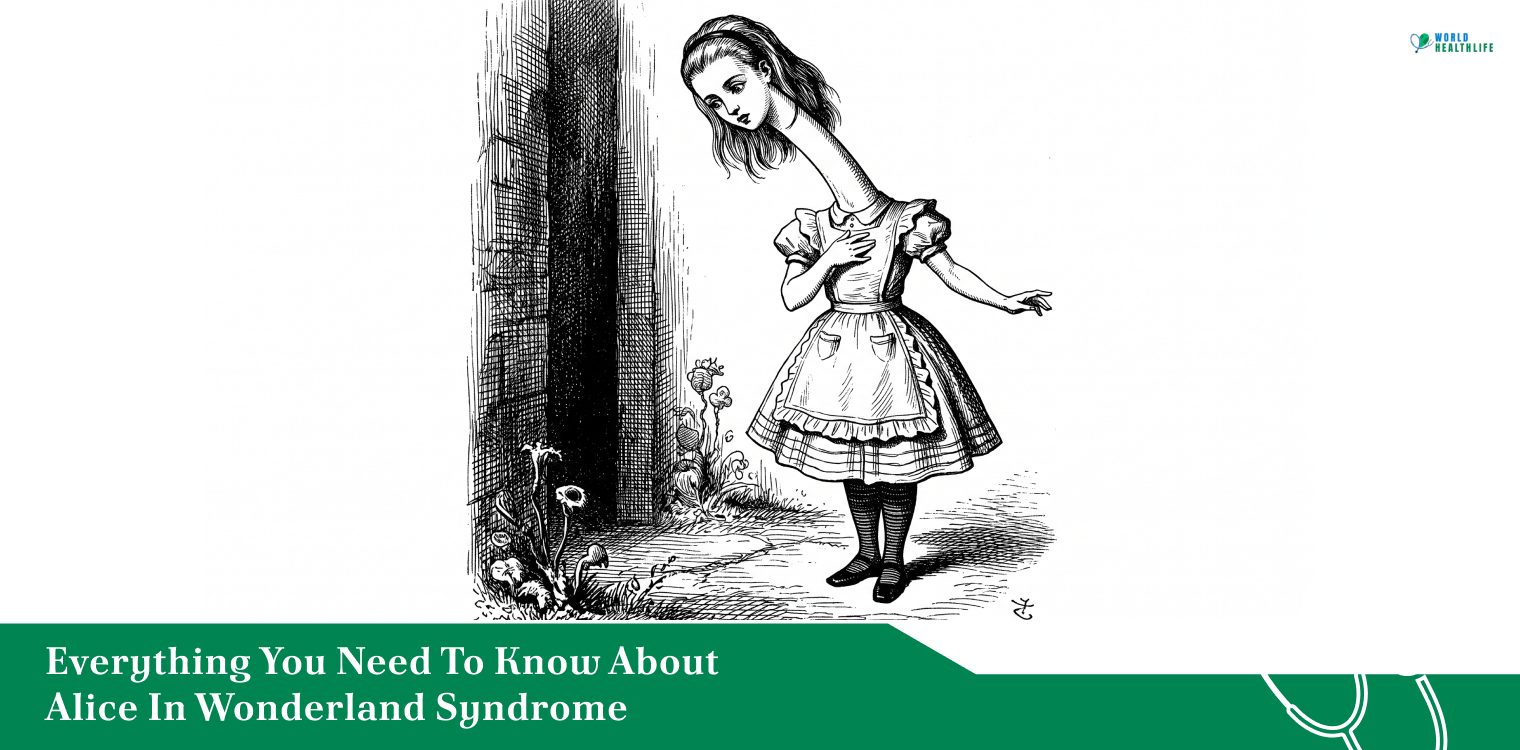
“Dear, dear! How queer everything is to-day! And yesterday things went on just as usual. I wonder if I’ve been changed in the night?” – Alice
| Quick Answer Imagine you are sitting comfortably on your sofa when, out of the blue, you notice the book has enlarged. Or a part of your body is shrinking smaller, or your leg is growing across the room. Well, this might be signs that you are suffering from Alice in Wonderland syndrome. It can also be caused by severe migraine, depression, or neurological conditions. But for instance, this is not permanent but episodic. Alice in Wonderland syndrome is a neurological disorder where the brain cannot navigate visual perception, sound, and time. Often unaware of reality. Yes, this comes from the very classic novel of Lewis Carroll, but have you ever wondered what led him to write such whimsical fiction? And why exactly is it named Alice in Wonderland Syndrome? Keep reading to find out! Imagine waking up, and the first thing you see is your coffee mug suddenly being sized up, or your hands and legs stretching across the room. The flower you picked and kept on your book is now the same size as your bed. This might sound very familiar and straight out of Lewis Carroll’s classic novel. It bears the same name as the novel and is in the same condition. Alice followed a rabbit down a hole and ate carrots until she shrank or grew back to her normal size. While all of these were happening in fiction, they are a daily reality for a few individuals with Alice in Wonderland syndrome. |
What is AIWS?
Alice in Wonderland syndrome is a neurological disorder that affects individuals and disrupts your brain’s ability to perceive the sizes of things around you, how you look at your own body, or how you feel about it. (Source: Cleveland Clinic)
Alice in Wonderland syndrome also disrupts your sense of reality and time. This means someone with Alice in Wonderland syndrome might see things, or people around them, moving at either a great speed or very slowly.
It is also commonly known as Todd’s syndrome, after the English psychiatrist John Todd named the condition in 1955, defined it as a self-experienced paroxysmal body image illusion. (Source: National Library Of Medicine)
Does It Occur Overnight?
According to some researchers, they have observed that one-third of individuals who have Alice in Wonderland syndrome were under the age of 18.
But this has no certain age limit according to studies. Even adults can have sudden attacks of unusual visual disruption, especially people with chronic neurological conditions. (Cleveland Clinic)
But these does not develop as permanent disorders. This distortion is often episodic, lasting for 5-30 minutes (Source: National Library of Medicine)
How often does it occur?
It is uncertain to state because these episodes happen all of a sudden. It is entirely based on how much of the virus is there and how chronic the illness is. Oftentimes, the patient gets multiple attacks in a day, or less.
Symptoms
While Alice in Wonderland Syndrome varies from person to person, even episode to episode, there are some of the symptoms which have these in common:
- Size Distortion
| Micropsia | Things appear to grow small |
| Macropsia | Things appear to grow larger |
- Perception Distortion
| Pelopsia | Things appear larger and closer |
| Telopsia | Tends to appear smaller and further |
- Time Distortion
- Sound Distortion
- Depersonalization, losing control over your limbs
- Derealization, where you feel disoriented from the world
- Feeling of being split in two. People often report feeling numb in one part of their body vertically, or feeling their body, but maybe they cannot fully control their body.
What Causes Alice In Wonderland Syndrome?
- Migrain aura: Cluster migraine or abdominal migraine
- Infections: Bacterial infection is reported as the most common cause of Alice in Wonderland syndrome.
- Seizure
- Certain strokes
- Medication: drugs found in cough medicines, such as dextromethorphan or montelukast.
- Cancerous tumors or brain tumors
- Recreational drugs
Risks And Diagnosis
Unfortunately, there is no defined diagnosis for this syndrome. The reported cases were too low to confirm the diagnosis conclusively.
Yet if you think you might have Alice in Wonderland syndrome, consult a doctor who later might diagnose your neurological condition and perform an ophthalmic exam. (Source: Sunrise Health)
These are some of the test the doctor run:
- MRI scan
- Blood testing: to test for any viruses or infections
- Neurological and psychiatric consultation
Literary Context: The Rabbit In The Hole
It’s natural for patients with Alice in Wonderland to feel like they have to deal with this alone. Or they might feel, “Why am I the only one to deal with this?”
Surprisingly, when medical experts went through Carroll’s diary, they discovered something very strange.
For years, researchers have wondered how Carroll wrote two classic novels with such a hyper-specific reality-bending concept.
Today they agree that it was not just written from his imagination, but from his personal experience.
He mentioned in his diary that he was visiting Dr. Bowman to complain about his right eye. On the contrary, at that time this syndrome was unrecognized, and until the 1870s, understanding what migraine was not the case.
According to Dr. Bowman, Carroll’s eye was aching as he used to write under a very dim candle. But now researchers believe Carroll’s right-eye complaint was actually a right-sided paracentral negative scotoma.
So, now we know that Alice’s reality-bending adventures were not whimsical fiction. It was a direct translation of what Carroll had been suffering years before he penned his famous books. (Source: The Lancet)
AIWS In 2026: Renewed Clinical Studies
Digital Warning
We live in a world of high-refresh-rate displays, ultra-realistic video games, and virtual reality headsets.
The technology is incredible, but it also forces our brains to process visual data at a pace they weren’t exactly wired for.
For anyone predisposed to Alice in Wonderland Syndrome, digital overload can be a major trigger.
According to researchers, use of the digital screen, especially in a dark room, acts as an environmental catalyst that strains the visual processing network. (Source: north49therapy)
Brain Mapping
Modern functional MRI states that AIWS roots in disruptions within specialized brain networks, specifically linking the extrastriate visual cortex, temporal regions, and the thalamus. (Source: medRxiv)