

Honestly, to understand what a hiatal hernia actually is, you have to picture how your upper body is put together.
Think of your torso like a two-story house. The top floor holds your heart and lungs, and the bottom floor holds your stomach and everything else.
Separating the two is a big, dome-shaped muscle called the diaphragm. It basically acts as a floorboard to keep your digestive tract from sliding up into your chest.
But there is a small catch. Your food pipe has to pass from your mouth down to your stomach, so your diaphragm has a tiny, built-in hole called the hiatus.
Normally, this hole wraps around your food pipe pretty snugly, like a tight rubber seal.
A hiatal hernia happens when that seal completely fails.
Whether it’s from everyday physical strain or just getting older, that little opening stretches out. When it goes slack, the very top part of your stomach squeezes right up through the hole and wedges itself into your chest cavity.
This completely messes up your internal plumbing. It forces open the lower esophageal sphincter, which is just the muscular valve that acts as a one-way gatekeeper for stomach acid.
When the diaphragm pinches your displaced stomach, it squeezes that acid right up into your throat. Long story short, you get stuck dealing with brutal acid reflux, chronic burning, and a ton of random discomfort.
So, What Actually Causes It?
Doctors usually point to two big things when that opening stretches out: constant pressure in your belly, or just aging.
Constant Belly Pressure
The pressure thing is pretty straightforward.
When you constantly strain your torso, your organs look for the easiest way out, and that little hole in your diaphragm happens to be the weakest link.
| Common Pressure Triggers | How It Affects the Diaphragm |
| Severe Constipation | Causes intense, repetitive straining during bathroom trips that pushes organs upward. |
| Chronic Coughing Fits | Long-term hacking from smoking or respiratory issues violently jolts the torso. |
| Heavy Lifting | Frequently moving heavy objects without bracing your core forces internal pressure up. |
| Physical Crowding | Carrying extra weight or being pregnant naturally reduces the physical space inside your belly. |
The Natural Aging Process
The aging part is just life. Like any muscle, the diaphragm loses its bounce as we get older. The tissues holding that opening tight get thin and fragile.
When that happens, even a basic daily movement can cause your stomach to pop upward out of nowhere.
For instance, it happens when twisting around or bending down to tie your shoes.
The Classic Symptoms to Watch For
If the hernia is tiny, you honestly might never notice it.
However, when a progressive protrusion begins to actively crowd your chest, it alters how your entire upper digestive tract functions and triggers some highly predictable issues.
| Symptom | What It Feels Like | Why It Happens |
| Brutal Heartburn | A fiery, intense burn right behind your breastbone that gets way worse after eating or when lying flat. | The stomach valve can’t close all the way, allowing concentrated acid to slosh back into the esophagus. |
| Active Regurgitation | A bitter, sour fluid suddenly rushing into the back of your throat completely unannounced. | The mechanical backup expands beyond simple irritation, pushing fluids up past the failed valve. |
| Trouble Swallowing | A constant, highly uncomfortable sensation that solid food is getting physically stuck halfway down your chest. | The physical bulge of the stomach pushes against the lower esophagus, crowding the food pathway. |
The Downright Bizarre Side Effects
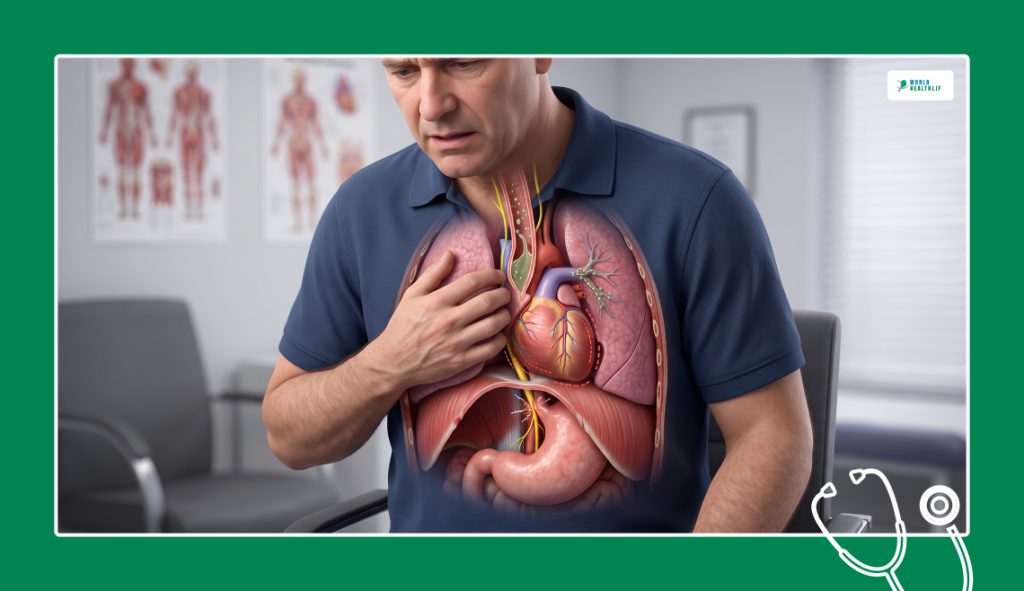
This is where things get genuinely weird. Because a large hernia takes up valuable real estate in your chest, it can press on your heart, your lungs, and your vagus nerve. This triggers bizarre, extra-digestive symptoms that people easily mistake for a panic attack or a scary cardiovascular emergency.
Fake Heart Attacks And Palpitations
The hernia sits right behind your heart. After a big meal, your stretched stomach can physically push against your heart walls or irritate nearby nerves.
This causes a racing pulse, skipped beats, and chest pain that feels terrifyingly like a heart issue, creating intense health anxiety.
Shortness of Breath And Respiratory Issues
With your stomach blocking the chest area, your diaphragm can’t drop down fully to let your lungs expand. You might feel totally winded just walking up a flight of stairs.
Plus, tiny droplets of acid can sneak into your airways while you sleep, causing a random dry cough or unexplained wheezing.
Vagus Nerve Chaos
Your vagus nerve is a massive nerve pathway running right along your food pipe.
If the hernia pinches it, it throws your whole autonomic nervous system for a loop.
This single nerve irritation can cause sudden dizzy spells, deep chronic fatigue, or a frustrating feeling that you have a permanent lump stuck in your throat.
Anatomical Classifications: Sliding Vs. Paraesophageal Hernias
Medical professionals divide diaphragmatic hernias into two starkly different structural categories on the basis of how the stomach behaves inside the chest gap.
The physical configuration completely dictates your long-term surgical risk profile.
Comprehensive Diagnostic Hierarchy
| Hernia Structural Classification | Anatomical Behavior | Primary Symptomatic Footprint | Acute Complication Risk Profile |
| Sliding Hiatal Hernia (Type I) | The junction where the esophagus meets the stomach slides up and down through the hiatus based on pressure. | Intermittent severe heartburn, acid regurgitation, and central chest burning after meals. | Exceptionally low risk of structural strangulation; usually managed via lifestyle changes. |
| Paraesophageal Hernia (Types II, III, IV) | The esophageal junction stays in place, but a portion of the stomach pushes up next to it, remaining trapped in the chest. | Deep thoracic pressure, early fullness during meals, severe breathlessness, and difficulty swallowing. | High clinical emergency risk; the trapped tissue can twist, cutting off its own blood supply (strangulation). |
Advanced Medical Diagnosis: Moving Past Guesswork
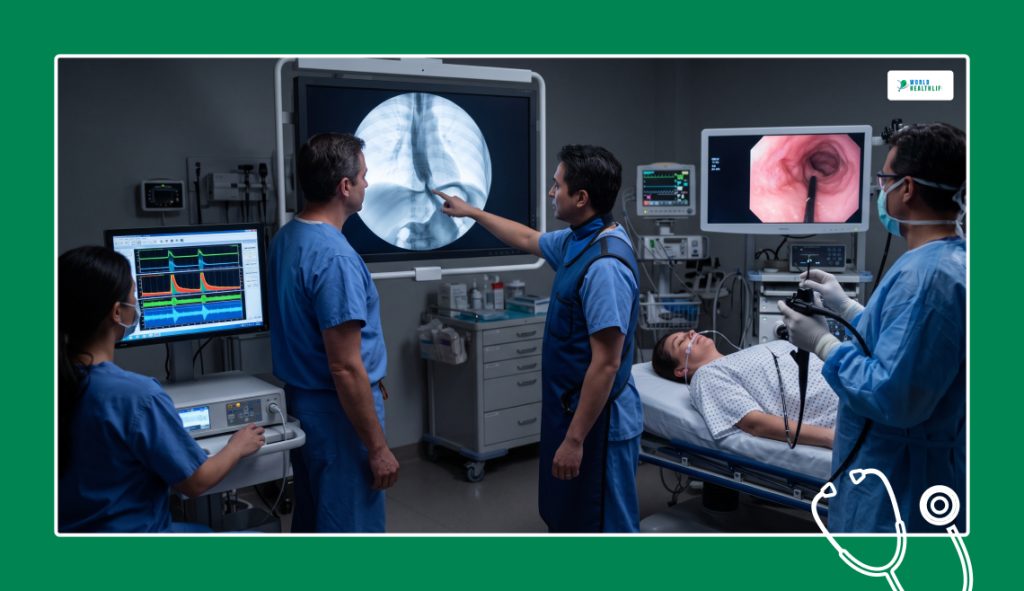
The confirmation of a diagnosis requires you to move past superficial symptom tracking and deploy precise diagnostic imaging to read the exact architecture of your diaphragm.
Gastroenterologists typically utilize three primary tools to confirm a diagnosis.
Barium Swallow Radiograph
In this type of diagnosis, the patient drinks a thick and chalky barium fluid. On the other hand, the radiologist takes continuous X-ray images.
This contrast fluid maps out the precise contours of your upper digestive tract. This shows exactly how many centimeters of the stomach have traveled above the diaphragm boundary.
High-Resolution Upper Endoscopy
A specialist guides a thin and flexible camera down the throat into the stomach. This tool allows doctors to visually inspect the health of the esophageal tissue, rule out structural conditions such as Barrett’s esophagus.
Following this check for localized bleeding or ulcerations along the hiatal pinch point.
Esophageal Manometry
A specialized diagnostic tube measures the exact muscle contractions and pressure variations inside your lower esophageal sphincter.
Consequently, it verifies whether your acid reflux is driven by a mechanical hernia or a functional nerve issue.
Comprehensive Long-Term Care Protocols
Curing the discomfort driven by a structural diaphragmatic shift requires a multi-layered care plan.
This plan is designed to lower abdominal pressure, stabilize digestive acid, and protect your thoracic organs from mechanical crowding.
Dietary And Lifestyle Modifications
To successfully manage your recovery, you must transition your eating habits to protect your lower esophageal sphincter from sudden pressure spikes.
This means swapping out large, heavy dinners for smaller, nutrient-dense meals eaten throughout the day to prevent the stomach from over-inflating inside the chest cavity.
Avoid known chemical triggers like caffeine, alcohol, citrus fruits, and spicy foods, which naturally lower sphincter muscle tone.
Crucially, never lie flat in bed within three hours of consuming food.
Finally, consider raising the head of your mattress by six inches to allow gravity to naturally keep stomach acid below the diaphragm line.
Pharmacological Support Mechanisms
To soothe inflamed esophageal tissue, physicians frequently utilize proton pump inhibitors (PPIs) or H2 blockers to dramatically lower the total acidity of your digestive juices.
While these over-the-counter and prescription medications do not physically repair the anatomical tear in your diaphragm, lowering the acid concentration stops the burning sensation.
In this way, it allows the mucosal lining of your throat to heal cleanly over time.
Surgical Interventions: Nissen Fundoplication
If a patient presents with a dangerous paraesophageal hernia, or if lifestyle adjustments fail to resolve intractable acid reflux, a thoracic surgeon will recommend a surgical repair.
The most common procedure is a laparoscopic Nissen Fundoplication.
During this minimally invasive surgery, the physician gently pulls the stomach back down into its proper home inside the abdomen.
Then, the stretched opening of the diaphragm hiatus is tightened with specialized mesh or sutures.
After this, the procedure is finished by wrapping the upper portion of the stomach around the lower esophagus. This creates a brand-new, functional muscular valve.
Restoring Functional Internal Alignment
Ultimately, unmasking the complexities of a diaphragmatic tear proves that the condition is less about a simple stomach issue and more about a fundamental breakdown in your body’s structural layout.
The digestive network functions perfectly only when its anatomical boundaries are fully preserved.
First of all, stabilize your daily intra-abdominal pressure along with targeted medical testing. This helps you to grade your hernia severity.
Then, proceed to adapt your eating habits to match your body’s mechanical limits. As a result, you can successfully protect your nervous system from chronic irritation.
It takes focused lifestyle consistency and patient tracking.
However, it allows your upper digestive tract to step out of the chemical crossfire.
Thus, it helps you recover your physical comfort, your breathing clarity, and your long-term peace of mind.
Disclaimer: The information provided in this article is for general informational purposes only. It does not, and is not intended to, constitute medical or health advice. Please consult a qualified healthcare professional for medical guidance or expert health assistance.


