

An itch can be ignored during the day, but it can ruin an hour of sleep when everyone is sleeping.
One of the most frequent triggers for people scratching their way through a bad night is itchy skin, and it’s not a random occurrence.
Your body has a 24-hour clock and that clock affects your skin’s behavior after dark. Sometimes it’s as easy as dry skin or a warm room.
Sometimes, itchy skin at night is the first sign of a skin condition, infestation or internal health issue.
Thus, the following guide explains why the itch is worse at night, what is typically the cause and what actually works.
Why Itchy Skin at Night Gets Worse After Dark
Itchy skin is not only about lack of something else to think about, although that is a factor.
Your skin changes measurably in the evening, and together they reduce the itch threshold.
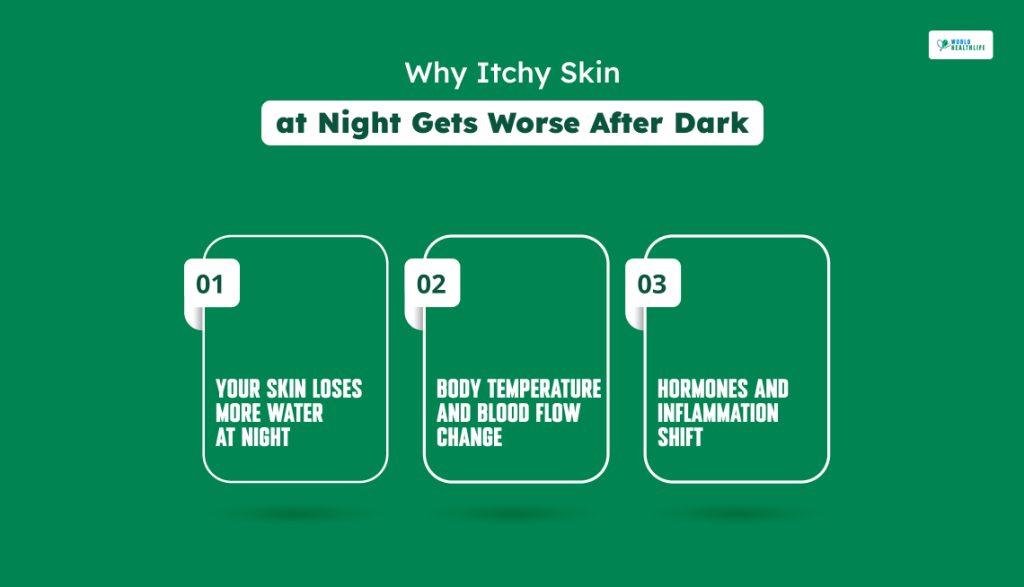
Knowing these changes helps to demystify the problem and offers a path to solutions. There are three that are most important.
Your Skin Loses More Water At Night
The skin barrier opens up in the evening, and water evaporates more quickly from the skin.
This is what dermatologists refer to as transepidermal water loss.
This leaves skin drier and less protected just when you’re about to fall asleep, which is why even people who don’t have any skin condition can feel itchy at bedtime.
Body Temperature And Blood Flow Change
In the evening, blood flow to the skin increases and skin temperature increases as the body is getting ready to cool down for sleep.
Warm skin is more responsive to itch signals. This is compounded by the use of heavy blankets and a warm room, and a little itch can become a scratch.
Hormones And Inflammation Shift
Your body’s natural anti-inflammatory hormone, cortisol, is at its lowest level late at night. Meanwhile, inflammatory chemicals (cytokines) increase.
This makes conditions such as eczema more likely to flare up at night. Throw in no distractions during the day, and the itch gets louder.
Common Causes Of Itchy Skin At Night
Some causes result in a rash. Conversely, others result in no rash at all.
The easiest way to narrow down the options is to sort them by what you see.
The table below provides a starting point and details on the most common causes.
| Cause | What you may see | Typical clue |
| Dry skin (xerosis) | Flaky, tight, rough skin | Worse in winter or after hot showers |
| Eczema (atopic dermatitis) | Red, scaly, thickened patches | Itch-scratch cycle, often in skin folds |
| Scabies | Tiny burrows, small red bumps | Intense night itch, others in the house itch too |
| Bed bugs | Clusters of bites in a line | Bites on exposed skin after sleeping |
| Hives (urticaria) | Raised, red welts that move around | Welts come and go within hours |
| Psoriasis | Thick, silvery plaques | Often on elbows, knees, scalp |
| Allergy to bedding or dust mites | Mild redness or none | Itch starts soon after getting into bed |
| Internal condition | Often no rash at all | Itch all over, with fatigue or other symptoms |
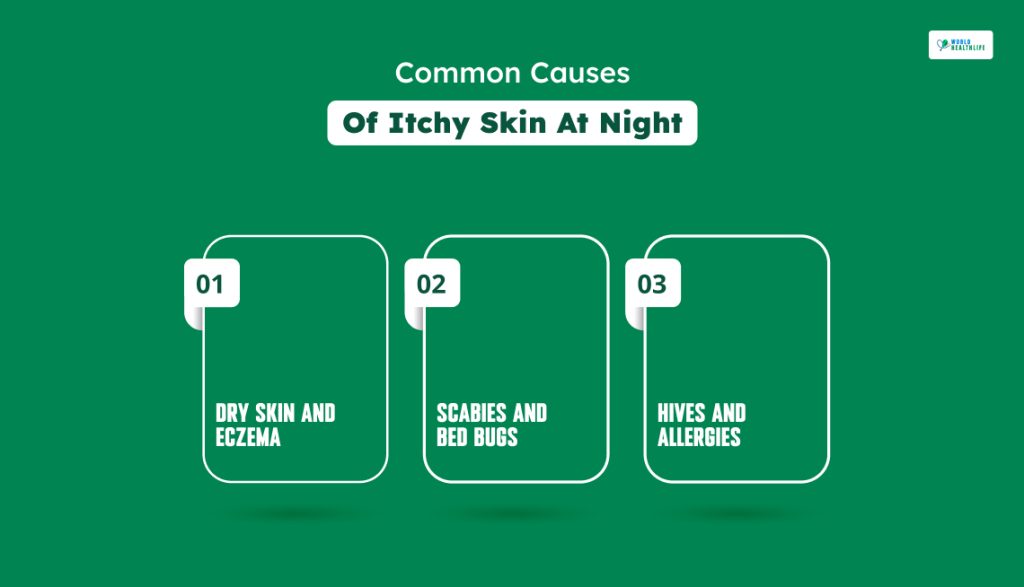
Dry Skin And Eczema
The most common cause is dry skin, particularly in older people and in cold or dry weather.
The next most common is eczema, which is likely to worsen at night due to hormonal and temperature shifts.
The scratching further weakens the barrier, leading to more itching. This is called the itch-scratch cycle and is the primary treatment objective.
Scabies And Bed Bugs
Scabies is caused by small mites that burrow into the skin and are most active at night.
The itch is severe, typically between the fingers, around the wrists, waist and genitals.
If the partner or family member is also itchy, it’s likely scabies. Bed bug bites typically occur in a row or cluster on exposed skin, like the arms, neck, and face, where the skin is exposed during sleep.
Both problems do not clear up with moisturizer, and a doctor’s diagnosis and treatment are necessary.
Hives And Allergies
Hives are raised welts that fade and then return to other areas, and are frequently caused by food, medicines, heat, or stress.
Dust mites can also cause itching and congestion shortly after lying down, as they are found in bedding.
Cleaning sheets once a week in hot water and using allergen-proof pillow covers can make a big difference more than people realize.
When Itchy Skin At Night Has No Visible Rash
Special attention should be given to itching with normal-looking skin.
If there is no rash, there is no apparent skin condition to treat, and the cause might be deeper in the body.
This is called pruritus without a primary skin lesion, and physicians are not to be taken lightly if it is widespread or persists for more than a few weeks.
It is known to be caused by several internal conditions.
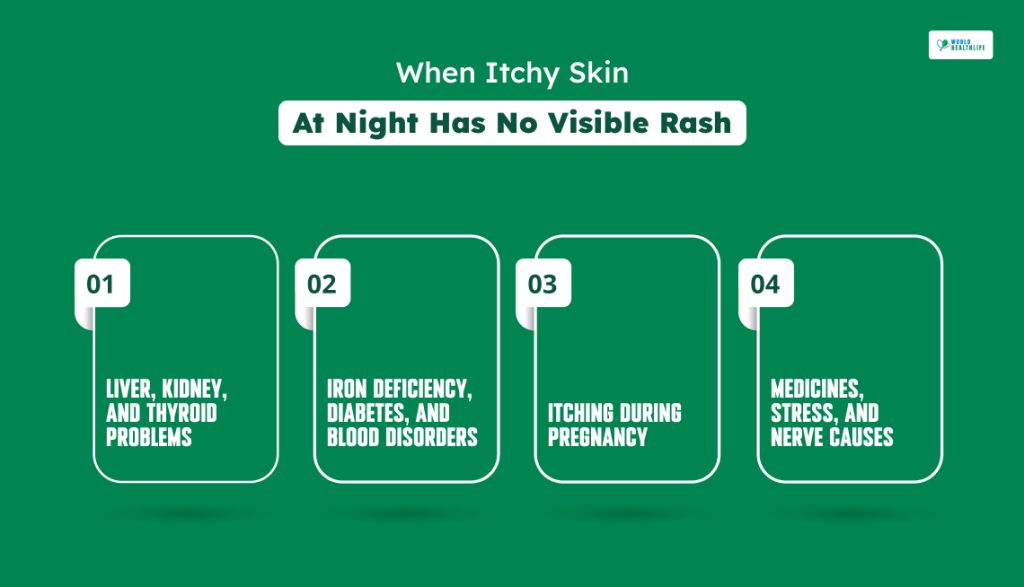
Liver, Kidney, And Thyroid Problems
Bile salts accumulate in the blood and can result in severe itching, particularly on the palms and soles, as a complication of liver disease.
Itching is a common problem among many dialysis patients who have chronic kidney disease.
Dry, itchy skin can also be caused by an overactive or underactive thyroid. In each instance, itching is relieved by treating the underlying problem.
Iron Deficiency, Diabetes, And Blood Disorders
Low iron can lead to itching all over the body before anemia is detected on a blood test.
Diabetes can cause dry skin and damage to small nerves, and some blood disorders such as polycythemia vera and some lymphomas are associated with itch which worsens after a warm shower.
These are less frequent, but persistent, unexplained itching is one reason that doctors request blood tests.
Itching During Pregnancy
Itching is a normal occurrence during pregnancy, especially on the stretched belly.
If the palms and soles are itchy, particularly at night, however, it may be a sign of intrahepatic cholestasis of pregnancy, a liver disease that can increase the risk to the baby.
If you have heard this before, please contact your midwife or doctor as soon as possible, not at your next appointment.
Medicines, Stress, And Nerve Causes
Itching is a side effect of some blood pressure medications, some painkillers, and some antibiotics.
Itching may also feel worse due to anxiety and stress, and nerve issues like pinched nerves or shingles can cause itching or burning in one spot.
If the timing coincides with a new medicine, inform your doctor prior to discontinuing the medication.
How To Calm Itchy Skin At Night
The relief typically is a result of a series of small changes, rather than one magic product.
The goal is to preserve the skin barrier, cool the skin and prevent the scratching habit until the cause is addressed.
Do the following routine for a week or two.
| Step | Why it helps | How to do it |
| Moisturize within minutes of bathing | Locks in water while the skin is damp | Use a thick, fragrance-free cream or ointment |
| Take a lukewarm, short shower | Hot water strips natural oils | Keep it under 10 minutes |
| Cool the bedroom | Warm skin itches more | Aim for about 60 to 67°F (16 to 19°C) |
| Wear loose cotton pajamas | Reduces friction and trapped heat | Avoid wool and rough synthetics |
| Apply a cold compress | Numbs the itch signal | Hold a cool, damp cloth on the area for a few minutes |
| Trim your nails short | Limits skin damage from scratching | Consider cotton gloves at night |
| Try colloidal oatmeal | Soothes irritated skin | Use in a lukewarm bath or as a cream |
Over-The-Counter Options
A small inflamed area can be treated with a 1% hydrocortisone cream for several days to reduce inflammation.
Sedating antihistamines like diphenhydramine can help you sleep, but they do not treat most itching.
Instead, they make you sleepy.
They may also lead to confusion or grogginess the next day, particularly among older people. Non-sedating antihistamines are effective only for hives or allergies.
What To Avoid
Avoid using scented soaps, fabric softeners, and hot baths.
Although it might feel good in the moment, don’t scratch, as it will stimulate more itch signals.
Also, do not use steroid creams for weeks without a diagnosis, as long-term use can cause the skin to become thin and may mask fungal infections or scabies.
When To See A Doctor
Most nighttime itches will improve in a week or two after you have corrected the dryness and cooled the room.
Some patterns require a good test, however. If the itch persists for over 2 weeks despite good skin care, if it involves the entire body, or if it interferes with sleep, make an appointment.
Similarly, if you notice a spreading rash, burrow-like lines on the skin, or other people at home itching as well, see a doctor.
If the itch is accompanied by yellowing of the skin or eyes, dark urine, unexplained weight loss, night sweats, extreme tiredness or swollen lymph nodes, seek prompt medical attention.
These indicate liver disease, blood disorders, or other internal diseases.
If the itching is accompanied by swelling of the lips or face or difficulty breathing, seek emergency treatment as it may indicate a severe allergic reaction.
Itch that comes at night is personal, but it’s a game your body has been playing all along.
Moisturize the skin, ensure the room is cool, and look for patterns.
If the itch persists despite your best attempts, then it’s no longer a matter of toughing it out, and the best way to get to sleep at night is to find the cause.
Disclaimer: The information provided in this article is for general informational purposes only. It does not, and is not intended to, constitute medical or health advice. Please consult a qualified healthcare professional for medical guidance or expert health assistance.
References
- Golen, T., MD. (2022). Why do I itch more at night? Harvard Health.
- Eurax. (2026). Why am I itching at night? Eurax.


