
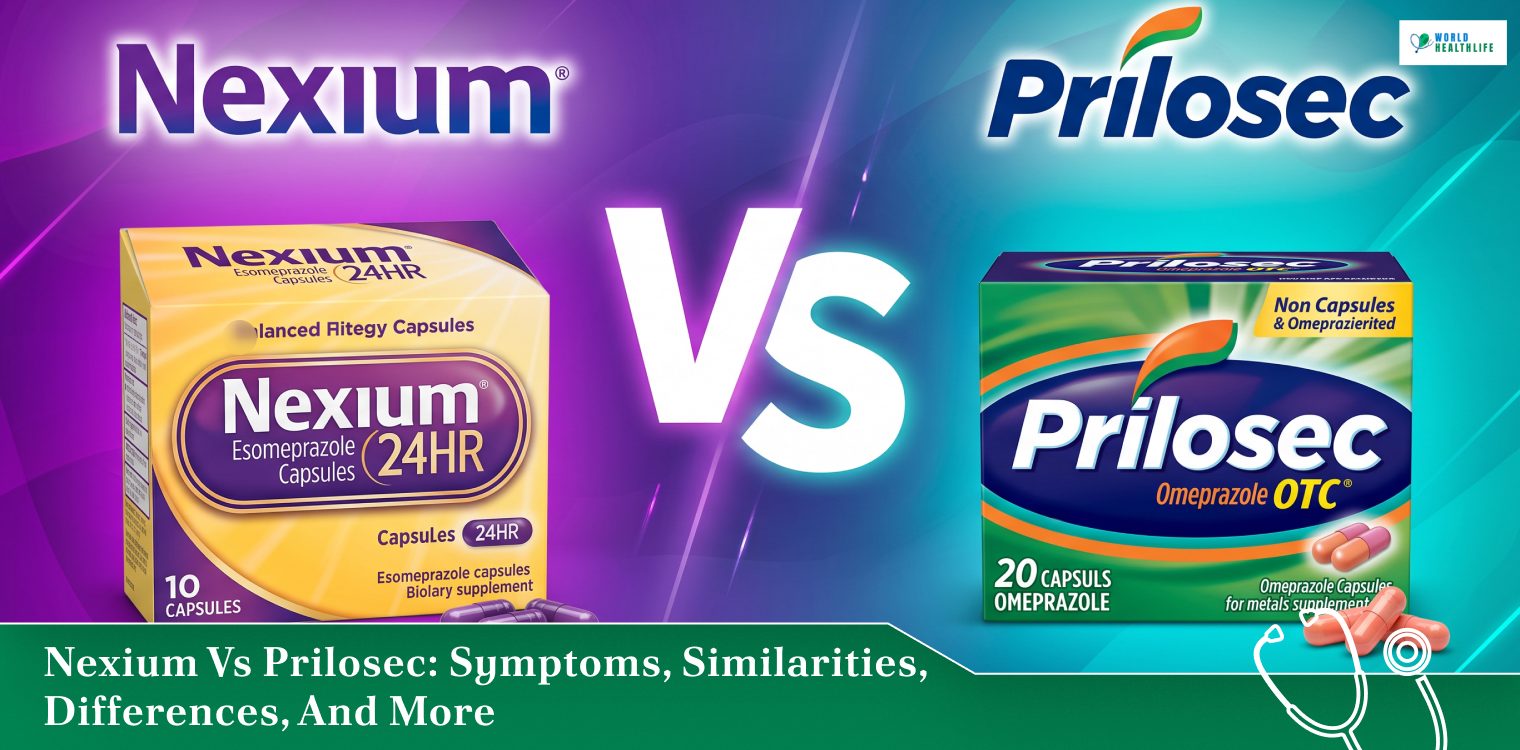
Nexium (esomeprazole) and Prilosec (omeprazole) are two of the most widely used proton pump inhibitors (PPIs).
These are prescribed to manage severe acid reflux, Gastroesophageal Reflux Disease (GERD), and erosive esophagitis.
They are chemically similar and both work by shutting down the acid-producing pumps in your stomach lining.
Still, key variations in their chemical structures mean that Nexium often controls stomach acid slightly faster and more effectively than Prilosec.
However, this higher potency can sometimes translate to a marginally higher cost and a slight increase in rare side effects.
Understanding these nuances, along with proper timing and long-term usage risks, will help you determine which medication safely aligns with your digestive health goals.
Here is a detailed Nexium vs Prilosec comparison.
What Is PPI?
Proton Pump Inhibitors, or PPIs, are some of the most used medicines when doctors have to deal with what is called GERD or Gastroesophageal Reflux Disease. So what are these?
A Proton Pump Inhibitor is a medicine that is used to reduce the amount of acid that is created in the glands of the inner lining of certain organs of the body. Most importantly, this acid is produced in the lining of the stomach.
If you are facing extreme acidity and heartburn, any of the Proton Pump Inhibitors can be prescribed to you. And there are many of them. These medicines are helpful in ensuring that the body is able to fight symptoms like severe acidity, heartburn, and reflux.
Among the various Proton Pump Inhibitors or PPIs that the doctors prescribe to the patient, the most common ones are Nexium and Prilosec.
Nexium: A Brief!

Nexium is the brand name for the PPI Esomeprazole.
It is one of the most effective proton pump inhibitors that work to provide relief from several symptoms of GERD or Gastroesophageal Reflux Disease.
Like all esomeprazole formulas, Nexium is also a DR (delayed release) product.
This means that the medicine is released only after it reaches the intestines and not the stomach.
Thus, it is able to provide relief effectively before breaking down in the stomach.
Apart from GERD, this medicine is also used for treating heartburn and other acid reflux conditions.
Nexium Side Effects
There are a number of side effects of taking Nexium. Some of them are:
- Constipation
- Dryness of mouth
- Gas
- Nausea
- Headache
- Diarrhea
- Fatigue
Prilosec: A Brief!

Similar to Nexium, which is the brand name for the esomeprazole, Prilosec is the brand name for the Omeprazole, which is another popular PPI. The doctors also prescribe this to treat GERD or Gastroesophageal Reflux Disease.
It is also used to treat erosive esophagitis. Apart from that, Prilosec is also prescribed in order to treat ailments like dyspepsia, severe heartburn, and bleeding of the gastrointestinal tract.
Prilosec Side Effects
Are you thinking about the side effects of intaking this popular omeprazole? Well, here are the Prilosec side effects that you were searching for:
- Constipation
- Nausea
- Flatulence
- Diarrhea
- Headache
Nexium Vs Prilosec: What Are The Differences?

Now that you know what Nexium and Prilosec are, it is time for you to know whether there are any differences between these two PPIs.
While these two are very similar drugs when it comes to their functions and purpose of treatment, there is a difference when it comes to the chemical nature of the medicines.
And that is the case here.
While Prilosec (omeprazole) contains a mix of S-omeprazole and R-omeprazole (stereoisomers), Nexium (esomeprazole) contains only one stereoisomer, the S-omeprazole.
Some studies have also shown that Nexium can be more effective in treating GERD.
The side effects of most PPIs are very common. However, they are rare.
But according to studies, Nexium is more likely to cause side effects compared to Prilosec.
Again, the price is also a factor of difference.
The price of Nexium is higher than that of Prilosec.
Nexium Vs Prilosec: What Are The Similarities?
Considering the fact that both medicines are popular PPIs used for treating GERD, there are a number of similarities.
First, both of them block the action of the enzymes that are responsible for the production of acid in the body.
Both medicines are available as over-the-counter drugs, and you can get them without the need for a prescription.
You also need to make sure that you do not take these medicines with other drugs like:
- Risedronate
- Clopidogrel
- Rifampin
- Delavirdine
- Rilpivirine
Nexium Vs Prilosec: Which One Should You Take?
Some studies show that Nexium has been more effective when it comes to acidity control.
It also works faster than Prilosec.
However, the overall use and treatment of Gastroesophageal Reflux Disease are the same for both of these PPIs.

Make sure that you do not keep using these medicines for too long, as long-term use of PPIs can cause adverse effects on the body.
Unless your doctor prescribes it, do not continue consuming this medicine for more than six months.
How To Take Nexium Or Prilosec Correctly?
Both drugs work best taken once daily, usually 30 to 60 minutes before a meal, most often breakfast.
PPIs only block acid pumps that are active, and eating switches those pumps on.
Swallow the capsule or tablet whole with water rather than crushing or chewing it.
Over-the-counter versions are for frequent heartburn, meaning two or more days a week.
They are a 14-day course, and you should not repeat them more often than every four months unless a doctor advises otherwise.
Important Drug Interactions
Both omeprazole and esomeprazole can reduce the effectiveness of clopidogrel, a blood thinner.
Also, the FDA advises avoiding that combination.
PPIs lower stomach acid.
So, they can also change medicine absorption, including certain antifungals, HIV medicines, and iron.
Tell your pharmacist about everything you take, including supplements.
Risks of Long-Term PPI Use
Observational studies link prolonged PPI use to lower vitamin B12 and magnesium levels.
These mean a higher risk of fractures, gut infections such as C. difficile, and kidney problems.
These are associations rather than proven causes, and the absolute risk is small for most people.
Still, they are the reason doctors advise the lowest effective dose for the shortest time.
Rebound Acid After Stopping
After weeks or months of use, stopping suddenly can cause a temporary surge in acid production.
So, heartburn may feel worse for a while. Ask your doctor about tapering rather than quitting abruptly.
When Heartburn Needs Medical Attention
See a doctor promptly, rather than self-treating, if heartburn comes with any of the following:
- Difficulty or pain when swallowing.
- Unintended weight loss.
- Vomiting blood, or black, tarry stools.
- Persistent vomiting.
- Chest pain, which should always be checked in case it is heart-related.
Also see a doctor if symptoms return soon after finishing a 14-day course, or if heartburn is new after middle age.
Who Should Talk To A Doctor Before Using A PPI
Speak with a doctor or pharmacist first if you are pregnant or breastfeeding, have liver disease, take a blood thinner, or have osteoporosis.
OTC versions are for adults.
So, children and teenagers should only take them under medical guidance.
Other Options For Occasional Heartburn
PPIs are not the only choice.
Antacids act within minutes for occasional symptoms, and H2 blockers such as famotidine work faster than PPIs but give shorter relief.
Neither is a PPI, which is worth remembering when comparing ‘alternatives’ to Nexium or Prilosec.
Lifestyle Steps That Reduce Reflux
Medication works better alongside a few habits:
- Eat smaller meals and avoid lying down for two to three hours afterward.
- Raise the head of your bed if symptoms strike at night.
- Limit personal triggers such as fatty or spicy food, alcohol, and caffeine.
- Stop smoking and, if relevant, work toward a healthier weight.
What About Cost?
Omeprazole and esomeprazole are both available as lower-priced generics.
So, paying for the brand name is usually unnecessary.
Ask your pharmacist which version suits you.
If you need to take a PPI, ask whether the lowest available strength is enough.
Also, schedule a review so that you do not continue the medicine for longer.
Frequently Asked Questions (FAQs):
Here are some of the questions that readers frequently ask about Nexium vs Prilosec. You might want to go through them for some additional information on the topic.
➥ There are a number of alternatives or substitutes for pantoprazole. Some of them are:
• Protonix
• Famotidine
• Dexilant
• Prevacid
• Prilosec
➥ A lot of people do not know this, but patients who take Omeprazole also experience anxiety and depression as side effects of this medicine. Omeprazole also causes insomnia, hallucinations, and nervousness.
➥ There are a number of alternatives for Nexium. Some of them are:
• Famotidine
• Aciphex
• Dexilant
• Prilosec
Disclaimer:
The information provided in this article is for educational and informational purposes only.
It should not be used as a substitute for professional medical advice, diagnosis, or treatment.
Both Nexium (esomeprazole) and Prilosec (omeprazole) are potent medications with distinct chemical properties, potential drug interactions (such as with blood thinners), and specific risks associated with long-term use.
Always consult with a qualified healthcare provider or pharmacist before starting, stopping, or altering any medication regimen, especially if you have underlying health conditions, are pregnant, or are experiencing severe or worsening symptoms.
Read More:


