
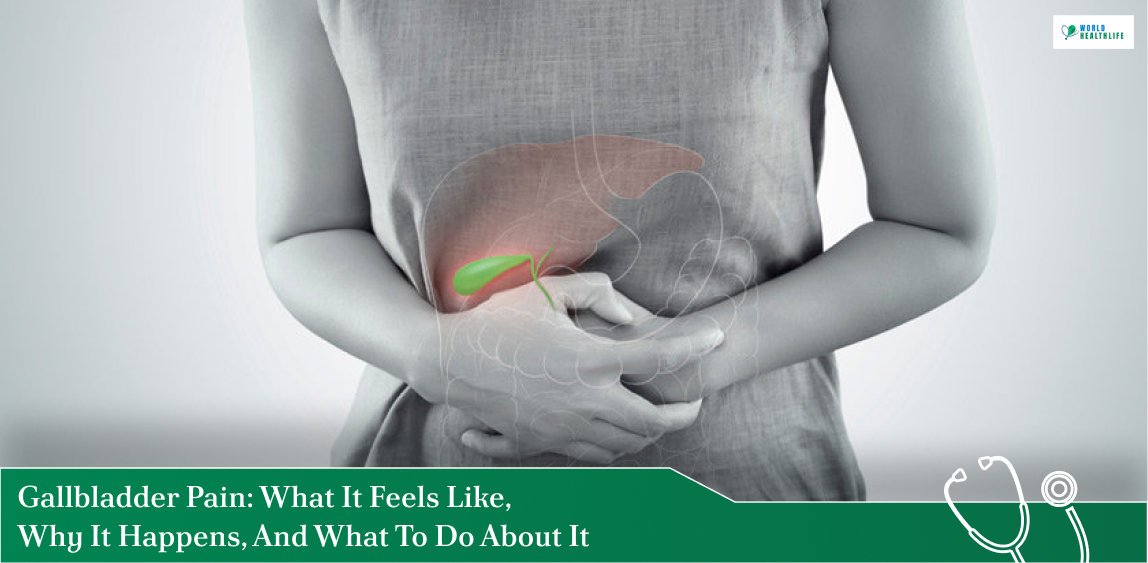
The majority of the population tends to rarely think about their gallbladder until it lets them know about its existence. That is usually in the middle of the night, a few hours after a rich dinner.
Gallbladder pain is one of the most common reasons for an emergency visit with upper abdominal pain. Moreover, it is often mistaken for heartburn, a pulled muscle, or trapped gas.
Usually, the cause is a blockage of the small ducts that carry bile out of the organ, most often caused by a gallstone.
Thus, the following guide will explain just how this pain behaves, what lies behind it, how it differs from other conditions, and when waiting stops being a safe option.
What Gallbladder Pain Feels Like
The gallbladder is a small pouch that is tucked under the liver on the upper right side of your abdomen.
Storing bile, a fluid that helps you digest fat, the gallbladder squeezes it into the intestine after you eat.
When something blocks that flow, the gallbladder keeps contracting against the obstruction, and the result is a distinct kind of pain.
So learning its pattern is the quickest way to tell it apart from everyday stomach issues.
Where You Feel It
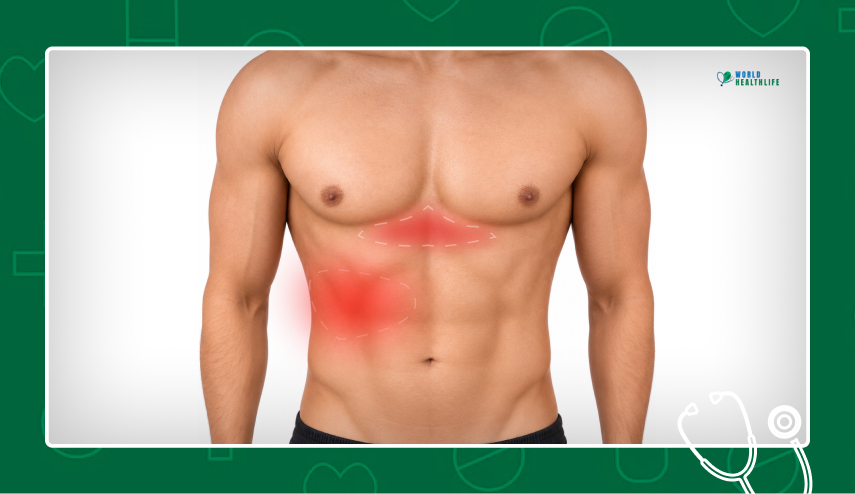
Usually, the pain sits in the upper right abdomen, which is just under the ribs, or in the middle of the upper abdomen below the breastbone.
Oftentimes, it spreads to the right shoulder blade or the back between the shoulder blades. Certain people feel it only in the back of the shoulder, which is why it is sometimes mistaken for a muscle problem.
How It Behaves
Doctors call the typical attack biliary colic, though the name is misleading.
That is because the pain does not come and go in waves like true colic.
Moreover, it builds over several minutes to a steady, gripping ache, holds at a plateau, and then fades.
A lot of people tend to describe this as pressure or a tight band under the ribs. Moving around, passing gas, or vomiting does not usually relieve this feeling.
How Long Does Gallbladder Pain Last
Typically, an attack lasts for a duration of 30 minutes to a few hours, settling on its own once the stone shifts out of the way.
Moreover, pain that stays for more than five or six hours is no longer routine. It suggests the gallbladder has become inflamed or the stone is stuck. This needs medical care the same day.
Why Does The Gallbladder Hurt
Several different problems can cause gallbladder pain, and they differ a great deal in seriousness.
Below, you can understand in greater detail the main ones from the most common to the least.
Besides that, there are sections after it that explain how they relate to each other.
| Cause | What Is Happening | Typical Pain Pattern |
| Gallstones (Biliary Colic) | A stone briefly blocks the cystic duct | Attacks of 30 minutes to a few hours, then relief |
| Acute Cholecystitis | The gallbladder becomes inflamed, often from a stuck stone | Constant pain for more than 6 hours, often with fever |
| Bile Duct Stone (Choledocholithiasis) | A stone travels into the common bile duct | Severe pain, possible jaundice, dark urine |
| Cholangitis | Infection of a blocked bile duct | Pain, fever, chills, and jaundice together |
| Gallstone Pancreatitis | A stone blocks the outlet shared with the pancreas | Severe upper abdominal pain, radiating to the back, vomiting |
| Biliary Dyskinesia | The gallbladder empties poorly, with no stones | Similar to colic, but scans show no stones |
| Gallbladder Sludge Or Polyps | Thick bile or small growths | Often silent, sometimes causes attacks |
Gallstones And The Stuck-Stone Problem
Gallstones form when substances in bile, which is mostly cholesterol or bilirubin, harden into crystals.
They can stay silent for years. Moreover, about two in three people with gallstones never feel a thing.
Trouble starts when a stone drifts into a duct.
After a meal, especially one that is high in fat, the gallbladder starts to contract, pushes the stone against the narrow opening, and triggers the attack.
When Pain Turns Into Inflammation Or Infection
If the blockage lasts, bile builds up, and the gallbladder wall swells. This is known as acute cholecystitis.
Moreover, it brings steady pain, tenderness under the right ribs, nausea, and a low fever.
If the stone reaches the common bile duct, bile backs up into the liver, which causes jaundice, and an infection there can become serious pretty fast.
Consequently, these are the situations in which gallbladder pain stops being a nuisance and becomes an emergency.
Pain Without Stones
Certain people have classic attacks with a clean ultrasound. In these cases, the gallbladder may not empty properly.
Medically, this is known as a condition called biliary dyskinesia, or functional gallbladder disorder. Furthermore, this is confirmed by a scan that measures how well the organ squeezes, called a HIDA scan.
Since several digestive conditions mimic this pattern, doctors usually rule out other causes first.
Gallbladder Pain Vs. Other Causes Of Upper Abdominal Pain
Upper abdominal pain has many sources, where the gallbladder is only one of them. Timing and associated symptoms are more reliable than location alone.
Below, it showcases the features that help in the separation of the most common look-alikes. However, only an exam and tests can settle the question.
| Condition | How It Differs From Gallbladder Pain |
| Acid Reflux Or Heartburn | Burning behind the breastbone, worse lying down, eases with antacids |
| Peptic Ulcer | Gnawing pain that changes with eating, sometimes better after food or antacids |
| Pancreatitis | Severe pain that bores through to the back, often with repeated vomiting |
| Kidney Stone | Pain in the flank that moves toward the groin, blood in the urine |
| Liver Inflammation (Hepatitis) | Dull ache with fatigue, dark urine, and possible jaundice |
| Irritable Bowel Syndrome | Cramping linked to bowel movements, relief after passing stool |
| Heart Attack | Pressure or tightness, sometimes in the upper abdomen, with sweating and breathlessness |
Why Heart Symptoms Must Never Be Assumed Away
These are some of the signs that can be the way a heart attack presents, particularly in women, older adults, and people with diabetes.
- Upper abdominal pain
- Nausea
- Sweating
If the pain comes with chest pressure, shortness of breath, or a cold sweat, call emergency services first and work out the gallbladder question afterward.
Symptoms That Usually Come With Gallbladder Pain
Pain is rarely considered the only sign. There are other symptoms that help doctors judge how severe the issue is and how they can decide on acting quickly.
Although some are common and mild, some others point toward a complication.
| Symptom | What it may mean |
| Nausea or vomiting after fatty meals | Typical of gallstone attacks |
| Bloating and belching | Common but not specific to the gallbladder |
| Low-grade fever | Possible inflammation (cholecystitis) |
| High fever with chills | Possible infection of the bile ducts |
| Yellow skin or eyes (jaundice) | Bile duct blockage |
| Dark urine and pale, clay-colored stools | Bile cannot reach the intestine |
| Rapid heartbeat or confusion | Possible serious infection, so seek emergency care |
Who Is More Likely To Get Gallbladder Pain
Anyone is able to develop gallstones.
However, some groups tend to be at a higher risk. The reasons are mostly related to how much cholesterol the liver puts into bile and how well the gallbladder empties.
Risk Factors You Cannot Change
Unfortunately, women tend to be twice as likely as men to develop gallstones. That is partly due to the fact that estrogen raises the cholesterol content of bile.
Not just gender, but the risk factors also rise due to age, a family history of gallstones, and certain populations. For example, these risk factors tend to be higher in Native American and Mexican American people.
There is also an added risk due to pregnancy. The reason behind this is that hormones slow the emptying of the gallbladder.
Risk Factors You Can Influence
Factors such as excess weight, rapid weight loss, and crash dieting are the main ones in this case that can affect you.
When you lose weight quickly, the liver releases extra cholesterol into bile, and the gallbladder empties less often.
Diabetes, high triglycerides, a very low-fiber diet, and long periods of fasting also contribute.
Gradually, when you try to lose weight, about one to two pounds a week, it is gentler on the gallbladder.
How Doctors Find The Cause
First, a doctor starts with your history.
The list includes:
- Where the pain is
- When it comes
- How long it lasts
- What triggers it
During the exam, they may press under your right ribs while you breathe in.
If this makes you stop breathing in due to the pain, then this is known as Murphy’s sign. Moreover, it points toward gallbladder inflammation. Tests then confirm the diagnosis.
Imaging
An abdominal ultrasound is the usual first test. It is quick, painless, and very good at finding gallstones and signs of thickened, inflamed walls.
When the answer is unclear, doctors may use a HIDA scan to check how well the gallbladder works, or MRCP (a type of MRI) or CT to look at the bile ducts.
On the other hand, if a stone is suspected in the duct, an endoscopic procedure called ERCP can both detect it and remove it.
Blood Tests
Blood work looks for white blood cells, which rise with infection, and for liver enzymes and bilirubin, which rise with a bile duct blockage.
Lipase or amylase tests help detect pancreatitis.
Together, these results show whether you have a simple stone, an inflamed organ, or a complication that needs urgent treatment.
Treatment Options
Treatment depends on whether you have occasional attacks, an inflamed gallbladder, or a complication.
A single mild attack doesn’t always require surgery, but repeated attacks usually do, because the stones tend to keep causing trouble.
Managing A Single Attack
Doctors may give pain relief, anti-nausea medicine, and fluids, and then monitor how things settle.
Over-the-counter painkillers can help at home, though if the pain is severe, you shouldn’t try to push through it.
Avoid fatty food until you have been assessed, and note what you ate, since it helps the doctor.
Gallbladder Removal: Cholecystectomy
Surgery to remove the gallbladder is the standard treatment for symptomatic gallstones.
Most operations are done laparoscopically, through a few small cuts, and many people go home the same day or the next morning.
You can live normally without a gallbladder, since the liver still makes bile and sends it straight to the intestine.
Some people notice looser stools for a few weeks, especially after fatty meals, and this usually improves.
Other Treatments
For people who cannot have surgery, a medicine called ursodiol can slowly dissolve small cholesterol stones, though it takes months and stones often return.
Stones in the bile duct are removed with ERCP. Infection of the gallbladder or ducts is treated with antibiotics and, often, drainage or surgery.
Eating And Living With Gallbladder Pain
Food does not cause gallstones to appear overnight. However, it can trigger or avoid attacks while you wait for treatment.
Here, the aim ends up being the avoidance of fatty, big meals that make the gallbladder contract hard.
| Lean Toward | Go Easy On |
| Vegetables, fruit, and whole grains | Deep-fried food and fast food |
| Lean protein such as fish, chicken, and beans | Fatty red meat and processed meats |
| Small, regular meals | Large, heavy meals, especially at night |
| Healthy fats in modest amounts (olive oil, nuts) | Full-fat dairy, butter, and cream in large amounts |
| Fiber-rich foods | Sugary snacks and refined carbs |
Note that diet changes ease symptoms but cannot dissolve gallstones.
If attacks continue despite careful eating, the problem is mechanical, and the fix is medical.
Consult A Doctor If You Face This
Make an appointment if you have repeated episodes of pain under the right ribs after eating.
This is especially important if they last longer than half an hour or wake you at night.
Mention any gallstones found on a scan, even if you feel fine. In this way, you can have a plan in place.
Go to the emergency room if the pain lasts more than five hours. Do that too if it comes with the following:
- Fever and chills
- Yellowing of the skin or eyes
- Dark urine
- Pale stools
- Repeated vomiting
Call emergency services for severe pain with chest pressure, difficulty breathing, a racing heart, or confusion.
Gallbladder pain tends to follow a pattern that is easy to recognize once you know it: upper right, after food, building and fading over hours.
Pay attention to that pattern, keep track of what triggers it, and don’t wait for the third or fourth attack before getting checked.
The treatment is straightforward, and the complications that make it dangerous are largely avoidable with early care.
Disclaimer: The information provided in this article is for general informational purposes only. It does not, and is not intended to, constitute medical or health advice. Please consult a qualified healthcare professional for medical guidance or expert health assistance.
References
- National Institutes of Health. (2024). Galled by the gallbladder? NIH News in Health.
- University of Utah Health. (2026). Gallbladder pain. University of Utah Health.
- UnitedHealthcare. (2026). Understanding gallbladder pain: causes, symptoms and treatment. UnitedHealthcare.
- NHS Inform. (2026). Gallstones | NHS inform. NHS Inform.
- Jones, M. W., Weir, C. B., & Marietta, M. (2026). Gallstones (Cholelithiasis). StatPearls – NCBI Bookshelf.
- Jones, M. W., Kashyap, S., & Deppen, J. G. (2023). Physiology, gallbladder. StatPearls – NCBI Bookshelf.


