Today’s topic: Clinical lycanthropy.
What if I told you that the human brain can easily betray its own skin? Also, it can even convince itself that fingernails are sharpening into claws while your teeth are hardening into fangs.
Believe me. This is based on a real event.
In 1853, a man stood before Queen Isabel II of Spain and made a confession so chilling it shocked everyone!
The man committed multiple horrific murders, but not because he wanted to. Instead, a curse physically transformed him into a wild wolf.
Manuel Blanco Romasanta was known as Spain’s “Werewolf of Allariz.” Moreover, in a groundbreaking moment for legal medicine, the Queen had commuted his death sentence. Consequently, this allowed doctors to investigate his condition.
Researchers made one of the earliest recorded attempts to study clinical lycanthropy, a rare psychiatric symptom.
A Brief Overview: Terminology Of Clinical Lycanthropy

Before I begin, you must have a basic question. What is clinical lycanthropy?
While the term originates from the Greek words Lykos, meaning wolf, and anthropos, meaning human, modern medicine categorizes it otherwise. That is, under the broader umbrella of clinical zoanthropy.
In this condition, a person holds a fixed and delusional belief that they have transformed or are currently transforming into an animal.
Additionally, this diagnosis covers human-to-animal metamorphosis that involves everything from domestic pets to reptiles.
Clarifying the diagnostic distinction is straightforward. Moreover, clinical zoanthropy serves as the broad medical classification for any animal transformation delusion.
On the other hand, clinicians strictly reserve true clinical lycanthropy for the specific subset of patients who believe they are transforming into a wolf.
Historically, it was treated as a spiritual curse, witchcraft, or demonic possession. However, modern science has proven that clinical lycanthropy is an organic brain processing error.
Contrarily, the mind does not create these episodes in a vacuum.
While neurological malfunctions alter internal physical sensations, external factors such as culture, media, and digital algorithms offer the structural blueprint. That is, for the beast a patient believes they are becoming.
History And The Archives: Notable Documented Case Studies
Medical and historical archives prove that clinical lycanthropy is a global phenomenon.
Additionally, a patient’s historical era and underlying diagnosis shape the distinct behavioral transformations that manifest this condition.
Since it is an exceptionally rare condition, its historical data is quite scarce. A famous comprehensive historical meta-analysis tracked scientific data since the year 1850 and uncovered only 56 globally documented cases of human-to-animal delusions.
Out of these 56 recorded instances of broader zoanthropy, only a small fraction met the strict diagnostic criteria for true and classic clinical lycanthropy involving a wolf transformation.
Key Case Studies At A Glance
| Case Study & Patient Profile | Specific Metamorphosis | Documented Connection to Clinical Lycanthropy |
| Manuel Blanco Romasanta (1853) | Wolf (Classic Variant) | Earliest legally recognized medical study of clinical lycanthropy |
| The Huntington’s Disease Case (2023) | Wolf (Classic Variant) | First documented case of clinical lycanthropy driven by neurodegeneration |
| The Obsessive-Compulsive Case (2021) | Buffalo (Boanthropy Variant) | Rare presentation of clinical lycanthropy linked to severe OCRDs |
| Schizophrenia Patient Case | Dog (Kynanthropy Variant) | Clinical lycanthropy triggered by sudden medication non-compliance |
| Major Depressive Case (2012) | Snake (Ophidianthropy Variant) | Acute presentation arising from severe psychotic depression |
The Huntington’s Disease Case (2023): A Neurological First
A breakthrough modern case report documented a male patient who developed a severe fixed werewolf delusion following two years of worsening anxiety.
This landmark case represents the first time clinical lycanthropy was directly linked to Huntington’s disease.
The severe and progressive nerve cell damage associated with the disease directly compromised the frontostriatal brain networks. These are responsible for maintaining stable human identity.
The Obsessive-Compulsive Context Case (2021): The Buffalo Variant

Medical researchers published an unusual case involving a 25-year-old male who suffered from the delusional conviction that he had transformed into a buffalo.
Instead of matching standard psychotic profiles, this patient’s presentation was heavily linked to Obsessive-Compulsive and Related Disorders (OCRDs).
This highly unusual presentation showed that severe unmanaged compulsive intrusive thoughts can morph into full clinical lycanthropy symptoms.
The Kynanthropy Presentation: The Dog Transformation
In a case tracking a 35-year-old male with long-standing schizophrenia, the patient suffered from kynanthropy.
This is the specific delusion conviction that transforms an individual into a dog.
Additionally, his symptoms escalated dramatically after he abruptly discontinued his prescribed antipsychotic medication. As a result of this sudden chemical drop, there was a trigger of intense bodily hallucinations.
This turned his underlying illness into active clinical lycanthropy behavioral patterns.
The Snake Transformation Case (2012): Ophidianthropy
A published case report detailed a 47-year-old woman suffering from major depressive disorder with severe psychotic features.
Additionally, she had experienced an acute delusion that her physical form was actively changing into a snake.
Driven by severe internal sensory distortions, she abandoned her bed and dropped to the floor, marking another heavily documented subset of clinical lycanthropy literature.
Statistical Prevalence And The Neurological Triggers

The historical meta-analysis reviewing those 56 original case descriptions confirmed that clinical lycanthropy is almost never a standalone psychiatric diagnosis.
Instead, it functions as a highly unique, temporary manifestation of severe underlying conditions rather than a permanent state.
Medical studies show that the underlying psychiatric condition can be successfully managed.
That is, with the help of antipsychotic medication or mood stabilizers, the delusion of animal transformation typically resolves within a few weeks to months.
The Brain’s Path To Clinical Lycanthropy
| Stages | Process Phase | What Happens Inside the Brain |
| Stage 1 | Coenaesthesiopathy | The internal virtual map of the body misfires, sending faulty sensory data. |
| Stage 2 | Underlying Triggers | Conditions like schizophrenia, severe bipolar mania, or deep psychotic depression activate. |
| Stage 3 | Active Manifestation | The logical mind grabs local folklore or media to explain the broken sensations, triggering clinical lycanthropy. |
The meta-analysis and modern neuroimaging point to three primary triggers that cause the human mind to adopt a clinical lycanthropy diagnosis.
Primary Psychiatric Conditions
Schizophrenia, psychotic bipolar mania, and major depressive disorder with psychotic features remain the most common root causes.
These conditions break down the brain’s ability to separate internal thoughts from external reality.
Coenaesthesiopathy
In this neurological phenomenon, deep perceptual abnormalities in the patient’s body schema is involved. That is, in the internal map of the brain.
However, the map misfires. Patients begin to experience terrifying physical distortions.
That includes feeling like:
- Their teeth are changing shape
- Their body is shrinking
- Their limbs are elongating into paws
Culture-Bound Expressions
As per biology, it dictates how the brain breaks. However, culture dictates what the delusion creates.
Delusions are strongly shaped by the patient’s cultural background.
For example, a person from any Western nation may likely experience clinical lycanthropy as a wolf transformation.
Contrarily, individuals in other geographic regions regularly report transforming into dogs, buffaloes, crocodiles or cats. Moreover, that is dependent on local wildlife and lore.
Clinical Lycanthropy Evolution Timeline: From Medieval To Present Day
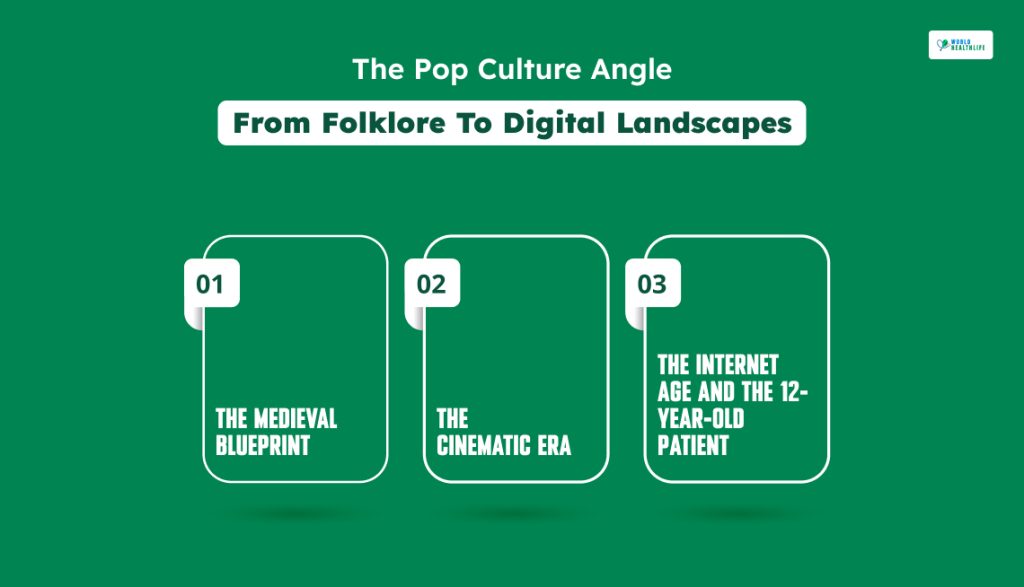
Since clinical lycanthropy relies heavily on culture to build its narrative, the way the delusion manifests has changed alongside human media consumption.
The Medieval Blueprint
In the 16th and 17th centuries, European society was consumed by the fear of witchcraft and the occult.
When individuals experienced psychotic breaks or body map episodes during this era, their minds interpreted the bodily confusion through a religious lens.
They did not view their condition as clinical lycanthropy. Instead, they had the belief of being literal monsters who had signed blood pacts.
The Cinematic Era
With the birth of 20th-century horror cinema, kicked off by films like The Wolf Man (1941), the imagery of transformation shifted.
Patients suffering from acute psychosis began describing their symptoms of clinical lycanthropy using theatrical, step-by-step Hollywood visuals.
Additionally, they reported watching their skin change under the light of a full moon. This directly mimicked the special effects shown on theatre screens.
The Internet Age And The 12-Year-Old Patient
The internet has fundamentally altered the way humans process identity and find communities.
This shift hit the medical community directly when researchers documented an unprecedented case. That was of a 12-year-old boy experiencing clinical lycanthropy heavily influenced by modern digital culture. [Source: National Institutes of Health]
The young adolescent had spent months consuming online media centered around wolf “pack” dynamics.
Moreover, he was also tracking fictional werewolf forums and watching viral videos of creators roleplaying as apex predators.
When an underlying psychotic episode occurred, his brain utilized this specific online aesthetic to build its delusion.
He began growling, hiding under furniture, and believing he was a literal wolf puppy separated from his online digital pack. Consequently, this illustrates how modern search algorithms can shape the content of a clinical lycanthropy emergency.
Medical Diagnosis Vs Digital Subcultures In Clinical Lycanthropy
As discussions around animal archetypes grow in online spaces, writers, medical professionals, and creators must know how to separate harmless digital identities from true clinical lycanthropy cases.
| Attribute | Online Animal Identity Communities | Clinical Lycanthropy Patients |
| Reality Testing | Fully intact. They know they have 100% human anatomy. | Completely lost. They believe their physical body is morphing. |
| Daily Function | Maintain normal jobs, school attendance and social lives | Severely disrupted. Often requires emergency hospitalization. |
| Physical Sensation | Spiritual or psychological connection only | Experience actual physical hallucinations (growing fur/ fangs) |
| Emotional State | Find comfort, creativity, and community expression | Experience extreme horror, panic and psychological distress |
Where The Human Map Ends And The Beast Begins
Ultimately, the phantom growl of clinical lycanthropy exposes just how fragile our grip on physical identity truly is.
It proves that when the brain’s internal coordinates glitch and the physical body map shatters, the conscious mind will desperately search for any narrative.
All just to make sense of the chaos.
In those dark spaces of acute psychosis, the mind stops relying on medical reality. Additionally, it starts to reach into the shadows of local folklore, classic Hollywood monsters, or online digital communities instead.
Thankfully, history and neuroimaging also prove that this terrifying break from reality is not a permanent sentence. When clinicians successfully treat the underlying primary triggers, the chaotic biological static clears.
The triggers include schizophrenia, progressive neurodegeneration, or deep psychotic depression.
Therapeutic care reverses the delusion within weeks. First, the brain fixes its internal map error. Then, the spatial processing systems recover. Finally, the patient regains their human self. The beast leaves the mind permanently.
| Disclaimer: This article is for informational and educational purposes only and does not substitute for professional medical advice. Reading this content does not create a doctor-patient relationship. Always consult a qualified healthcare provider for medical concerns and never delay seeking professional advice based on what you read here. |