Today’s topic: Ekbom Syndrome.
The sensation feels as vivid as it is agonizing. An intense and relentless crawling feeling beneath the surface of your skin that mimics the movement of hundreds of microscopic insects burrowing through tissue.
Sufferers usually check their arms and legs frequently under bright lights while being desperate to catch these culprits. But nothing is found there.
Yet the stinging continues, sharp and authentic, so much that it compels them to scratch and pick the skin until it breaks. Despite turning to the medical community for answers, clean blood tests and pristine skin biopsies yield a frustratingly uniform verdict of no bugs.
Ekbom Syndrome, a rare and deeply misunderstood neuropsychiatric disorder, isolates its patients in a harsh clinical reality. Known formally in medical literature as delusional parasitosis or delusion infestation, the condition blurs the line between phantom physical sensations and psychiatric reality.
For people experiencing it, the microscopic invaders are not a product of an overactive imagination. Instead, it is a tangible everyday nightmare that reshapes their entire existence.
While the resulting behaviors often appear inexplicable to family members and primary care physicians, viewing the disorder through a neuropsychiatric lens reveals a more complex framework. In addition, the framework suggests misfiring of brain chemistry as well as altered neural pathways.
What Is Ekbom Syndrome?
To have a deeper understanding of Ekbom Syndrome, one needs to look past the surface-level panic while examining its clinical foundations.
Neither is it a simple dermatologist irritation, nor is it a brief spell of hypochondria. Instead, it is a deeply entrenched neuropsychiatric state.
Historical Context
The pioneering Swedish neurologist, Karl-Axel Ekbom, named the condition after himself, having published a series of seminal clinical accounts between 1937 and 1938. Ekbom meticulously described patients suffering from what he termed “presenile dermatozoic delusions.”
It is further important to clarify a common point of confusion in medical history. Karl-Axel Ekbom also heavily studied Restless Legs Syndrome (RLS), which people occasionally refer to as Willis-Ekbom disease.
Contrarily, Ekbom Syndrome as a psychiatric term specifically and exclusively refers to the unshakeable delusion of parasitic infestation.
The early work of Ekbom was revolutionary. The system recognized that the pathology was located entirely within the central nervous system, even though the patient’s complaints were entirely dermatological.
The Scientific Term: Delusional Parasitosis
Modern medical professionals classify the condition under several synonymous terms, most notably delusional parasitosis or delusional infestation.
The Diagnostic and Statistical Manual of Mental Disorders (DSM-5) categorizes it under “Delusional Disorder, Somatic Type.”
The core definition hinges on the word delusion. It means a fixed, false belief that is resistant to all conflicting evidence, mathematical logic, or medical proof. Furthermore, patients do not simply worry about having pests.
Instead, they hold an absolute and unshakeable conviction that organisms are actively multiplying within their bodies. These range from identifiable insects such as fleas, lice, and mites to imaginary, shape-shifting worms or bacteria.
Who Gets Affected
Although the condition can strike anyone at any age, epidemiological data indicates a distinct demographic pattern.
In addition, primary cases most frequently develop in middle-aged and elderly populations. This typically presents in individuals over the age of 50.
There is also a stark gender imbalance. Among a younger patient population, the distribution between men and women is relatively equal. But in the over-50 demographic, women tend to outnumber men by a ratio of roughly three to one.
Researchers, healthcare providers, and studies frequently cite social isolation, living alone, and preexisting sensory deficits (such as poor eyesight and age-related neuropathy) as secondary factors. These can exacerbate the onset of the condition.
Key Symptoms And Behavioral Signs Of Ekbom Syndrome
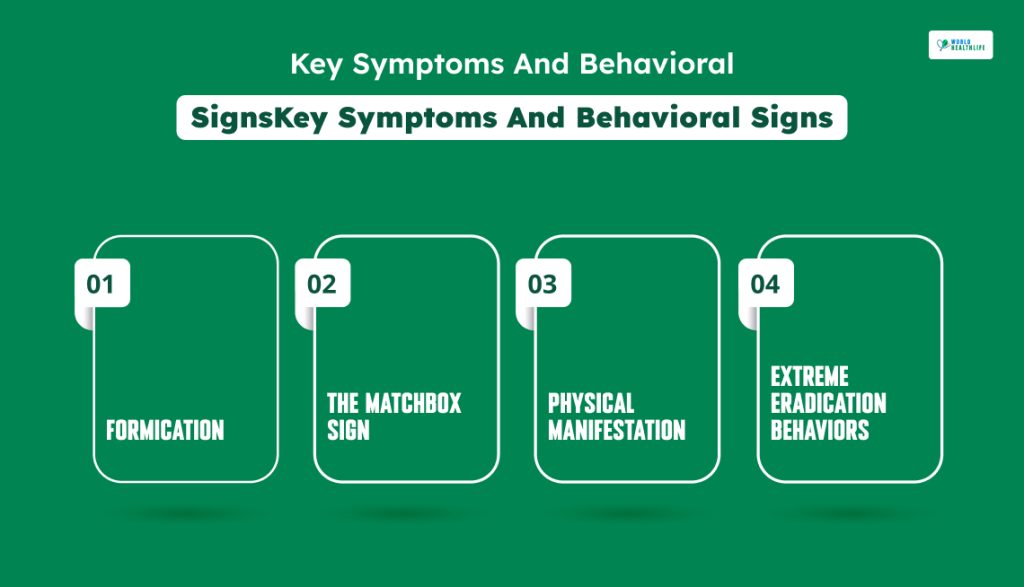
The clinical presentation of Ekbom Syndrome is remarkably consistent across different cultures and continents.
Sufferers tend to exhibit a highly specific cluster of physical complaints as well as behavioral patterns. These are the ones that medical professionals recognize immediately.
Formication
The fundamental symptom of Ekbom Syndrome is a specific tactile hallucination called formication. The word is derived from the Latin word formica, meaning ant. Furthermore, it describes the vivid and terrifying physical sensation of insects crawling on, sticking to, and burrowing beneath the skin.
For the patient, this sensation is completely real. The somatosensory cortex is actively firing, generating the authentic sensations of itching and burning.
Since the nerve signals feel identical to a real bug bite, the patient comes to a logical conclusion that an external organism must be causing this distress. They are also entirely unaware of the false signal originating from within the brain itself.
The Matchbox Sign
The ‘matchbox sign’ is one of the most unique and definitive clinical diagnostic markers of this condition. Driven by a desperate need to prove their reality to skeptical medical professionals and family members, patients meticulously gather evidence.
Here, the evidence is from their environment as well as their own bodies. These include skin flakes, bits of dried blood, lint, hair, dust, or clothing fibers. Furthermore, they begin to manifest a belief that these fragments are the offending parasites or their eggs.
Historically, patients brought these specimens into clinics packed inside small cardboard boxes. In modern times, patients are more likely to present these fragments in clear plastic bags, tissue paper, or sample jars.
Additionally, they frequently accompany their collection with smartphone photographs magnified to show what they perceive as legs, antennae or wings.
Physical Manifestation
Patients completely self-induce the physical damage on their bodies through their relentless efforts to extract imaginary invaders.
Moreover, sufferers spend hours in front of mirrors while utilizing their fingernails, tweezers, safety pins, sewing needles, or even knives to dig into their flesh.
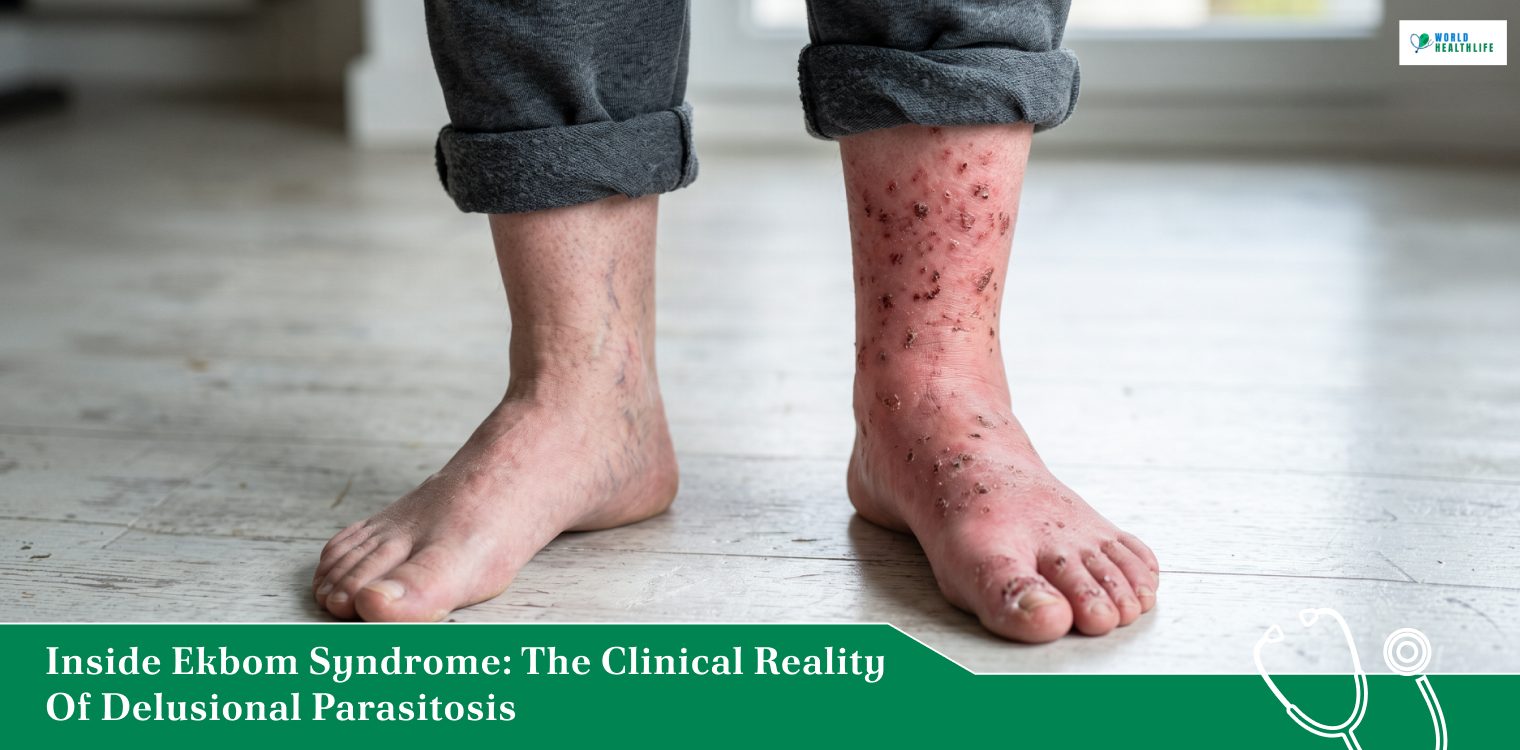
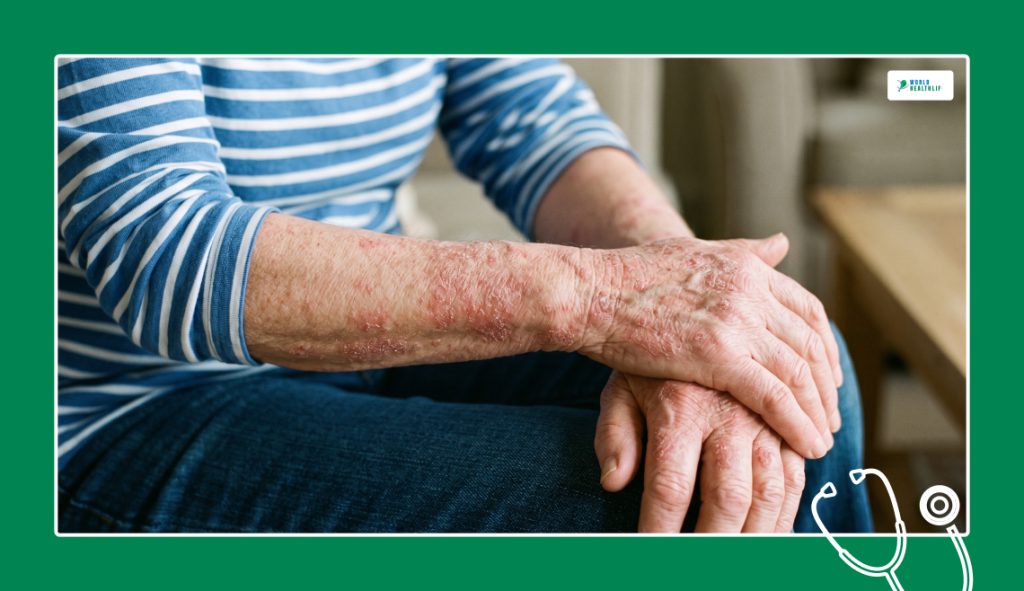
This chronic practice of picking and digging results in widespread skin mutilation. Furthermore, a typical examination reveals extensive linear excoriations, deep ulcerations, bleeding wounds, and thick cross-hatched scarring.
Patients usually concentrate these actions on body areas they can easily reach. The body parts include forearms, face, scalp, upper chest and thighs, whereas the mid-back remains completely clear.
Extreme Eradication Behaviors
The delusion inevitably forces patients to alter their entire lifestyle to eliminate the perceived threat. [Text Wrapping Break]
Moreover, sufferers will wash their clothes in boiling water multiple times a day, discard thousands of dollars’ worth of clothing and mattress sets,s or repeatedly abandon their homes.
Even more dangerously, patients turn to extreme chemical measures. It is common for them to apply highly toxic substances directly to their open wounds. These include household bleach, kerosene, and other veterinary treatments.
The harsh chemicals applied can lead to severe contact dermatitis or chemical burns. Patients may interpret these as further evidence of the parasites damaging their skin.
As a result, a catastrophic and self-reinforcing loop creates physical harm.
Primary Vs. Secondary Ekbom Syndrome: Understanding The Root Causes
In order to treat this condition effectively, medical professionals must know the difference between its two distinct classifications. Furthermore, their underlying origins determine their definition.
Primary Ekbom Syndrome
In its primary form, the disorder occurs as an isolated and standalone psychiatric event. The patient does not suffer from any other hallucinations.
Instead, their thought process regarding topics outside of the bugs remains completely rational, while having no underlying systemic illnesses to trigger the belief.
The individual functions normally in their daily life, except for their monodelusional focus on the infestation.
Secondary Ekbom Syndrome
On the contrary, in the secondary case, the delusion is a symptomatic byproduct of another medical, psychiatric, or chemical factor.
Medical And Neurological Conditions
Structural changes in the brain caused by conditions such as stroke, dementia, Alzheimer’s disease, or brain tumors can disrupt sensory processing.
Furthermore, systemic metabolic diseases, severe hypothyroidism, chronic kidney failure and severe B12 deficiencies can also cause peripheral neuropathy that mimics formication.
Psychiatric Disorders
The infestation belief can be a specific manifestation of a broader psychiatric illness. These include schizophrenia, major depressive disorder with psychotic features or severe bipolar mania.
Substance-Induced
Chronic abuse of or withdrawal from central nervous system stimulants heavily triggers severe formication.
This is colloquially termed as “cocaine bugs” or “meth mites,” where chemical surge of drugs such as methamphetamines or cocaine can cause direct severe chronic tactile hallucinations.
The Dopamine Hypothesis
According to neurological research, the underlying cause of Ekbom Syndrome is an imbalance in brain chemistry. This is specifically within the dopamine signalling pathways.
Dopamine is the primary neurotransmitter responsible for regulation motivation, reward, and the perception of real-world sensory inputs.
Neuromaging studies also suggest that sufferers have a significant reduction in the availability of dopamine transporter (DAT) sites within the striatum. This is a critical subcortical region of the brain.
When these transporters are diminished, an excess of free-flowing dopamine overstimulates the brain’s sensory receptors.
Additionally, the brain misinterprets this neurochemical chaos as a physical touch or crawl on the skin. On the other hand, it simultaneously generates a fixed delusional explanation to make sense of the rogue physical sensation.
The Diagnosis Dilemma: Ruling Out Real Infestations

The path to diagnosing this condition is fraught with tension. It further requires immense clinical precision and psychological strategy.
Medical Exclusion Testing
A medical professional can never assume a patient’s complaints to be delusional without conducting exhaustive diagnostic testing.
In addition, the doctor should meticulously rule out every actual physical cause of chronic itching (known as pruritus) as well as tactile sensations.
A standard clinical workup includes complete blood counts, liver and kidney function panels, thyroid testing, and checks for blood sugar levels to rule out diabetic neuropathy.
Furthermore, the physician must carefully examine the skin and perform microscopic skin scrapings to definitively rule out real microscopic infestations such as scabies, demodex mites, body lice, or hookworms.
Only when every single physical diagnostic test returns completely negative can a diagnosis of Ekbom Syndrome be confidently established.
The Doctor-Patient Trust Gap
The true challenge of this disorder lies in the profound breakdown of trust that exists between the patient and the medical community.
Since the crawling sensation feels completely real, the patient is entirely convinced their problem is structural and dermatological.
When a doctor states that there are no bugs and suggests seeing a psychiatrist, the patient often feels insulted, dismissed, and deeply gaslit. As a consequence, they tend to reject the medical advice while embarking on a frustrating journey of “doctor-shopping.”
They cycle through dozens of dermatologists, infectious disease specialists and emergency rooms. Furthermore, they grow increasingly isolated, suspicious and desperate as every medical authority denies their reality.
Treatment Strategies For Ekbom Syndrome

To overcome this condition, a delicate and multi-step therapeutic approach is required. This allows in balancing physical symptom relief with targeted psychiatric medication.
Establishing A Therapeutic Alliance
The frontline doctor, generally a dermatologist, must never argue with the patient. They should also not try not to logically prove that the bugs do not exist.
Instead, they must build an alliance by validating the patient’s very real physical suffering. Furthermore, they should focus the treatment goals entirelyṣ on stopping the itching, healing the open skin lesions and restoring normal sleep patterns.
Atypical Antipsychotic Medications
Atypical, or second-generation, antipsychotics are considered the definitive gold standard of pharmacological treatment. In addition, these medications directly block specific dopamine receptors in the brain.
They also correct the chemical imbalance and stop the tactile hallucinations. As a result, this gently dissolves the rigid delusion.
Aripiprazole, Risperidone And Olanzapine
Aripiprazole is frequently considered an excellent alternative. This is because of its mild side-effect profile.
Elderly patients also find it highly tolerable, especially the ones who may be sensitive to sedation or blood pressure changes.
On the other hand, risperidone and olanzapine are two of the most frequent medications for this condition. Administered in low doses, they effectively eliminate the crawling sensations within a few weeks.
As a result, the self-inflicted skin wounds heal naturally.
The Dermatologist As The PrescriberThe Dermatologist As The Prescriber
Since patients will almost always refuse to visit a psychiatric clinic, the dermatologist often serves as the primary prescriber.
They frequently frame the antipsychotic medication to the patient as a specialized drug that is designed to “calm down the overactive nerve endings in the skin.”
Patients are, thus, allowed to accept the life-saving psychiatric treatment without feeling stigmatized.
How To Support A Loved One With Ekbom Syndrome
It can be quite heartbreaking to witness a family member suffer through this condition. However, the way you communicate with them can determine whether they accept medical help or sink deeper into isolation.
- If they ask you to look at a specimen or agree that the house is infested, do not tell lies just to comfort them. Furthermore, do not pretend to see bugs. This will only reinforce the brain’s delusion while delaying proper medical treatment.
- Do not go into any arguments or debate with them. Never yell at them or try to oppose their delusions. Arguing will cause extreme emotional distress, breaking their trust in you. As a result, they will only hide their suffering from you completely.
- Focus your empathy entirely on their visible exhaustion and physical pain. Use supportive phrases. For instance, you can say something like “I can see how completely exhausting and terrifying this sensation is for you.”
- Shift the conversation away from the cause of the problem while focusing entirely on re-eating the effects. Moreover, guide them toward a medical professional.
Finding The Light Beyond The Phantom Invaders
Ekbom syndrome is a profoundly harrowing neuropsychiatric disorder, serving as a powerful reminder of how deeply our brain chemistry dictates our perceptions of reality.
The crawling, biting and stinging sensations endured by sufferers are not imaginary drama. Instead, they are authentic and chemically driven neurological misfires that cause immense human suffering.
Approaching this condition with mockery or dismissiveness will only deepen the patient’s isolation while prolonging their physical harm.
Instead, combining empathy, medical evaluations, and antipsychotics successfully rebalances brain chemistry.
| Disclaimer: This article is for informational and educational purposes only and does not substitute for professional medical advice. Reading this content does not create a doctor-patient relationship. Always consult a qualified healthcare provider for medical concerns and never delay seeking professional advice based on what you read here. |
References:
- Melo MM, Pinto I, Branco P, et al. Ekbom syndrome secondary to a major depressive episode. Prim Care Companion CNS Disord. 2021;23(5):20cr02872. https://doi.org/10.4088/PCC.20cr02872
- Hinkle, N. C. & Annual Reviews. (2010). Ekbom Syndrome: The challenge of “Invisible bug” infestations. Annu. Rev. Entomol., 77–94. https://ent.uga.edu/content/dam/caes-subsite/entomology/documents/publications/hinkle-publications/hinkle-EkbomSyndrome.pdf
- Ansari, M. N., & Bragg, B. N. (2023, May 22). Delusions of parasitosis. StatPearls – NCBI Bookshelf. https://www.ncbi.nlm.nih.gov/books/NBK541021/
- Delusional parasitosis: Mayo Clinic. https://www.mayoclinic.org/diseases-conditions/mental-illness/in-depth/delusional-parasitosis/art-20044996