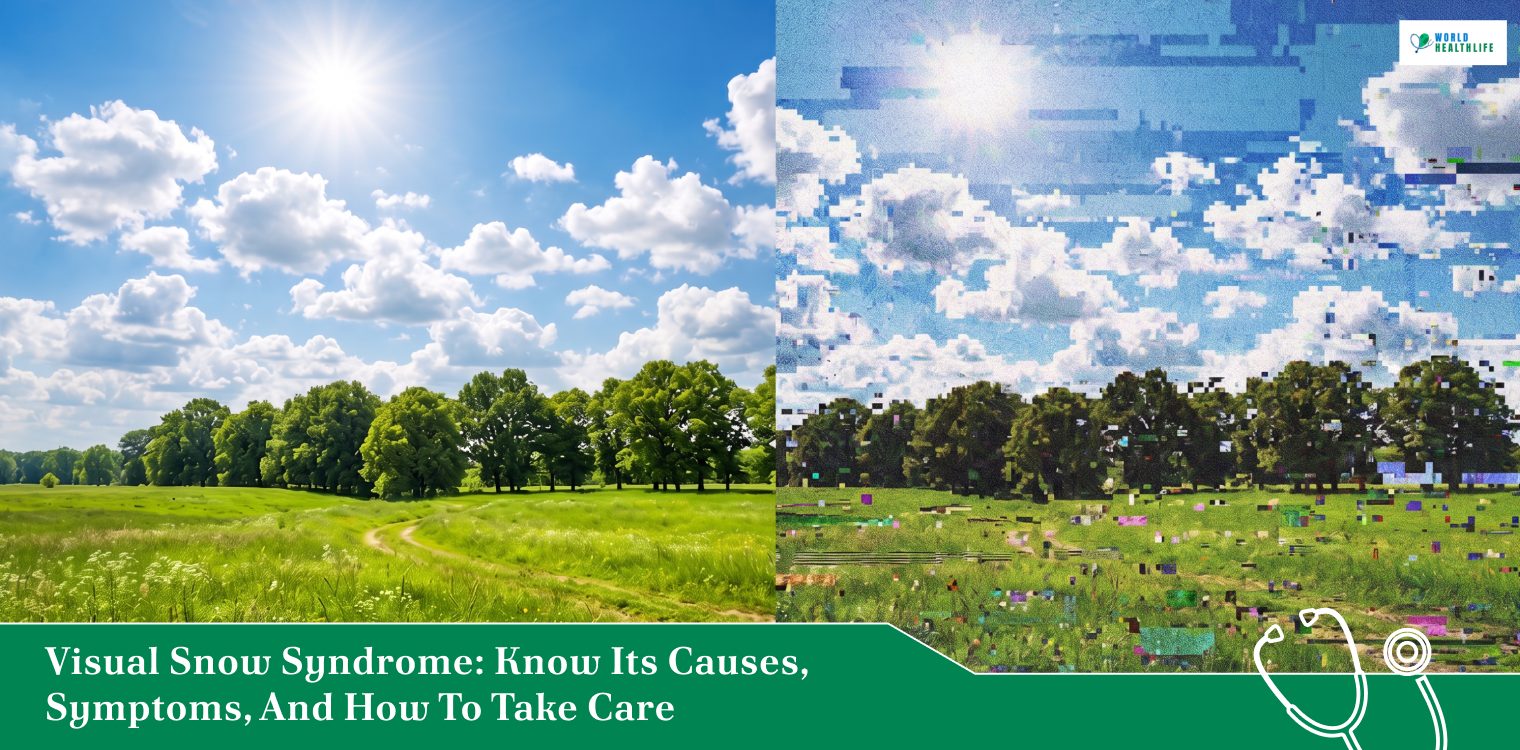
Imagine looking at the world through a window covered in a permanent layer of flickering television static.
This is the daily reality for individuals living with Visual Snow Syndrome (VSS). It is a complex, chronic neurological condition that alters how the brain processes visual information.
Unlike typical vision problems caused by eye damage, this syndrome originates entirely within the brain’s processing networks. Moreover, individuals will perceive constant static even when their physical eye exams return completely normal.
The dynamic “snow” that fills your visual field can appear as black, white, transparent, or even shimmering multi-colored dots and grains.
This is not a temporary or episodic flash. Instead, it remains present 24/7, persisting through the day and night, regardless of whether your eyes are open or closed.
Because standard eye tests and structural brain scans show no physical abnormalities, doctors frequently misdiagnose patients. Doctors or others wrongly dismiss their physical symptoms as simple anxiety, stress, or psychological stress.
However, modern clinical research proves that Visual Snow Syndrome is a legitimate neurological issue that resides within the visual processing centers of the brain, rather than a problem with the eyes themselves.
𝐐𝐮𝐢𝐜𝐤 𝐒𝐮𝐦𝐦𝐚𝐫𝐲 𝐨𝐟 𝐭𝐡𝐞 𝐂𝐨𝐧𝐝𝐢𝐭𝐢𝐨𝐧

The Experience: A constant layer of tiny, flickering dots that overlay your real-world vision.

The Cause: Research points to hyperactive nerve cells in the brain that fail to properly filter out background neurological noise.

Official Recognition: In a major milestone for patients, the World Health Organization officially added Visual Snow Syndrome to the International Classification of Diseases.

The Outlook: While there is currently no cure, the condition is benign, does not worsen over time, and will not cause blindness. It is managed by brain and vision specialists.
What Is Visual Snow Syndrome?
When looking at the global impact of this condition, many patients and family members frequently search online to understand exactly what is visual snow syndrome. Besides that, they also search for how it affects daily life.
Well, when you put it simply, visual snow syndrome is a chronic, debilitating neurological condition. Furthermore, it causes an individual to see continuous visual static, dots, and flickers across their entire field of vision.
Acting like a permanent biological filter, it distorts the way the brain interprets sight, despite the eyes themselves being perfectly healthy.
As of August 2026, medical experts studying the condition clarify that it is categorized as a central sensory processing disorder.
Rather than a structural eye defect, it is driven by widespread cortical hyperexcitability. This means the nerve cells in the visual cortex are overactive and constantly “firing.”
As a result of this hyperactive state, the brain loses its ability to correctly filter out internal neurological background noise. Thus, it forces the patient to consciously perceive an uninterrupted layer of visual static 24 hours a day.
What Are The Common Symptoms?
If you doubt that you might have visual snow syndrome, then here are some of the symptoms:
- Constant visual static
- Light sensitivity (Photophobia)
- Seeing a trail of an object after the original image is gone (Palinopsia)
- You can see light even with your eyes closed (Entoptic phenomenon)
- Enhanced entoptic phenomenon happens when you see floating objects or flickering dots in the sky
- You are having difficulty seeing anything at night (Nyctalopia)
Associated Non-Visual Symptoms
But it does not just end there. There is always an extended version of every disease, so here are some symptoms the doctors notice that you might experience:
- Feeling anxious, depressed, or you are always irritated.
- Tinnitus, it is a condition where you hear ringing bells in your ears.
- Feeling confused or finding it difficult to concentrate. You also might have cognitive fog.
- You would get frequent migraine auras.
- An uneasy feeling, as if you might vomit.
Why Are They Often Missed?
Despite you seeing the static, flickering dots across your visual field, doctors often miss diagnosing it. Medical professionals often miss them because eye exams, brain imaging, and retinal scans come back normal most of the time. (Source: Dr. Daniel Cameron)
Ophthalmologists (specialized eye and vision care) often focus on examining the eye, but studies show that the problem is more often in the brain than in the eye.
For instance, when the doctors find nothing in the test results, the patients leave with confusion about their condition.
Visual Snow Syndrome Vs Migraine Aura
| Key factors | Visual Snow Syndrome | Migraine Aura |
| Duration | Continuous and Chronic | Episodic, lasts for 5- 60 minutes |
| Symptom | Flickering dots, trails, and television-like noise | Zig-zag lines, flashing light |
| Trigger | Unprovoked and constant state | Specific factors like stress, diet, environmental change |
| Headache | Occurs continuously regardless of the patient having migraine | Moderate to severe headache phase. |
(Source: Visual snow initiative, Sciencedirect.com, American Academy Of Ophthalmology, University of Colorado Anschutz)
Diagnosis In 2026
There’s no exact number of how many people are already affected by visual snow syndrome. According to medical records, the estimated number of diagnoses is 2-3% around the world, with a population of 8 billion.
Many of the cases are underdiagnosed, as they were either misdiagnosed or the doctors could not figure out the exact root cause of the “snow”
The appearance of the “snow” does not happen due to any other disease or any drugs. And your symptoms are also not similar to those of migraine aura.
Initially, the healthcare provider will ask you about any medical history or what symptoms have come to your notice so far.
Unfortunately, there’s no single diagnoses procedure for Visual Snow Syndrome. The doctor will first test your eye. If that does not lead to the symptoms you described, then they will order an MRI.
So far the medical record, there are no guidelines for completely curing the disease yet. But it is ideal to consult a neuro-ophthalmologist. Headache specialists, neurology, and ophthalmology collectively treat patients with visual snow syndrome.
(Source: https://danielcameronmd.com)
How Do I Take Care Of Myself If I Have VSS?

Although there is no permanent cure for visual snow syndrome, maintaining a few protocols will lower symptom intensity.
1. Actionable Lifestyle
- First and foremost, maintain a healthy sleep and waking up schedule to avoid fatigue.
- Avoid doing any task in the dark or low light area
- To avoid neural firing, you need to have a strict limit on caffeine or alcohol consumption.
(source: Wicks Eye Care, Nandadeep Eye Hospital, Visual Snow Initiative)
2. Screen Optimisation
- The best way to prevent eye pressure and give your eyes some rest is to install dedicated blue reduction apps
- Always enable warm light settings
- After consulting your doctor, buy rose-colored FL-41 lenses or custom precision filters that block the harsh photophobic wavelengths
- Lower the screen brightness of your device to match the ambiance of your room light.
- Set your device to “reduce motion”
- Increase the font size to put less pressure on your eyes
(source: Wicks Eye Care, Nandadeep Eye Hospital, Visual Snow Initiative)
3. Somatic Calming
At this stage, your central nervous system is on high alert:
- Try deep breathing and muscle relaxation to send calm signals to your brain
- Constantly train your brain to focus on the background objects rather than the static “snow”
4. Diet And Inflammation
- Cut out packaged, processed foods.
- Focus more on eating omega-3 and protein.
- Shift to a leafy greens diet
- Maintain steady water throughout the day
(Source: American Academy of Ophthalmology, Cleveland Clinic)
Embracing The Static: Adapting To The New Normal
Navigating life with visual snow syndrome can be quite an overwhelming feeling. Especially so when you adjust to a world that never truly goes quiet.
However, it is vital to remember that a diagnosis is not a dead end. By shifting your focus toward actionable nervous system calming, screen optimization and everyday lifestyle tweaks, you can significantly lower the intensity of the symptoms.
Also, you can give your brain the space it needs to fully adapt. You do not have to carry the weight of this condition all by yourself.
A growing global community, alongside dedicated neurological specialists, is actively working to raise awareness and discover new management strategies every single day.
Take things one day at a time. Moreover, implement these supportive protocols at your own pace, while allowing your mind to find its balance within the static.
Disclaimer: This information is intended for educational purposes only and does not substitute for professional medical advice, diagnosis, or treatment. Always consult a qualified neuro-ophthalmologist or neurologist regarding health concerns.