
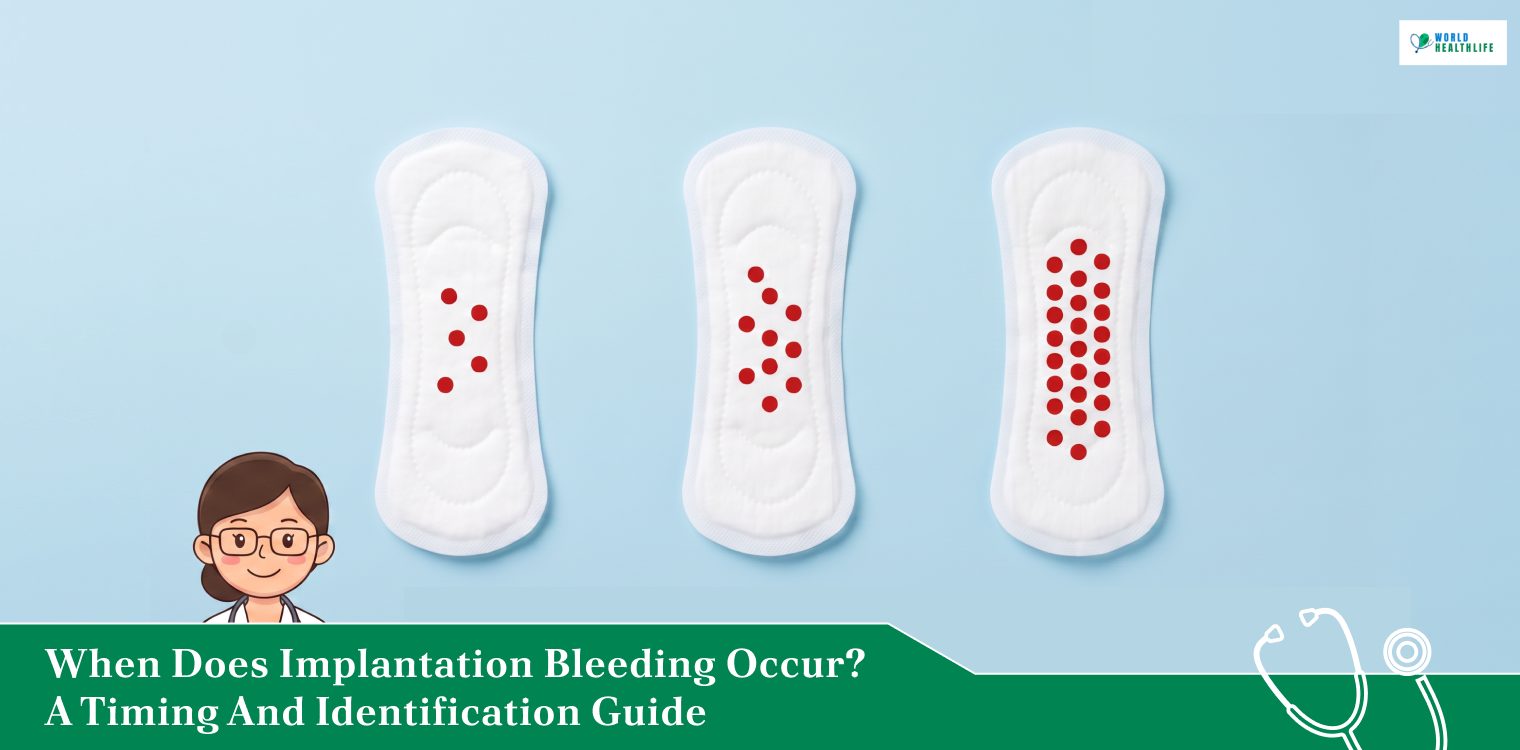
When you discover unexpected light spots or a faint smear of blood, it can immediately trigger a wave of questions.
If you are actively trying to conceive or navigating the aftermath of a contraceptive mishap, there is one pressing question that arises in your mind.
“Am I seeing early signs of pregnancy, or is my regular period just starting a bit early?”
To answer this accurately, you have to look closely at your calendar. Determining when does implantation bleeding occur is the single most effective way to separate a temporary hormonal shift from a true early pregnancy milestone.
This comprehensive guide breaks down the biological timeline of early pregnancy while exploring how to distinguish implantation spotting from other cycle events. These include ovulation or emergency contraception side effects.
Besides these, it will also offer clear instructions on when to trust a home pregnancy test.
The Biological Timeline: When Does Implantation Bleeding Occur?
In order to map out exactly when does implantation bleeding occur, you have to look at the chain of events that takes place after an egg is released.
Implantation is not an instantaneous event that happens right after sex. Instead, it is a slow and multi-day journey through the reproductive tract.
Early Pregnancy Milestone Timeline
The following table outlines the progression from egg release to the ideal window for taking an over-the-counter pregnancy test.
| Timeline | Biological Stage | What Is Happening in the Body |
| Day 0 | Ovulation & Fertilization | The ovary releases a mature egg, which is successfully fertilized by sperm in the fallopian tube. |
| Days 1–5 | Embryonic Travel | The newly formed embryo continuously divides as it travels down the fallopian tube toward the uterus. |
| Day 6 | Uterine Entry | The developing embryo officially enters the uterus to look for a plush landing spot. |
| Days 6–12 | Implantation Window | The embryo burrows into the vascular uterine lining. This localized disruption is exactly when does implantation bleeding occur as light spotting. |
| Days 8–10 | Peak Attachment | The most common days for successful implantation to finish. Baseline production of the pregnancy hormone hCG begins. |
| Days 12–14 | Expected Period / Testing Window | Your regular period would normally be due. Progesterone levels remain high if pregnant, and hCG levels finally rise high enough to register on a home test. |
The Days Past Ovulation (DPO) Window
The biological window for an embryo to attach itself to the uterine wall is highly specific. Moreover, clinical tracking shows that a fertilized egg typically burrows into the vascular lining of the uterus between 6 to 12 days past ovulation (DPO).
A milestone study tracking early human chorionic gonadotropin (hCG) in daily urine samples established that among pregnancies that progressed successfully, 84% of embryos implanted specifically on day 8, 9 or 10 after ovulation.
Therefore, if you are wondering when does implantation bleeding occur in terms of standard tracking, it most commonly manifests around 9 to 10 DPO.
When you experience early spotting, it is actually the exception rather than the rule. Furthermore, the vast majority of pregnant individuals never see any early spots or brown streaks at all.
A missing period and a properly timed home test remain the most reliable early signs of pregnancy.
Mapping It To A Standard 28-Day Cycle
If you track your cycle based on calendar days instead of ovulation testing, the timing falls right in the week leading up to your next anticipated menstruation:
- Day 1: First day of full menstrual flow.
- Day 14: Approximate window for ovulation (egg release).
- Day 20 to 26: The localized window where an embryo attaches. This is precisely when does implantation bleeding occur for a standard cycle.
- Day 29: Your next expected period is due.
Because this spotting happens mere days before your anticipated period, it is incredibly easy to mistake it for the very beginning of a normal menstrual cycle.
While cycle tracking software serves as an excellent historical record, it relies entirely on mathematical averages calculated from your past entries. Also, it cannot physically confirm real-time hormonal shifts.
The physical characteristics of the blood itself provide much stronger clues to help you differentiate the two.
How To Understand What Implantation Bleeding Looks Like?
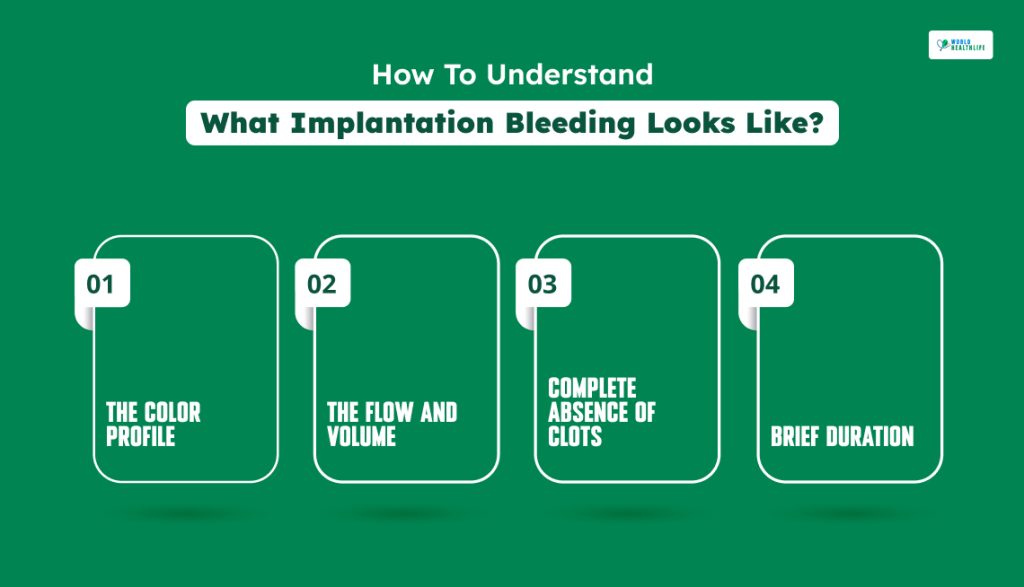
When evaluating unexpected blood, appearance provides important secondary clues. True implantation spotting functions like a minor internal bruise instead of an open wound.
As the tiny embryo burrows into the plush uterine wall, it may slightly disturb local microscopic blood vessels. As a result, this leads to a trace amount of blood exiting the body.
It should also be noted that the physical traits of this process are highly distinct from those of a period.
The Color Profile
Implantation fluid is almost always light pink or dark rusty brown in color. Fresh blood looks pink when diluted by normal vaginal secretions.
On the other hand, older blood turns a muted brown as it travels slowly out of the cervix. However, bright and vibrant red blood is rare. Typically, this points to an active period or alternative causes.
The Flow And Volume
Implantation is more of a light spotting event instead of a continuous flow. You might observe a faint streak on a piece of toilet paper or a few minor spots in your underwear.
The volume is far too low to turn the toilet bowl water noticeably red. Moreover, it will never heavily soak through a traditional pad or a tampon.
Complete Absence Of Clots
A hallmark of menstrual flow is the shedding of endometrial tissue chunks. Moreover, implantation spotting is entirely localized and minor. It is also completely free of blood clots.
Brief Duration
While a period steadily builds and lingers for 3 to 7 days, implantation spotting resolves quickly. It typically wraps up within a few hours to two days maximum.
Side-By-Side: Implantation Bleeding Vs. Regular Period
In order to evaluate your symptoms directly, use this comprehensive matrix.
| Physical Feature | Implantation Spotting | Regular Menstrual Period |
| Primary Timing | 6–12 days post-ovulation (roughly a week before a due period). | 14 days post-ovulation (exactly on your cycle’s due date). |
| Overall Flow | Barely visible drops, light streaks, or faint smears. | Continuous flow that starts light, peaks in volume, then tapers. |
| Coloration | Pale pink or rusty, dark brown. | Vibrant bright red to dark crimson. |
| Total Duration | A few hours up to 48 hours maximum. | 3 to 7 full days. |
| Tissue Clots | Never present. | Frequently contains visible blood clots. |
| Accompanying Cramps | Very mild, faint, localized twinges. | Moderate to severe aching across the lower back and pelvis. |
Differentiating Other Causes: Ovulation Bleeding Vs. Plan B Spotting

Unexpected bleeding between periods does not automatically mean pregnancy has occurred.
Two other common cycle events share an overlapping presentation, which are ovulation spotting and emergency contraception side effects.
Understanding the calendar differences between these events helps clarify what your body is experiencing.
Ovulation Spotting: Mid-Cycle
Ovulation spotting occurs much earlier in the cycle than implantation bleeding. Precisely, it happens when an ovary releases a mature egg, driven by a brief drop in estrogen levels right after the luteinizing hormone (LH) surge.
The Timing Differences
Ovulation spotting occurs mid-cycle, which is roughly day 14 of a 28-day cycle. This is roughly two full weeks before a period is due.
However, implantation spotting occurs only days before the period is expected.
Distinct Clues
Ovulation spotting is often accompanied by clear, stretchy, egg-white cervical mucus and a localized, one-sided pelvic twinge known as mittelschmerz.
Plan B: Emergency Contraception Spotting
If you take an emergency contraceptive pill like Plan B (levonorgestrel), your normal hormonal cycle is temporarily disrupted.
Plan B delivery works primarily by delivering a sudden, high dose of synthetic hormones to stop or delay ovulation.
This abrupt hormonal surge and subsequent drop frequently causes breakthrough bleeding or unexpected spotting.
The Timing Difference
Spotting from emergency contraception is directly tied to when you took the medication. It usually appears anywhere from a few days up to one full week after taking the pill.
The Biological Catch
Emergency contraception only works if you have not ovulated yet. If fertilization and ovulation already occurred before you took the pill, Plan B will not halt the process.
In those specific scenarios, spotting that occurs 6 to 12 days after that initial ovulation window could potentially be true implantation bleeding. It might not be a side effect of the pill.
Will A Pregnancy Test Be Positive During Implantation Bleeding?
To answer that concisely, it is no, at least not right away.
The delay usually causes confusion. Home pregnancy test kits react exclusively to human chorionic gonadotropin (hCG), a specialized hormone produced by the development of the placenta.
However, your body does not begin producing hCG until the embryo has successfully burrowed deep into the uterine lining. Clinical blood draws are much more sensitive than standard over-the-counter urine tests.
Additionally, these tests can find tiny amounts of hCG roughly 10 days after conception.
However, home kits need a much higher concentration to trigger a positive line.
When implantation bleeding occurs, the baseline levels of hCG are still far too microscopic to be picked up by a standard over-the-counter urine test. Testing on the exact day you notice early spotting will frequently trigger a false negative result.
The Ideal Testing Window
In order to get an accurate result, you need to give the hormone time to accumulate in your system. During early pregnancy, hCG levels double roughly every 48 hours.
- The 48-hour fallback: If you choose to test early, wait at least 48 hours after the spotting has completely stopped to allow your urine concentrations to reach detectable levels.
- The gold standard: For the most reliable results, wait until the first day of your missed period. If your cycle is irregular and you don’t know when your period is due, take a test 21 days after the unprotected sexual encounter.
Recognizing Concurrent Early Pregnancy Symptoms
Implantation spotting rarely happens in complete isolation.
Because your body experiences an immediate shift in progesterone and estrogen during this timeframe, you may notice several concurrent physiological shifts.
The table below describes the secondary markers that frequently accompany early embryonic attachment.
| Symptom | What It Feels Like | Why It Happens |
| Mild Uterine Twinges | Very light, faint pelvic cramping or pull sensations that are less intense than a standard period. | Triggered by the literal stretching of the uterine lining and embryo attachment. |
| Breast Tenderness | Sensations of unusual fullness, heavy ache, or distinct sensitivity to the touch. | Caused by rapid, sudden early hormonal spikes in estrogen and progesterone. |
| Uncharacteristic Fatigue | A deep, overwhelming exhaustion that sets in despite getting standard sleep. | Driven by a sudden rise in natural progesterone levels, which acts as an internal sedative. |
| Elevated Basal Body Temperature | Your waking resting body temperature remains high past your normal luteal window. | Progesterone levels remain consistently high to protect the new pregnancy, keeping the body warm. |
Next Steps For Accurately Tracking Your Symptoms
Figuring out the true cause of mid-cycle spotting always requires looking at your individual calendar timeline.
Since the appearance of blood alone can be highly ambiguous, cross-referencing your dates against known biological windows remains your most effective strategy.
If your bleeding is light, painless, and falls within 6-to-12-days post-ovulation window, wait a minimum of two to three days before taking a home pregnancy test. This will help prevent an early false negative.
To help establish your timeline, what was the first day of your last period, and how long is your typical cycle?
Sharing if you have taken any recent medications like Plan B or if you are tracking other symptoms can help clarify the situation.
Disclaimer: The information provided in this article is for general informational purposes only. It does not, and is not intended to, constitute medical or health advice. Please consult a qualified healthcare professional for medical guidance or expert health assistance.


