Most people measure life by the steady rhythm of a heartbeat, the warmth of breath, or the sharp clarity of self-awareness.
But what happens when the human brain experiences a profound neurological severing, completely isolating the mind from bodily perception?
You may look at your hands, check your pulse, and listen to your own voice. However, you remain entirely unshakably convinced that you are dead.
Moreover, you feel that your flesh is rotting and your organs are gone. And you also feel that you are nothing more than a ghost trapped in a breathing shell.
This terrifying fracture of reality is not a premise from a psychological horror film. Instead, it is the daily existence of someone living with cotard syndrome.
People colloquially call this extraordinarily rare neuropsychiatric condition Walking Corpse Syndrome.
Representing one of the most profound disruptions of human consciousness known to medical science, it challenges our fundamental understanding of identity.
To uncover the neurological mechanics, haunting symptoms and historical cases behind the condition, read for a detailed exploration below.
Understanding The Walking Corpse Syndrome

Human consciousness has a significant reliance on a delicate balance of neurological signals that convince us that we are alive and physically present in the world.
When this system fractures, it gives rise to one of the most baffling and deeply unsettling phenomena in modern neuropsychiatry.
What Is Cotard Syndrome
Cotard’s syndrome is a rare neuropsychiatric disorder defined by fixed, nihilistic delusions of negation.
Furthermore, individuals who suffer from this condition hold an unshakeable fixed belief that they have lost their vital organs, blood, and brains.
There is also a belief among these individuals that their body is actively rotting away or that they have ceased to exist entirely.
In its most extreme cases, patients start to hold a firm belief that they are spiritually or physically dead.
The condition is not classified as a standalone disease in major diagnostic manuals such as the DSM-5. Instead, experts recognize it as a complex symptom cluster or a profound manifestation of severe underlying psychiatric, neurological, or systemic illnesses.
Philosophical Nihilism Vs Cotard Syndrome
In order to have a full and true grasp of the depths of cotard syndrome, it is essential to distinguish between philosophical nihilism and the classic nihilistic delusions of the condition.
When it comes to philosophical nihilism, it can be described as an intellectual framework or belief system that asserts the fact that life is inherently meaningless, valueless, and without objective purpose.
Furthermore, a person who practices the philosophical approach still has full acknowledgment of their physical existence. Instead, they simply question the point of it.
In stark contrast, the nihilistic delusion found in Cotard syndrome is not an intellectual philosophy. Instead, it is a literal and somatic denial of existence.
A patient with this syndrome does not just feel that life lacks meaning. They believe their physical biology has been negated.
In this condition, patients completely convince themselves that they lack a stomach, have no blood flow, or are corpses.
On one hand, a philosopher debates the concept of nothingness. On the other hand, a patient with Cotard syndrome lives inside that very concept.
Symptoms Of Cotard Syndrome: Stages Of Delusion

The presentation of Cotard syndrome manifests through a series of severe, life-altering somatic delusions that fundamentally break a person’s connection to their own biology.
Though the condition evolves over time, several distinct and haunting features define its core symptomatic baseline.
Belief Of Death And Bodily Decay
The primary hallmark of the syndrome is the absolute conviction of physical non-existence or death. Patients do not use “dead” as a metaphor for feeling numb.
Instead, they have a belief in being clinically and physically deceased. The delusion, further, is frequently accompanied by visceral somatic hallucinations.
These include patients claiming that they can smell their own rotten flesh, feel maggots burrowing under their skin and look in the mirror to perceive their reflection as a decomposing skeleton.
Missing Anatomy
Beyond the overarching belief of death, patients usually experience targeted delusions regarding missing anatomy. Furthermore, they may hold an unshakable belief that they no longer have blood flowing through their veins.
They also have a belief that their brain has completely dissolved or that their chest cavity is entirely empty. In addition, it is common for a patient to explain the lack of a heart, liver, or intestines in their body to a doctor.
As a result, this renders any medical attempts to check their vital signs entirely useless in their eyes.
Severe Self Neglect
When a mind is fully convinced that the body it inhabits is already dead, any normal biological survival instincts completely collapse. This results in a state of catastrophic and severe self-neglect.
Patients usually refuse to bathe, brush their teeth, or change clothes. In the most severe and dangerous cases, they usually refuse to even consume any food or water.
In their internal logic, a corpse has no functional digestive system while requiring no physical sustenance to survive. This makes eating a completely futile and nonsensical act.
Delusions Of Immortality
Paradoxically, the absolute denial of life usually twists into an equally intense delusion of immortality.
Some patients have this belief that since they are already dead, they have passed beyond the realm of mortality entirely. Furthermore, they may also believe that they can never die a natural death and cannot be physically harmed by weapons.
They further think that they are condemned to wander the earth forever as lost souls. This specific symptom causes a complex clinical paradox where a patient feels utterly trapped in an eternal and inescapable state of non-being.
Causes And Underlying Conditions Of Cotard Syndrome
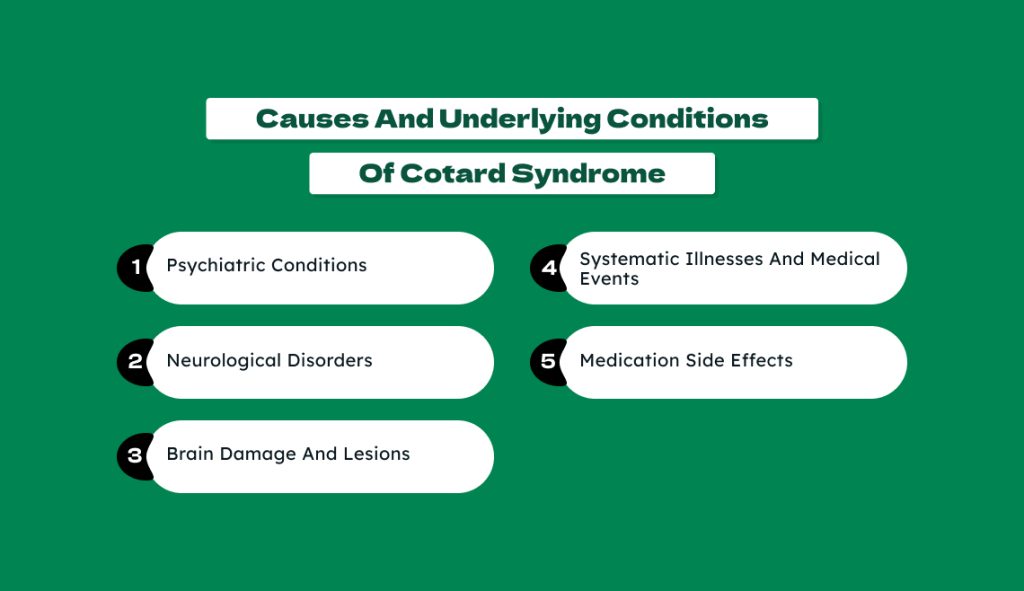
Usually, cotard syndrome is caused by a severe breakdown in the way the brain processes self-awareness, mood, and reality. Furthermore, the condition is triggered by extreme psychotic depression.
Though the exact trigger varies, the disorder is almost always secondary to an underlying mental health or neurological disorder.
Experts usually theorize that Cotard syndrome is a physical disconnection between the brain’s face recognition centers (fusiform gyrus) and its emotional processing centers (amygdala).
When patients look in a mirror, they fail to feel any emotional connection to their own face. As a result, this causes them to have a rational but delusional conclusion of not existing.
Psychiatric Conditions
The vast majority of recorded cases are rooted in severe psychiatric illnesses.
It is also most frequently triggered by psychotic depression. This is a form of major depressive disorder where severe melancholy is accompanied by hallucinations or delusions.
It is also highly prevalent in patients who suffer from bipolar disorder during severe depressive phases.
This also happens in individuals with schizophrenia. Here, underlying thought disorders cause distortions in the boundaries of reality.
Neurological Disorders
Since the syndrome involves a physical disruption of neural networks, neurological disorders play a major role in its onset.
Conditions that impair cognitive functions include advanced Alzheimer’s disease, Parkinson’s disease dementia, and Lewy Body dementia.
Furthermore, there can be degradations to the brain circuits that are responsible for self-perception, paving the way for nihilistic delusions to take root.
Brain Damage And Lesions
Physical trauma to the brain can suddenly fracture the overall sense of self of a person.
Traumatic brain injuries (TBI), ischemic or hemorrhagic strokes, brain tumors, and localized lesions can instantly sever the vital pathways that connect emotional processing with physical self-awareness.
This is specifically effective in the right hemisphere, parietal lobe, or frontal lobe.
Systematic Illnesses And Medical Events
In certain cases, conditions affecting the entire body can trigger the onset of the condition.
Additionally, severe metabolic imbalances, advanced kidney failure (uremia), liver encephalopathy, and uncontrolled epilepsy can cause toxic buildups or erratic electrical storms.
These cause temporary disruptions in normal cognitive processing while inducing acute states of delusion.
Medication Side Effects
In incredibly rare and specific circumstances, medication toxicities can trigger transient symptoms of cotard syndrome.
Moreover, a well-documented medical anomaly involves the antiviral drug acyclovir. Patients with underlying renal failure can have a breakdown product of the medication (CMMG). This further accumulates to toxic levels in the bloodstream.
The specific toxicity can lead to a sudden and reversible state of cotard delusion, resolving completely once the drug is cleared from the body through diagnosis.
Diagnosis And Prognosis
To have a more detailed understanding of the condition, you should understand its various diagnostic stages and the prognosis that follows.
Diagnostic Stages
Diagnosis of Cotard syndrome is a meticulous process that requires medical, neurological, and psychiatric evaluations to map the exact progression of the symptoms.
Moreover, there are three distinct clinical milestones.
Germination Stage
During the initial prodromal phase, clinicians look out for an abrupt escalation of vague hypochondria.
Furthermore, the patient displays unexplainable bodily complaints with intense, generalized anxiety as well as a profound sense of depersonalization that entirely resists standard medical reassurance.
Blooming Stage
The diagnosis is officially confirmed when the patient transitions into this phase.
Characterized by the open expression of fixed and unshakable somatic delusions, the patient actively voices that they are dead or rotting away.
They also express feelings of complete missing internal anatomy.
Chronic Stage
In this final stage, doctors evaluate long-term stabilization and entrenchment of the delusion.
The clinical focus shifts to the assessment of the severity of the patient’s absolute social withdrawal, depressive immobility, and life-threatening physical self-neglect.
Prognosis
The overall prognosis is heavily dependent on the speed of intervention and the nature of the underlying cause.
When the syndrome is triggered by acute psychiatric conditions such as psychotic depression or by reversible medical events such as drug toxicities, the prognosis is highly favorable.
In addition, with targeted treatment, many patients experience a complete resolution of their delusions and successfully rebuild their lives.
However, when the syndrome is secondary to progressive, irreversible neurological decline, management focuses on maximizing comfort while minimizing distress and supporting daily care.
This is further visible in cases such as advanced dementia or severe and widespread structural damage.
Treatment And Management

Since cotard syndrome is a symptom of an underlying medical issue, treatment usually targets the primary psychiatric or neurological cause.
This is done instead of treating the delusion in isolation.
Pharmacotherapy
The primary line of pharmaceutical defense usually involves a tailored combination of medications. Antidepressants, such as SSRIs or SNRIs, lift the crushing weight of the underlying depressive state.
Concurrently, doctors introduce atypical antipsychotics, such as olanzapine, risperidone, or aripiprazole, to disrupt, weaken, and ultimately dismantle the fixed and unshakeable nature of the delusions.
Electroconvulsive Therapy (ECT)
Medical professionals widely consider ECT an effective and safe intervention that acts as the fastest in cases of severe cotard syndrome.
This is especially true when the condition is rooted in deep treatment-resistant psychotic depression.
By sending brief electrical stimulation to the brain while the patient is under anesthesia, ECT safely changes brain chemistry while rebalancing neural networks.
This frequently leads to a dramatic and rapid lifting of the nihilistic delusions, usually succeeding where medications have failed.
Psychotherapy And Supportive Care
Once medical professionals stabilize a patient, cognitive behavioral therapy (CBT) can help them gradually reality-test their perceptions while safely re-engaging with their physical self.
Crucially, medical teams must implement supportive care immediately.
Since many patients suffer from severe self-neglect, they require hospitalization, intensive nursing care, and nutritional support. This is so that they can preserve the patient’s physical life while their mind heals.
The overall prognosis relies heavily on the underlying cause.
When triggered by acute psychiatric conditions or reversible medical events like drug toxicities, the prognosis is highly favorable.
Additionally, many patients achieve complete resolution.
However, when secondary to progressive neurodegenerative decline, management shifts to maximizing comfort and supporting daily care.
Notable Figures With Cotard Syndrome
Cotard syndrome has had quite a notable history, both in reel and real life. The following are certain cases where the condition has been discussed in a broader spectrum.
Historical Medical Figures: The Case Of Dr. Jules Cotard And Mademoiselle X
The history of cotard syndrome starts with Dr. Jules Cotard, a French neurologist working in Paris in the late 19th century.
In 1880, he encountered a 43-year-old woman whom he gave the medical pseudonym “Mademoiselle X.” She claimed she had no brain, no nerves, no chest, and no stomach.
Paradoxically, she believed she was eternally damned and would never die a natural death. Convinced she had no digestive system and needed no nourishment, she stopped eating.
Ultimately, she passed away from starvation and cemented the first official clinical profile of the condition.
Notable Musician Suspected Case: Per Yngve “Dead” Ohlin
In modern musical history, the tragic case of Per Yngve Ohlin, the former lead singer of the pioneering Norwegian black metal band Mayhem, stood as a heavily suspected example of the cotard syndrome.
As a child, Ohlin suffered a catastrophic ruptured spleen followed by a severe beating by bullies. This resulted in him experiencing a period of clinical death before being resuscitated.
Following the severe trauma, his mental health faced severe deterioration. Additionally, he developed a profound and lifelong obsession with his own non-existence while taking up the stage name “Dead.”
He had a severe history of self-harm while having a routine of applying heavy makeup to resemble a corpse.
Unfortunately, in 1991, he took his own life. Psychologists heavily scrutinize his legacy as a classic textbook manifestation of the delusion triggered by early childhood trauma.
Modern Medical Breakthrough Cases
In 2013, a British man known in medical literature as “Graham” became a landmark breakthrough case for neuroscientists studying the physical architecture of the mind.
Following a severe depression-induced suicide attempt through electrocution in a bath, he woke up convinced that his brain was dead.
Researchers performed advanced PET scans on his brain, making the case revolutionary. Furthermore, they found that his metabolic activity across his frontal and parietal regions dropped so low that it perfectly mirrored someone in a vegetative state, despite being fully awake and walking.
His brain was physically processing reality as if it were asleep or comatose.
Following years of intensive psychiatric care, medication and behavioral therapy, Graham made a remarkable recovery and stated feeling that his brain had come back to life.
The Disease In Fiction
Writers and filmmakers have inevitably captured the haunting and surreal nature of walking corpse syndrome.
They have further used it as a visceral metaphor for grief, isolation, or identity loss.
Caden Cotard: Synecdoche, New York
In Charlie Kaufman’s critically acclaimed 2008 film, Synecdoche, New York, Philip Seymour Hoffman plays the main protagonist, an aging theater director named Caden Cotard.
His last name is a direct and deliberate nod to neurological disorder. Throughout the film, Caden descends into an escalating and surreal delusion that his physical body is rotting away and that his life is actively ceasing to exist.
Georgia Madchen: Hannibal
In the psychological thriller television series Hannibal, the character Georgia Madchen has a severe acute case of the cotard syndrome.
This causes her to be unable to recognize human faces, including her own, which causes her to look at people as faceless masks.
This further makes her commit horrific acts under the terrifying conviction that she is already dead and trapped in an unfailing purgatory.
The Fragility Of Being Alive
Cotard’s syndrome pulls back the curtain on a fascinating yet terrifying truth. That is, our sense of being alive is incredibly fragile.
The simple certainties we take for granted each day are not automatic guarantees. Instead, they are delicate biological illusions that the human brain must actively maintain every single second.
These include the feeling of our own pulse, the warmth of our breath, and the instant recognition of our face in the mirror.
When these internal neural pathways disconnect, the reality the mind builds in their place can feel like an absolute nightmare.
Yet, this profound isolation does not have to be permanent.
Thanks to modern neuroimaging, targeted medical treatments, and dedicated psychiatric care, science continues to prove that the brain can heal.
Even when a person feels completely lost to the void of non-existence, they can still be guided safely back to the real world.