Imagine a scenario like this. When you look up at your spouse or parent, you become completely convinced that a stranger in disguise has replaced them.
They look exactly like your loved one, sound just like them, and are wearing the same clothes. However, something feels entirely off.
Instead of feeling safe, a persistent voice in your head tells you that the real person has vanished and an identical duplicate has taken their place.
Doctors know this terrifying condition, which alters a person’s psychiatric and neurological reality, as Capgras syndrome.
The condition was first documented in 1923 by French psychiatrists, who described it as a “delusion of doubles.”
Specifically, it falls under a broader category called delusional misidentification syndromes. This happens because a person’s brain stops properly mapping out the identity or familiarity of people, objects, and locations.
Consequently, when a person suffers from this condition, their reality fractures fundamentally. Furthermore, the disorder challenges our core assumptions about memory, sight, and human connection.
It reveals that our brains require both logical visual patterns and deeper emotional signals to recognize the people closest to us.
Ultimately, without both of these systems working together perfectly, home turns into a place of deep isolation and suspicion.
Read on to find out about this rare disorder, its symptoms, its causes, and its possible treatments.
A Brief Overview Of Capgras Syndrome
To get a full understanding of how this condition impacts an individual, it is essential to define its foundational characteristics first.
The disorder presents unique behavioral anomalies instead of altering the personal relationships of a patient.
What Is Capgras Syndrome
Capgras syndrome is classified as a rare neuropsychiatric disorder where an individual holds a firm, irrational belief that a close family member has been replaced by a near-identical imposter.
This delusion can involve a close friend, parents, children, a spouse, or even a household pet.
Contrary to the broader memory disorders, individuals who suffer from this issue do not experience face blindness or general amnesia. Furthermore, they can recognize facial features perfectly.
The breakdown occurs entirely because the emotional warmth and sense of familiarity that should accompany the face are missing.
Who Is Affected By Capgras Syndrome?
Considering the history, early psychiatric theories viewed this syndrome as a rare condition that predominantly affected women.
Often framed through a psychoanalytic lens, modern clinical science has thoroughly corrected this misconception. That is, the syndrome can occur across all genders while manifesting at varying life stages.
According to epidemiological patterns, the demographic profile is significantly dependent on whether the root cause is structural or psychiatric:
- Younger Adults: When it develops alongside functional psychiatric conditions such as schizophrenia, it is more commonly observed in younger populations.
- Older Adults: On the contrary, when it is driven by underlying organic brain changes, neurodegenerative diseases, or structural lesions, it presents much more frequently in older populations.
Causes Of The Syndrome
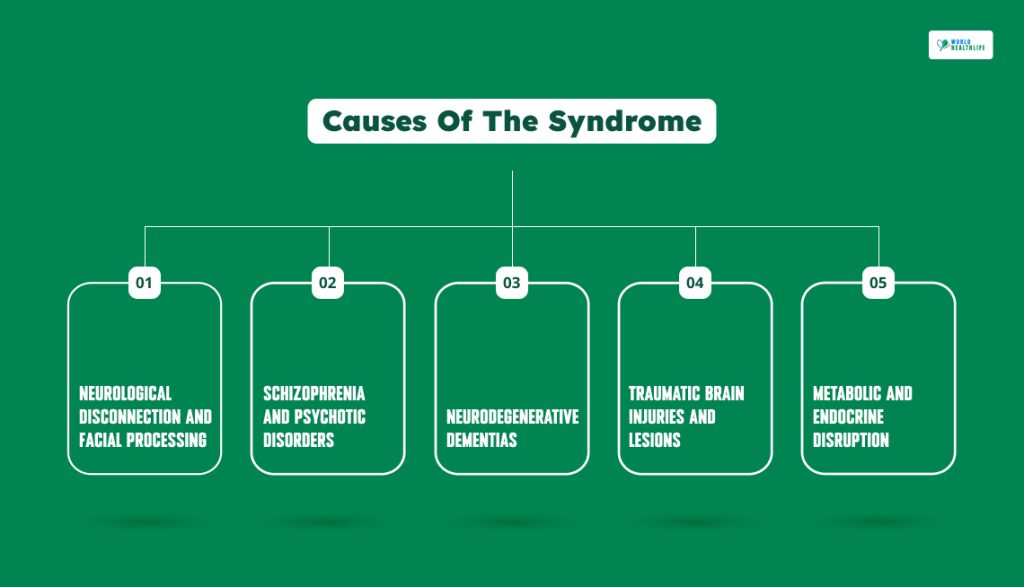
The structural origins of this syndrome involve specific breakdowns in brain communication networks.
Researchers take a close look at both neural pathway disruptions and the mental health issues that commonly trigger these episodes.
Neurological Disconnection And Facial Processing
The most prominent explanation relies on a two-route model of facial recognition. Usually, your brain processes visual information through two distinct tracks concurrently.
In the ventral route, it analyzes geometric features that allow you to intellectually recognize who the person is.
On the contrary, in the dorsal route, it connects visual centers to the amygdala. This generates an automatic gut feeling of familiarity.
A person suffering from capgras syndrome faces structural damage that breaks the vital connection between the temporal lobes and the amygdala.
Clinical research indicates that psychiatric conditions cause approximately 56% of documented cases.
Schizophrenia And Psychotic Disorders
Functional psychoses remain a prominent psychiatric root for this delusion. Clinical research indicates that approximately 56% of documented cases are tied closely to psychiatric conditions.
This is particularly true in cases of paranoid schizophrenia. Individuals with this type have dopamine hyperactivity that warps baseline reality monitoring.
This neurochemical imbalance compromises the ability of the brain to correct false beliefs, leading to bizarre structural thoughts to go unvetted and become fixed.
Neurodegenerative Dementias
In the case of older adults, the delusion usually and very frequently presents as a secondary symptom of structural cognitive decline.
It is widely recognized as a behavioral complication in advanced Alzheimer’s disease and Lewy body dementia.
Gaps are created in situational awareness. This happens as progressive neurodegeneration destroys cortical and subcortical pathways; it creates gaps in situational awareness.
Thus, the brain is unable to seamlessly bundle visual input and past emotional memories while filling these cognitive gaps.
Traumatic Brain Injuries And Lesions
Structural trauma, tumors, localized aneurysms and silent strokes affecting the right hemisphere account for over a third of organic clinical cases.
Specifically, damage to the bifrontal and right temporal areas has a direct effect on the neural systems that are responsible for identity verification.
Without these structural regions functioning correctly, a person loses their subconscious feeling of familiarity.
Metabolic And Endocrine Disruption
Though less frequent, acute physical and chemical disturbances can trigger sudden and transient delusional states.
Severe nutritional issues, such as a profound Vitamin B12 deficiency, can damage myelin sheaths while interrupting critical neural signals.
These imbalances lead to a temporary blockage of normal connectivity between visual processing centers and emotional networks, creating a perfect storm for delusional misidentification.
Symptoms Of Capgras Syndrome

The behavioral manifestations of this condition present clearly during a clinical evaluation.
Caregivers usually notice distinct changes in how the individual communicates and handles daily interactions with close family members.
The Core Imposter Delusion
The defining feature of capgras syndrome is a persistent and unwavering belief that a familiar person or even an object has been swapped out for a duplicate.
The individual acknowledges that the “imposter” looks, acts, or speaks exactly like the original person. However, they remain absolutely convinced that a malicious body double or a convincing replica has taken their place.
Emotional Detachment And Disconnection
Patients usually experience something called hypo-identification. When you look at someone you deeply care about, you will be able to recognize their physical features/
However, they do not feel the usual emotional warmth or attachment that generally accompanies seeing a loved one. Since the brain cannot link the visual memory to that particular emotion, the patient rationalizes this lack of feeling by concluding that the person is fake.
Anxiety, Fear And Paranoia
Living with these perceived doubles can be deeply terrifying and confusing for the patient. Since they do not know who the “imposter” really is or what they want, they usually exhibit different emotions.
These include extreme stress, panic and paranoia in their presence, where they may constantly worry about their safety while being unable to relax in their own home.
Defensive And Aggressive Behaviors
Capgras syndrome is driven by fear and a perceived need to do two things. They either want to protect themselves or rescue their loved ones, becoming very hostile.
From locking doors to wanting to keep the “imposters” out, patients have paranoia that can lead to verbal threats as well as physical violence.
Obsession With Exposing The Duplicate
A lot of individuals with the syndrome may develop a strong fixation on uncovering the truth. Furthermore, they spend hours just arguing with their loves ones just to prove their duplicity.
In addition to this, they will often stubbornly refuse to accept any logical evidence or reassurance offered by other family members.
Manifestation Of Other Underlying Conditions
Having capgras syndrome is a rare standalone phenomenon. Typically acting as a symptom of an underlying psychiatric or neurological disorder, a patient can display related symptoms.
For instance, someone who has Alzheimer’s may have visual hallucinations, memory loss, or disorganized thinking.
Diagnosis, Prognosis And Treatment
To address capgras syndrome, you need an organized medical approach that evaluates physical brain structures alongside psychiatric indicators.
Diagnosis
The diagnosis of capgras syndrome relies on psychiatric interviews and screening. Furthermore, clinicians check if face processing matches personal identity rejection.
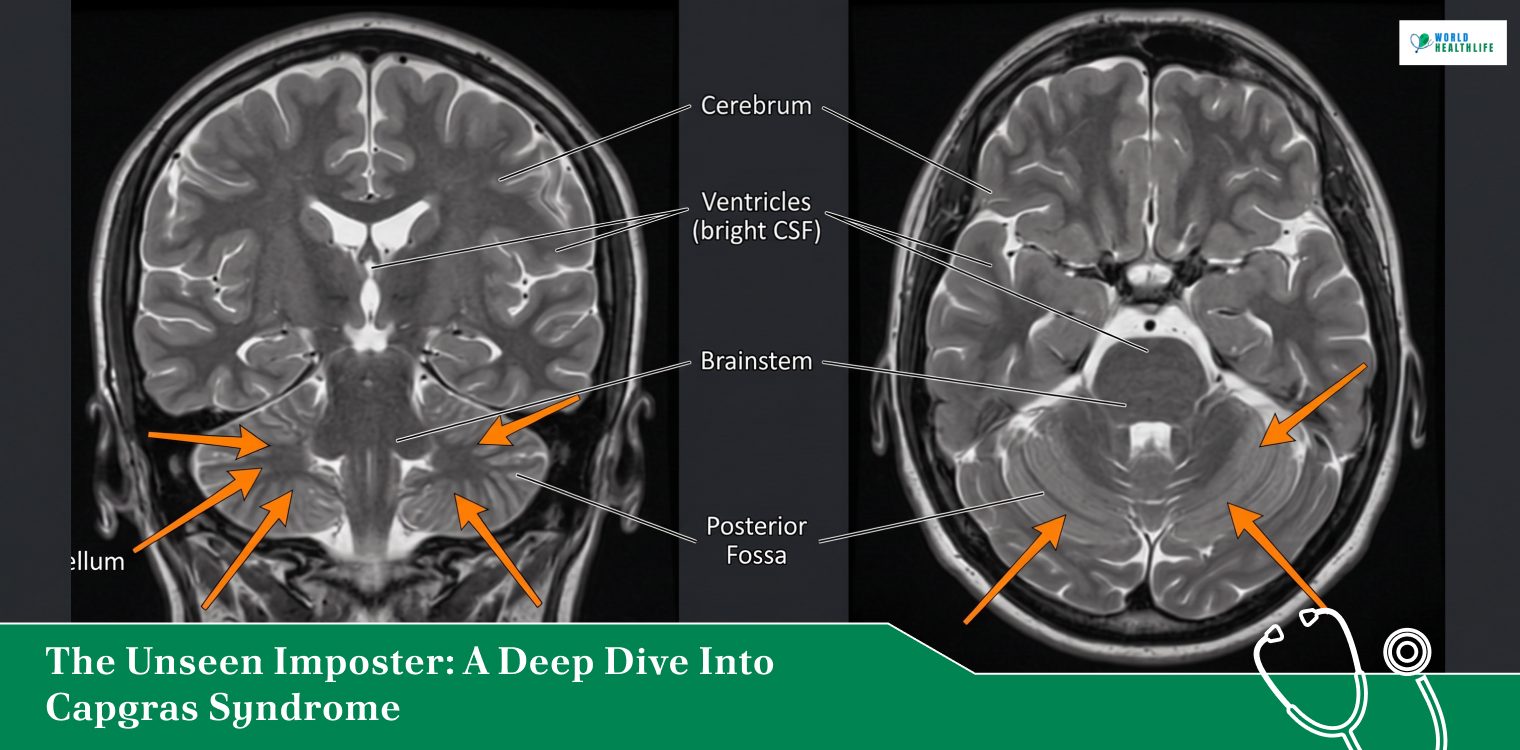
Brain scans such as MRIs exclude silent strokes and tumors.
Prognosis
The outlook is dependent on having any underlying diseases.
In case the syndrome is linked to a treatable acute metabolic issue, an infection or a psychiatric flare-up like a brief psychotic episode, the prognosis seems to be positive.
On the other hand, if it is driven by a progressive neurodegenerative disease such as Alzheimer’s, the delusion can fluctuate while proving more challenging to manage over time.
Treatment
Since the delusion is usually a symptom of an overarching disorder, medical interventions are targeted directly at the primary cause.
| Treatment Type | Primary Purpose | Common Examples |
| Pharmacotherapy | Reduction of delusional conviction while stabilizing co-occurring mood symptoms | Antipsychotics, such as risperidone and olanzapine, Cholinesterase inhibitors for dementia or SSRI antidepressants. |
| Cognitive Behavioral Therapy (CBT) | Helps patients with partial awareness gently reality-test and manage distress. | Narrative reconstruction, exploring coping strategies for anxiety. |
| Validation and Reality Orientation | Focuses on the reduction of fear rather than forcing compliance. | rather than forcing compliance.Validating the patient’s underlying feelings of fear while using environmental cues to anchor them. |
Some Personalities With The Syndrome
Reviewing historical case studies offers researchers deep insights into how these complex symptoms show up in daily life.
These clinical accounts highlight the overall diversity of the demographics that experience the core features of the condition.
Madame M. And The Foundations Of DMS
The very first formal description of the syndrome surrounds a 53-year-old French woman, known as Madame M. in medical literature.
She held a complex web of delusions while having a firm belief that her husband, children, neighbors, and even the local police had been replaced by lookalike doubles.
Furthermore, she also believed that these imposters were from a massive underground conspiracy who were operating out of hidden tunnels.
The rigorous charting by Dr. Joseph Capgras of her symptoms laid the overall groundwork for separating memory retrieval from familiarity in clinical research.
The 60-Year-Old Woman And The Low-Dose Interventions
In the recent clinical literature, a well-documented case involved a 60-year-old woman who suddenly became convinced that her family members were clever imposters.
Her brain had rationalized this by putting a focus on minute details while asserting that they ate differently or had a smile with unfamiliar facial expressions.
This case turned out to be an important example of clinical success as the patient responded exceptionally well to low-dose antipsychotic medication (risperidone).
Conditions You Should Not Confuse With Capgras Syndrome
Clinical precision is absolutely essential when you check a patient for this rare disorder. Because certain medical and psychological terms sound similar, it is easy to misclassify distinct clinical conditions.
Prosopagnosia: Face Blindness
This is a purely structural neurological condition where a person cannot visually recognize faces at all, sometimes even failing to recognize their own reflection.
Unlike Capgras syndrome, there is no psychological delusion involved. Instead, their emotional connections and memory remain completely intact, and they quickly recognize loved ones by their voice, scent, or gait.
Fregoli Syndrome
While Capgras syndrome causes a patient to perceive familiar people as strangers, Fregoli syndrome is the exact inverse delusion.
A person with Fregoli syndrome believes that completely unfamiliar strangers are actually familiar faces wearing physical disguises to stalk or follow them.
Empathy and Treatment: Overcoming the Delusion
Navigating the unique realities of this delusion requires an approach built on scientific clarity, patience, and empathetic care.
By focusing on root neurological problems rather than taking the rejection personally, families can find more balanced ways to move forward together.
Capgras syndrome serves as a profound reminder of how deeply our sense of reality relies on the seamless connection between visual recognition and emotional feeling.
When that neurological bridge breaks, the brain goes to remarkable lengths to make sense of a world that suddenly feels cold and unfamiliar.
While a diagnosis can feel overwhelming, understanding that these misidentifications stem from structural neural pathways rather than a lack of love is a crucial first step for families.
Through an integrated approach combining professional medical care, family counseling, and tailored communication strategies, individuals with Capgras syndrome can experience significant relief.
Thus, they are assisted in restoring a sense of safety, stability, and connection to their daily lives.
References
1. Capgras Syndrome. Cleveland Clinic.
2. Capgras Syndrome in Dementia: Are You a Pretender or the ‘Real Mary’? Michigan Medicine.
3. Capgras Syndrome. WebMD.
4. The Delusion of Doubles: When Familiar Faces Become Strangers Capgras Syndrome and its Clinical Implications. International Journal of Research and Innovation in Applied Science (IJRIAS). (2025).
5. The Masks of Identities: Who’s Who? Delusional Misidentification Syndromes, Carolina A. Klein and Soniya Hirachan, Journal of the American Academy of Psychiatry and the Law Online Sep 2014, 42 (3) 369-378.